




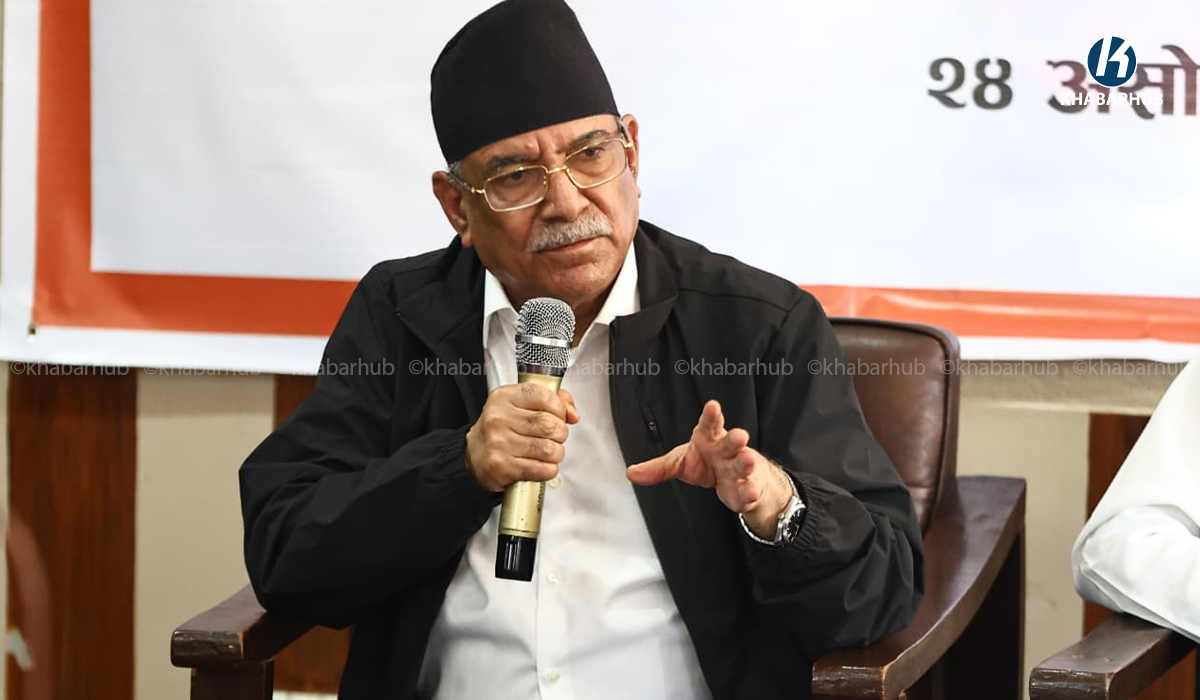
KATHMANDU: CPN (Maoist Centre) co-ordinator Pushpa Kamal Dahal ‘Prachanda’ has formally abandoned his core Maoist principles, aligning once again with the Marxism–Leninism embraced by the Nepal Communist Party (NCP) formed in 2018.
The NCP was created when CPN (UML) and CPN (Maoist Centre) merged in 2018, at which time both parties agreed on a joint ideological foundation. While the Maoist faction brought ‘Prachandapath’ and the UML contributed ‘People’s Multiparty Democracy,’ the unified party recognized both as a creative application of Marxism–Leninism. The approach combined the Maoist vision of revolutionary transformation with the UML’s focus on socialism through democratic means, establishing a long-term goal of scientific socialism.
By signing an 18-point agreement with seven other parties to form a unified party on November 500, Prachanda has formally abandoned the Maoism he had pursued since the decade-long People’s War. The newly unified party will adopt Marxism–Leninism as its guiding principle, while declaring that Nepal’s revolutionary program will follow a “scientific socialism adapted to Nepali realities.” Immediate strategies will focus on protecting gains from the people’s democratic revolution, national sovereignty, good governance, social justice, and laying the groundwork for socialism.
What Maoism is in the Nepali context
Prachanda’s version of Maoism, often referred to as ‘Prachandapath,’ was a localized reinterpretation of Marxism–Leninism and was not a direct copy of Chinese Maoism. He framed it around four key pillars:
Continuation of Marxism–Leninism adapted to Nepal: Maoism was seen as an extension of Marxism–Leninism, applied to Nepal’s unique class structure, geography, and social conditions, aiming for a people’s democratic state transitioning toward socialism.
People’s War and People’s Power: He transformed the long-term principle of armed struggle into Nepal’s context, starting from rural encirclement of urban centers and ultimately moving toward constitutional and peaceful means after the 2006 movement. This shift culminated in the Comprehensive Peace Accord of 2006.
Transition from New Democracy to Socialism: The Maoist goal of a “New Democratic Revolution” aimed to end feudalism, exploitative capitalism, and foreign dependence, creating conditions for socialism through national capitalist development. This stage was viewed as a precursor to building a socialist economy and eventually communism.
‘Prachandapath’ as Nepali Maoist Thought: The approach combined Nepal’s specific geographic, class, and cultural realities, allowed flexibility between armed struggle and peaceful politics, and linked class struggle with national independence and identity issues. Dialogue with other political forces, such as those supporting “People’s Multiparty Democracy,” was also emphasized.
By abandoning Maoism, Prachanda shifts away from the armed-struggle-based revolutionary ideology and fully embraces the Marxism–Leninism framework that guided the NCP era, marking a significant ideological realignment in Nepal’s leftist politics.





Comment