




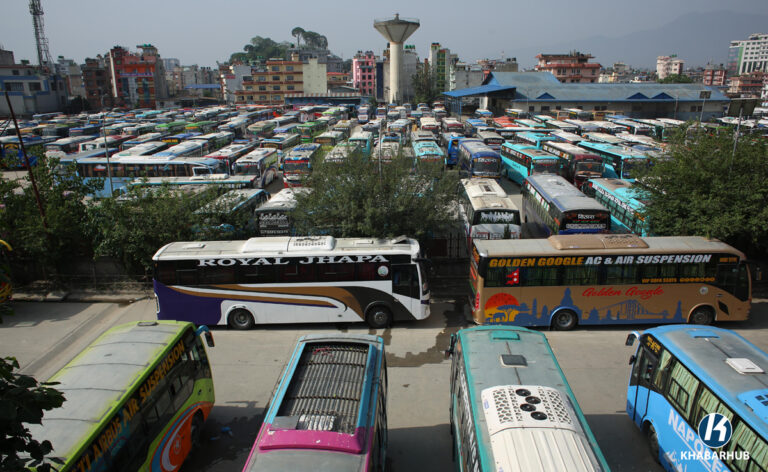
KATHMANDU: Following a nationwide transport strike opposing the legalization of ride-sharing services from the federal to provincial levels, an agreement was reached between transport entrepreneurs and the government on Monday.
The strike was sparked after the Gandaki Province government initiated the drafting of a law to formally regulate ride-sharing services. The Central Struggle Committee to Protect Public Transport led the shutdown of transport services across the country on Monday, severely disrupting daily life and forcing the Home Ministry to call for talks.
After the negotiations, a committee was formed under the coordination of the Joint Secretary of the Ministry of Physical Infrastructure and Transport. The committee includes representatives from various ministries as well as transport entrepreneurs and labor organizations.
According to Bhim Rai Jwala, central president of the Nepal Transport Independent Workers Organization, the committee comprises eight government members and four representatives from transport entrepreneurs and workers. Rai said the agreement includes a decision to temporarily halt the implementation of the ride-sharing regulations being developed by the Gandaki Province government.
Gandaki Province had approved the Ride-Sharing (Regulation and Management) Rules through its council on April 13, and the rules were scheduled for publication in the provincial gazette on May 15, signaling imminent enforcement.
Transport entrepreneurs vehemently opposed this move, arguing that the new regulations would threaten their livelihoods by allowing private vehicles to compete for passengers, thereby undermining public transport businesses.
Meanwhile, the Supreme Court had already directed the government on July 27, 2024, to recognize ride-sharing services legally.
During the talks, transport entrepreneurs presented several demands. They urged the cancellation of provincial transport rules that conflict with federal legislation.
Since federal law prohibits private vehicles from carrying passengers, the entrepreneurs argued that provincial laws allowing ride-sharing are unlawful and should not be enforced.
They requested the formation of a task force to work on amending transport laws, acknowledging that immediate changes are not feasible.
Referring to a Supreme Court order dated April 1, 2025, entrepreneurs demanded decisions be made based on road conditions, vehicle status, and passenger demand.
They expressed grievances that although the Supreme Court allowed transport committees to register, the government did not comply, hindering the transformation of committees into corporate entities.
They called for strict regulation of overloaded Indian vehicles transporting goods, demanding rigorous enforcement of rules requiring excess cargo to be offloaded before reaching destinations.
The government and transport entrepreneurs will continue dialogue through the newly formed committee to find a sustainable resolution that balances innovation in transport services with the protection of existing livelihoods.





Comment