




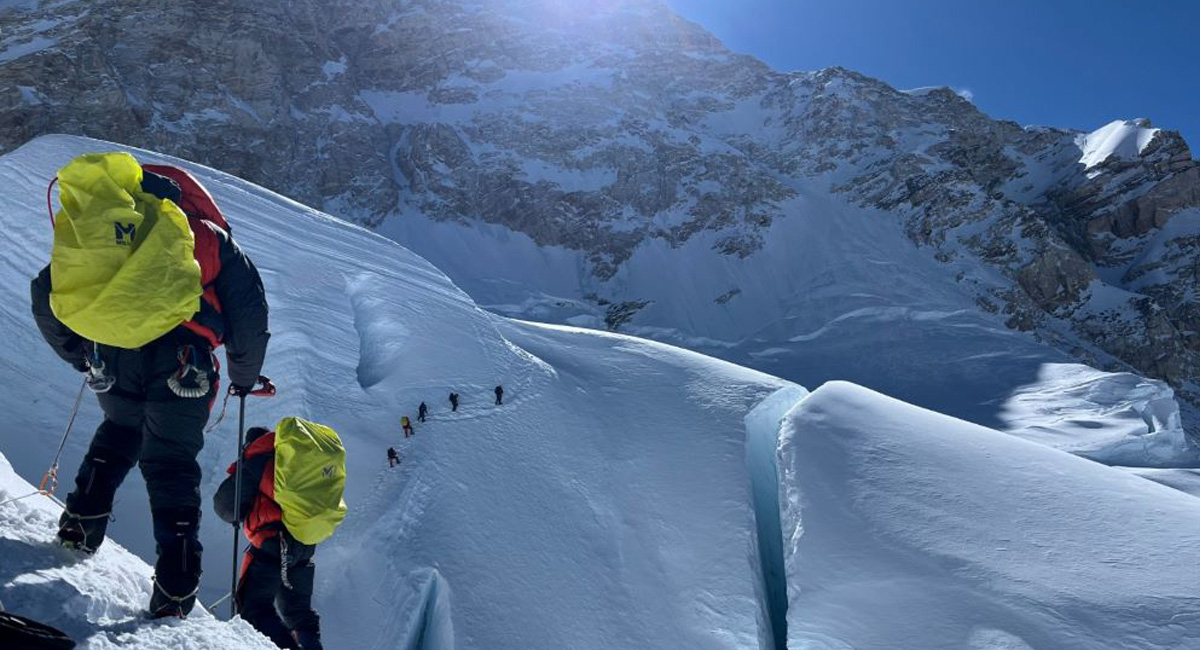
KATHMANDU: A recent joint expedition by Nepali and Indian army personnel to Mount Kanchenjunga has sparked sharp political and cultural backlash in India’s northeastern state of Sikkim.
The mountain, located on the Nepal-Sikkim border, is revered as a sacred peak by local communities and is at the center of a longstanding dispute over access and sovereignty.
The joint team—comprising 10 personnel from the Nepali Army and 5 from the Indian Army—successfully summited Kanchenjunga, the world’s third-highest mountain at 8,586 meters, on May 21.
The Nepali team was led by Major Gajendra Deuba, while the Indian contingent was led by Colonel Sarfaraz Singh. The climbers planted the flags of Nepal, India, and the United Nations at the summit.
Additionally, another Indian Army expedition led by Colonel Ranveer Singh Jamwal, along with four other Indian soldiers and four Sherpas, scaled the mountain on May 18 as part of the “Har Shikhar Tiranga” campaign. All ascents were carried out from the Nepali side.
Although the expeditions were conducted from Nepal’s Taplejung district—where Mount Kanchenjunga is geographically located—strong reactions have emerged in Sikkim, where the peak holds deep spiritual significance for indigenous communities like the Lepchas, Bhutias, and Sherpas.
In Sikkimese culture, Kanchenjunga is considered not just a mountain but a sacred guardian deity, referred to as “Fo Lha.” Annual celebrations such as the “Pang Lhabsol” festival are held in its honor, and the state has long banned climbs from the Sikkim side to preserve its sanctity.
Political leaders and civil society groups in Sikkim have decried the expeditions as a violation of cultural and spiritual sentiments.

The Sikkim Bhutia Lepcha Apex Committee (SIBLAC), through its coordinator Chheten Tashi Bhutia—who also serves as a senior advisor to the ruling BJP’s Sikkim unit—issued a strongly worded statement condemning the ascent. He emphasized that the peak is a sacred protector of Sikkimese identity, protected under Article 371F of the Indian Constitution.
Likewise, Sonam Gyatso Sherpa, president of the Sikkim Sherpa Protection Force, criticized the Sikkim government’s silence on the matter and questioned its inability to prevent the climb, despite the state’s previous stance against such expeditions.
In response to mounting protests, the Sikkim state government has clarified that it had no involvement in the climb, stating that the ascent took place entirely from the Nepali side and that the Indian central government had not issued any permits for it from Sikkim.
Tourism and Civil Aviation Minister T.T. Bhutia assured the public that Sikkim would never facilitate an ascent of what it considers a sacred mountain.
Amid the uproar, a letter from Sikkim Chief Minister Prem Singh Tamang (P.S. Golay) to Indian Home Minister Amit Shah has been made public. In the letter, CM Golay requests the Indian government to raise the issue with Nepal and urges that future climbs be prohibited out of respect for Sikkimese religious beliefs. He likened the situation to China’s ban on expeditions to Mount Kailash, a similarly sacred peak.

The Sikkim government’s call for Nepal to halt future Kanchenjunga climbs from its side has drawn criticism in Nepal for perceived overreach. So far, the Nepali government has remained silent on the controversy.
However, many in Nepal note that the mountain is clearly within Nepal’s internationally recognized borders and has long been accessed from the Taplejung side, which also offers better climbing infrastructure than the Sikkim side.
While the immediate controversy has been driven by the Indian Army’s participation, the broader tension highlights the delicate intersection of national sovereignty, religious sentiment, and mountaineering tourism in the Himalayas.




Comment