




Amid a volatile region shaken by fleeing leaders, collapsing governments, and assertive militaries, Nepal charted a different course—its army choosing a strategic pause that defended disciplined restraint, upheld the constitution, and gave politics the space to peacefully absorb a youth-led uprising. This approach—not intervention—helped safeguard democracy.
South Asia between 2021 and 2025 has undergone one of its most turbulent phases since the end of the Cold War, marked by the onset of Cold War 2.0. A combination of political polarization, economic collapse, youth-led uprisings, insurgencies, and the retreat of democratic institutions produced distinct crises across Afghanistan, Bangladesh, Nepal, Pakistan, and Sri Lanka.
Although the region has historically been known for political instability, the last five years mark an unprecedented convergence of mass protests, contested state authority, and strained civil–military relations. Yet the outcomes in each country have differed dramatically: some states experienced complete constitutional collapse, others witnessed negotiated transitions, and a few maintained fragile but functional constitutional orders.
Among these, Nepal’s response stands out for the army’s decision to impose what can be termed a “strategic pause”—a calibrated period of security stabilization without direct political intervention.
This essay provides a comparative framework to understand these developments, focusing on three key variables: volatility, military involvement, and constitutional outcomes. It then explains why Nepal’s military adopted a unique “strategic pause” that helped preserve the constitutional order even during severe political stress.
Afghanistan (2021): Complete State and Constitutional Collapse
The Afghan crisis is the most dramatic example of systemic breakdown in recent South Asian history. As the Taliban advanced rapidly following the US withdrawal, the Afghan National Security Forces collapsed almost without resistance.
Nepal’s 2025 crisis was unique in the region. It began with youth protests after a social media ban, which evolved into a broader anti-political system movement.
President Ashraf Ghani fled the country; the republican constitution was rendered void; and the Taliban re-established their emirate-style governance. The Afghan military did not intervene to protect the civilian leadership because it lacked cohesion, morale, and—following the withdrawal of Western support—critical logistical capacity.
This case demonstrates how the absence of a professional, coherent military forces a complete rupture of the political order. Afghanistan thus represents the far end of the volatility spectrum: a total constitutional and state collapse.
Sri Lanka (2022): Economic Meltdown and a Constitutionally Managed Transition
Sri Lanka’s crisis, though severe, produced a very different outcome. Triggered by a catastrophic economic collapse marked by fuel shortages, inflation, and debt default, mass protests engulfed the country throughout 2022. Protesters stormed government buildings, setting the stage for a dramatic confrontation.
The Sri Lankan military intervened, but its role remained focused on evacuating President Gotabaya Rajapaksa and former Prime Minister Mahinda Rajapaksa, securing government compounds, and restoring order without seeking to assume political power.
Crucially, despite the intensity of the protests, Sri Lanka retained its constitutional framework. Ranil Wickremesinghe was elected by Parliament according to constitutional procedure.
This illustrates that although the crisis was deeply volatile, civil–military boundaries remained intact, allowing for a constitutional, if imperfect, transition.
Bangladesh (2024): Popular Uprising and a Constitutionally Ambiguous Interim Arrangement
Bangladesh in 2024 experienced a massive youth-driven uprising, initially over civil service quotas but quickly escalating into a nationwide anti-government movement. With security forces unable to control crowds and protesters storming the prime ministerial residence, Prime Minister Sheikh Hasina resigned and fled the country.
The Bangladesh Army played a decisive role in the transition by brokering an interim government under Muhammad Yunus—an arrangement not clearly provided for in the constitution. While the army refrained from a formal coup, it exercised significant political influence.
By restoring basic order, the army enabled political leaders to negotiate without street-level coercion, ensured institutions regained functionality, and prevented opportunistic actors from exploiting chaos.
Bangladesh’s crisis demonstrates how military intervention can occur through political brokerage rather than direct rule. The result was a partial constitutional disruption: the constitutional order did not collapse entirely, but it was effectively bypassed to create a new power structure.
Pakistan (2022–2024): Amalgamated Governance and Persistent Military Dominance
Pakistan’s crisis pattern remained consistent with its long history of military influence. Following the ouster of Prime Minister Imran Khan, the country witnessed mass protests, political polarization, and violent confrontations.
Although Pakistan did not face a sudden collapse or mass uprisings comparable to Bangladesh and Sri Lanka, its volatility stemmed from chronic tension between elected leaders and the military establishment.
The armed forces exercised significant influence behind the scenes, shaping electoral outcomes, governance decisions, and crackdowns on opposition. Pakistan’s constitutional framework continued formally, but substantive democratic functioning weakened. Thus, Pakistan represents a form of managed volatility, controlled by a dominant security establishment.
Nepal (2025): Gen-Z Uprising, Democratic Pressure, and the Army’s “Strategic Pause”
Nepal’s 2025 crisis was unique in the region. It began with youth protests after a social media ban, which evolved into a broader anti-political system movement. The situation was further aggravated by the delayed response of prominent political leaders from the Nepali Congress (NC), Nepal Communist Party, United Marxist Leninist (UML), and Maoist Center (MC).
Unlike Afghanistan, Bangladesh, Pakistan, and Sri Lanka, Nepal’s crisis did not result in the flight of leaders, collapse of security institutions, or dissolution of constitutional order. Instead, the Nepali Army, under the President’s office, played a carefully calibrated role that can be labeled a strategic pause.
Stabilization Without Overreach
When state institutions and political parties were strained during the September 8–9 youth-driven uprising, the Nepali Army intervened only to create the necessary “cooling-off space.” Police capacity had been overwhelmed, violence had escalated, and political parties were unable to control the situation, leading to nearly twenty deaths of innocent youths on the first day.
Yet the broader movement was not anti-state; it pushed for reforms, accountability, and constitutional amendments, not the collapse of the existing order. Nepal still had a functioning president, parliament, judiciary, and provincial governments. In this environment—shaken but not fallen—the army acted to prevent breakdown, not to take charge.
Its response was calibrated, protective, and deliberately restrained. Curfews were imposed, critical infrastructure secured, and only limited force was used to prevent further casualties.
The Army Chief publicly appealed for dialogue, expressed regret for the loss of life, and urged protesters to exercise restraint. The message was consistent: the army’s role was to safeguard unity, sovereignty, and public security—not to insert itself into governance.
This posture reflected an institutional doctrine refined over years. Lessons from 2005–06, post-conflict reforms, peacekeeping experience, and constitutional restructuring produced a force that understands its mandate lies in national defense, not political authority. That institutional memory anchored the army within the constitutional framework when tensions peaked.
In a region where militaries often overstep their bounds, Nepal’s approach stands out as a rare example of restraint as strategy, demonstrating that stability can sometimes be best achieved not through intervention, but through deliberate non-intervention.
By restoring basic order, the army enabled political leaders to negotiate without street-level coercion, ensured institutions regained functionality, and prevented opportunistic actors from exploiting chaos.
Crucially, it preserved space for peaceful dissent that did not threaten national security. This stabilizing pause allowed for the political transition—including the appointment of an interim prime minister—to unfold through civilian processes, not military arbitration.
Regional dynamics reinforced this restraint. Both China and India, Nepal’s immediate neighbors, oppose abrupt political shifts, and any perception of a coup would have drawn heavy external pressure. The army’s limited intervention reassured neighbors and international partners that Nepal remained committed to democratic norms and regional stability.
What occurred was not militarization but controlled stabilization. The army framed its involvement as an obligation to protect the nation, stepping in only long enough to halt violence and stepping back once institutions could function again. It was a calculated restraint—firm enough to prevent collapse, yet careful enough to avoid shaping political outcomes.
The stakes are high: stabilization must not become a normalized precedent for military arbitration. Long-term legitimacy depends on fully withdrawing once equilibrium is restored. Yet the evidence points to discipline. The Nepali Army neither sought political authority nor attempted to guide the transition. It acted out of urgency, not ambition.
Nepal emerged from the crisis with its democratic framework intact and its civilian institutions re-empowered. The 2025 response showed that the country can manage internal turmoil without sliding into authoritarianism, while the army can act decisively without compromising constitutional governance.
In essence, the Nepali Army demonstrated that national stability can be defended without political overreach. By choosing restraint over dominance and protection over power, it helped return Nepal to a path where civilian leaders address the nation’s challenges through dialogue, law, and the constitution.
This is the enduring message of 2025: Nepal’s institutions held firm, the army acted responsibly, and the nation upheld both sovereignty and democratic values.
Conclusion
The South Asian crises of 2021–2025 reveal a spectrum of state resilience. Afghanistan shows the extreme of total collapse; Bangladesh, a hybrid military-brokered shift; Pakistan, a chronic hybrid system; Sri Lanka, a painful but constitutional transition; and Nepal, a case of institutional self-restraint.
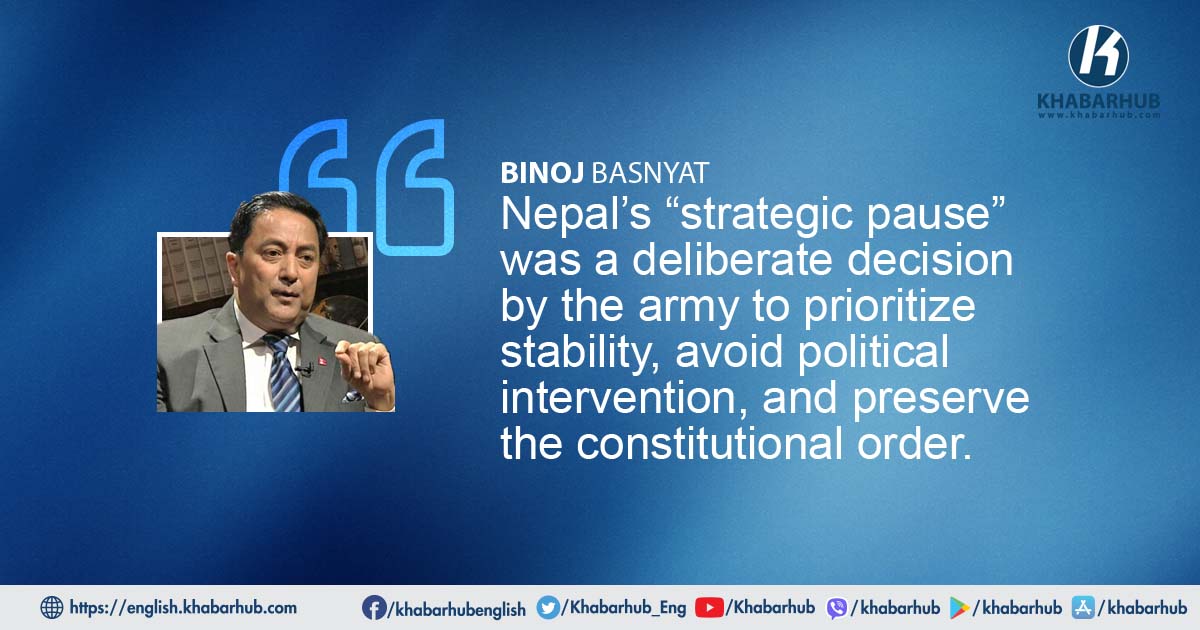
Nepal’s “strategic pause” was a deliberate decision by the army to prioritize stability, avoid political intervention, and preserve the constitutional order while allowing political actors the space to negotiate solutions, without showing weakness.
In a region where militaries often overstep their bounds, Nepal’s approach stands out as a rare example of restraint as strategy, demonstrating that stability can sometimes be best achieved not through intervention, but through deliberate non-intervention.
(Basnyat is Maj. Gen. (Retd.) and a strategic affairs analyst based in Kathmandu. He writes on South Asian geopolitics, national security, and the intersection of governance, diplomacy, and stability.)





Comment