




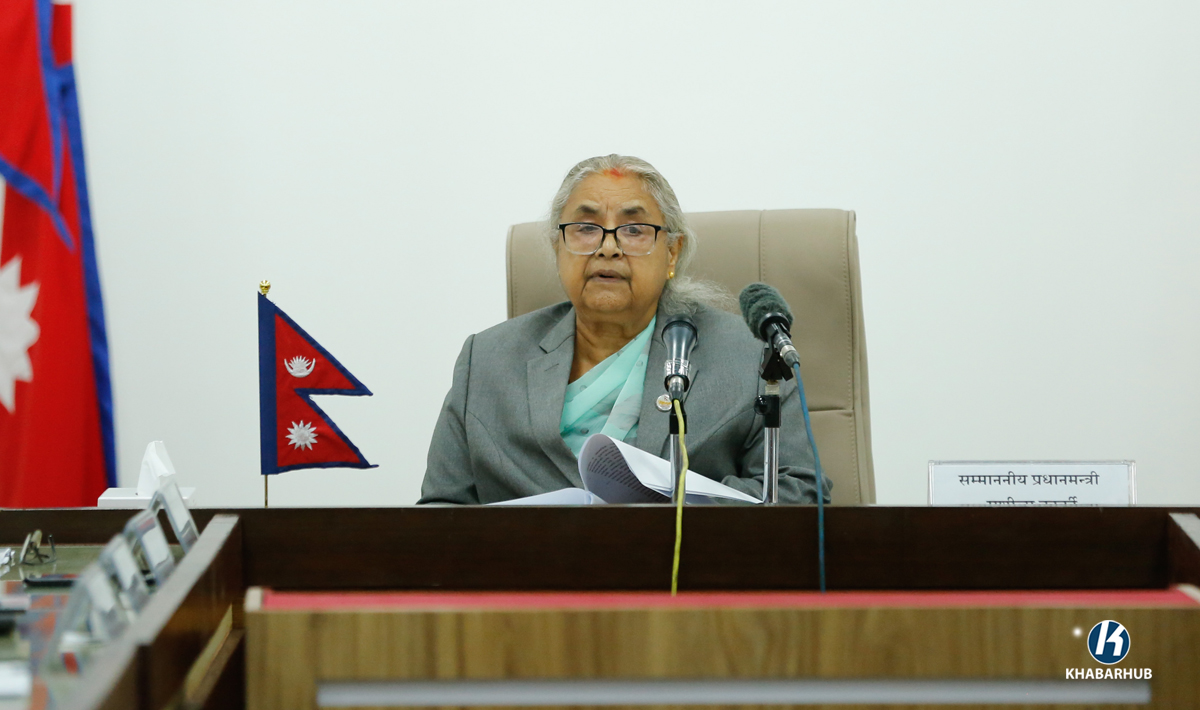
KATHMANDU: Since assuming office as Nepal’s first female prime minister following the Gen-Z movement, Sushila Karki has taken on a daunting portfolio of responsibilities, overseeing peace, security, governance, and the fulfillment of the movement’s objectives.
Her tenure has been defined by the enormous task of stabilizing the nation in the aftermath of widespread protests, while simultaneously steering the government toward elections and maintaining public trust in state institutions.
Karki’s role is particularly complex due to the high expectations placed on her by the public and political actors alike. She must balance the need to enforce law and order with the demand for accountability over incidents that occurred during the September 8 and 9 Gen-Z protests, which left extensive damage across Kathmandu and other parts of the country.
According to official records, more than 2,089 government and private buildings were damaged, and over 1,276 lethal weapons were looted from police, army, and armed security forces. While 720 of these weapons have been recovered, 556 remain unaccounted for. In addition, 14,043 detainees escaped from jails, including juvenile facilities, leaving approximately 5,000 still unaccounted for, highlighting the scale of the security challenge her government inherited.
The prime minister’s responsibilities extend beyond crisis management. As per the Nepal government’s rules, she supervises more than a dozen key national institutions. These include the National Investigation Department (NID), Revenue Investigation Department, Investment Board, National Planning Commission, National Development Council, universities, and even specialized agencies like the Tiger Conservation Committee.
As the country watches closely, Karki continues to juggle multiple high-stakes responsibilities, from security and governance to political negotiation and election readiness. Her ability to manage these challenges effectively will play a decisive role in shaping Nepal’s post-Gen-Z political landscape.
Each of these institutions carries a significant operational mandate, requiring continuous oversight, policy guidance, and coordination with respective leadership. Experts note that this level of supervision is unprecedented for a Nepalese prime minister, especially for one assuming office in the immediate aftermath of a nationwide civic movement.
Karki’s leadership is also tested by the demands of political management. Following the Gen-Z protests, she is tasked with negotiating with multiple political parties, coordinating with the movement’s dispersed leadership, and preparing the country for upcoming elections scheduled for March 5, 2026.
The Gen-Z groups remain fragmented, operating in numerous factions such as the Sudan Gurung group, Miraj Dhungana group, Raksha Bam group, Gen-Z Movement Alliance, Indigenous Gen-Z Collective, Red Gen-Z, The Red Chapter, Anti-TK G, Gen-Z Alliance for Monarchy, and the Gen-Z United for Change. Each faction has its own demands, ranging from reinstatement of the monarchy to changes in federal structures and directly elected executive positions. Karki must mediate between these groups and ensure their demands are addressed in ways that remain within the constitutional framework.
The aftermath of the Gen-Z protests also means that Karki’s government must manage the sensitive task of investigating human and property losses. A three-member high-level judicial commission, led by former Supreme Court Chair Gauri Bahadur Karki, was formed to investigate the September 8 and 9 incidents.
The commission is tasked with submitting its report within three months, analyzing the causes of violence, reviewing the role of security forces, and recommending steps to prevent future unrest. Karki must ensure that these processes proceed smoothly while maintaining confidence among citizens and political actors that justice will be served.
The prime minister also faces internal government challenges. Despite her initial cabinet expansion, several critical ministries, including foreign affairs, defense, water supply, women, children and senior citizens, environment, culture, tourism, civil aviation, labor, employment, and social security, remain without permanent ministers.
As a result, much of the administrative and policy burden for these ministries rests on her shoulders, requiring her to supervise decisions across multiple sectors simultaneously. Observers have pointed out that this situation has increased the workload on Karki’s office and slowed down the pace of governance in certain areas.
In addition to crisis management and cabinet supervision, Karki must maintain oversight of Nepal’s electoral preparations. The Election Commission has confirmed that preparations, including voter registration, are progressing, and elections will be held on the scheduled date.
Yet political parties have raised security concerns and emphasized the need for guarantees before fully engaging in the election process. This puts Karki in a crucial coordinating role, as she must ensure that both security forces and political actors have confidence in the neutrality and efficiency of the government while guaranteeing a free and fair electoral environment.
Experts highlight that Karki’s premiership is unique not only because of her gender but also due to the confluence of challenges she inherited. Former government officials note that her responsibilities demand a careful balancing act: overseeing law enforcement and judicial follow-up on the Gen-Z incidents, managing political negotiations, supervising over a dozen key institutions, addressing public expectations, and preparing the country for elections—all under intense public scrutiny.
“Prime Minister Karki’s role involves supervising, coordinating, and directing government institutions without taking on all responsibilities personally,” said former Nepalese government secretary Umesh Mainali. “The key is delegation, timely action, and ensuring ministries and agencies function effectively while maintaining oversight.”
While the Gen-Z movement propelled her to the premiership, it also set high expectations for her administration to deliver reforms, establish accountability, and stabilize governance. Successfully navigating these responsibilities will define Karki’s legacy as a leader capable of guiding the country through turbulent times while honoring the promises of the civic movement that brought her to power.
As the country watches closely, Karki continues to juggle multiple high-stakes responsibilities, from security and governance to political negotiation and election readiness. Her ability to manage these challenges effectively will play a decisive role in shaping Nepal’s post-Gen-Z political landscape.





Comment