




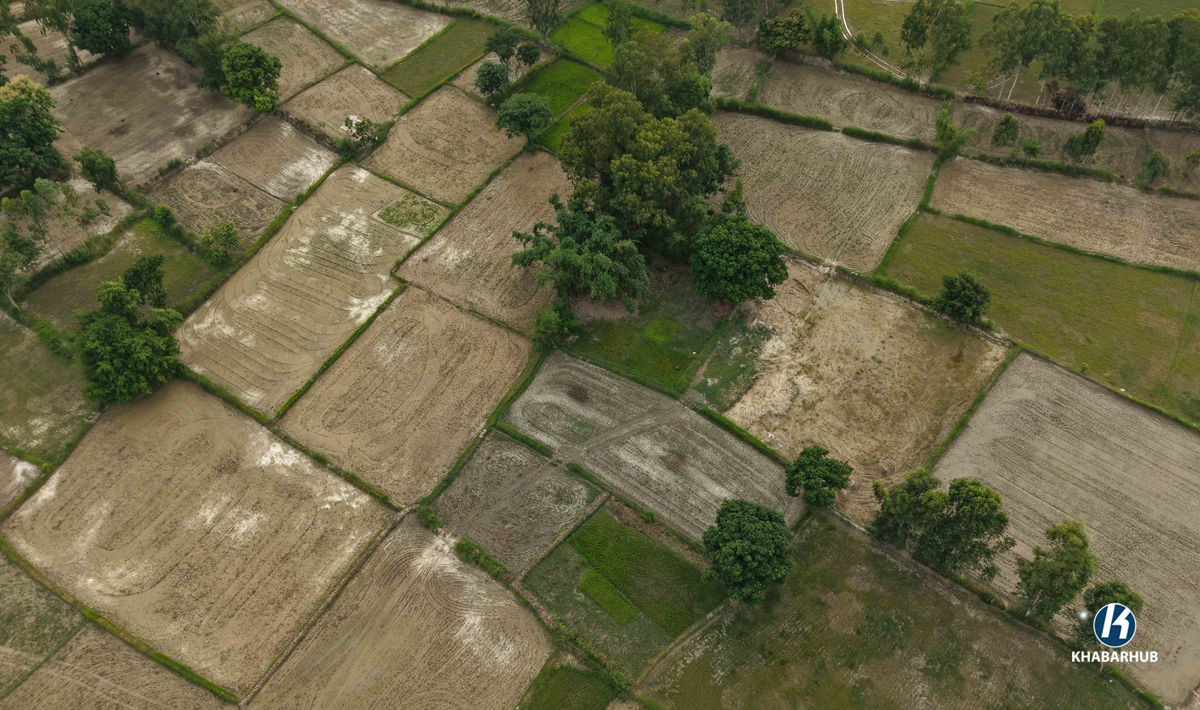
MAHOTTARI: In the parched fields of Mahottari, anxious farmers continue to gaze at the sky, hoping for rain that would allow them to plant rice before the season slips away.
With August already here, the traditional planting window is closing fast, leaving farmers worried about an impending food crisis.
“This time of year, rice seedlings should be swaying in the fields,” said Ramkisan Mandal of Bhangaha-1. “Instead, we are still waiting for rain, praying we can at least do some late planting.” He lamented that the traditional schedule for sowing seeds, transplanting seedlings, and finally planting the kharuan (secondary transplantation after seedlings mature) has been completely disrupted by the prolonged dry spell.
In Mahottari and across the Madhesh, farmers typically sow seeds by early June, transplant seedlings by early July, and complete the final transplantation by mid-August. This year, however, the long dry stretch has thrown the entire agricultural calendar into disarray.
A brief shower earlier this week revived some drying seedlings, but it was far from enough to start large-scale planting. By end of July, only 35 percent of rice transplantation has been completed in Mahottari, according to the Agriculture Knowledge Center. Officials say that even the transplanted rice has come at a high cost for small farmers who had to rely on rented irrigation pumps and depleted household food stocks to fund the effort.
“We have no wells or boring pumps of our own. Renting everything has emptied our grain stores,” said Ritbahadur Khatri of Bardibas-7. “If the drought continues, there will be a food shortage. We are staring at the sky with burning eyes, hoping for rain that never comes.” He added that the hot, dry eastern winds of spring are now drying up what little moisture remains in the soil.
Local agriculture officials warn that the prolonged drought has turned Mahottari into one of the hardest-hit districts in the Madhesh, where the government has already declared a three-month disaster period. Across the region, less than 50 percent of rice fields have been planted, and Mahottari is lagging even further behind.
The district has 71,000 hectares of arable land, with around 42,500 hectares suitable for rice cultivation, said senior agriculture officer Dewananda Yadav. Only 10 percent of that land has access to permanent irrigation via canals, and another 10 percent relies on tube wells and bore wells. But this year, even those water sources are drying up, leaving farmers to struggle with dwindling groundwater and failing irrigation channels.
So far, around 35 percent of planting has been completed using underground water sources, Yadav said, but the outlook remains grim. Farmers fear that even if rain arrives now, the shortage of seedlings and the poor condition of early-planted rice will prevent them from achieving meaningful yields.
Many farmers say that years of neglect, poor irrigation infrastructure, and a lack of timely government coordination have left them vulnerable to the whims of the weather. “If we had reliable irrigation, seeds, fertilizer, and technical guidance, farming would not be this uncertain,” one farmer said. “All three tiers of government must now coordinate to prevent a looming food crisis in the Madhesh.”






Comment