




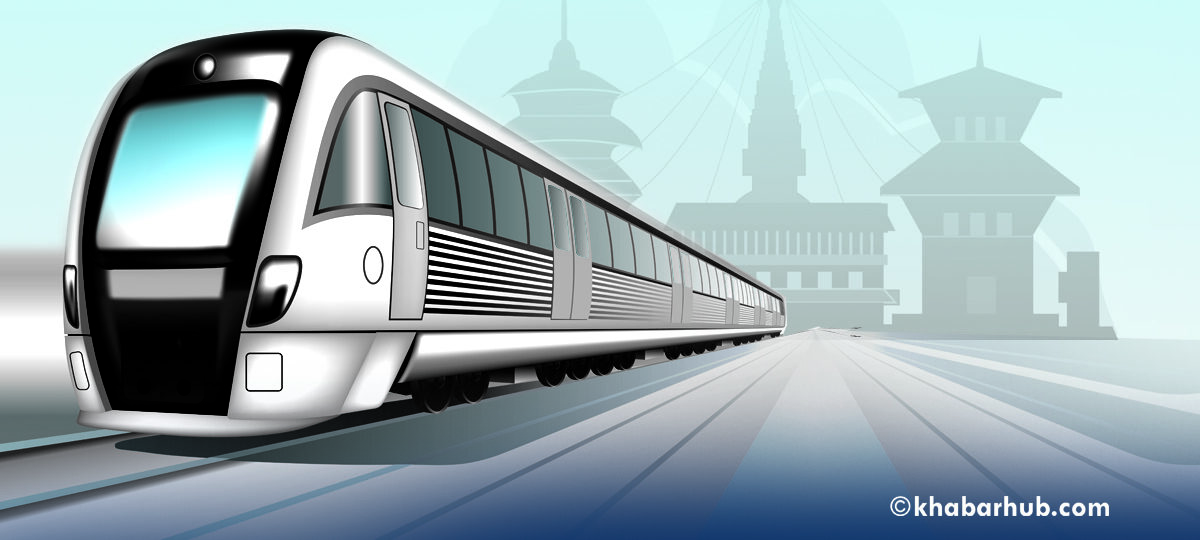
KATHMANDU: The construction of the East-West Electric Railway, touted as a national pride project by the government, remains in a dismal state even after 16 years.
Despite spending over Rs 54.92 billion, the project has barely moved beyond the initial stages.
Launched in the fiscal year 2066/67 BS after the declaration of the republic, the project was envisioned to transform Nepal’s transportation landscape. However, at the current pace, it may take up to 150 years to complete, raising serious concerns over its future.
If this trajectory continues, two generations of Nepalis will miss out on its benefits—and even the third generation may be too old to enjoy it.
What has been achieved so far?
The government formally established the Railway Department under the Ministry of Physical Infrastructure and Transport on June 15, 2011, but the East-West Railway Project had already begun two years earlier.
Preparation of the Detailed Project Report (DPR) began in 2010 and was completed in phases by various consulting firms, according to Kamal Kumar Sah, Information Officer at the Railway Department.
The final DPR, completed only last fiscal year, outlines the total railway length from Kakarbhitta in the east to Gaddachauki in the west at 1,104 kilometers.
Kiran Karki, Chief of the East-West Railway Project Directorate, stated that although the project was initiated during Madhav Kumar Nepal’s tenure, it has already witnessed 10 government changes.
Over 16 years, a total of Rs 54.92 billion has been allocated to the project. On average, around 71.83% of the budget has been spent over the past 15 years, excluding the current fiscal year.
Despite this, actual work has been limited to just a 70-kilometer stretch between Bardibas and Nijgadh (Chocha)—and even this is only in the preliminary stage involving track-bed preparation.
Karki mentioned, “We’re currently working on the Bardibas–Chocha section, and once complete, even vehicles will be able to run on it.”
Land acquisition and costs
So far, the project has acquired around 925 bighas of land, but acquisition in the Sunsari section is still pending. Karki estimated that Rs 25–30 billion would be required to complete land acquisition in that area alone.
He further noted that the cost per kilometer of railway construction—including land compensation—is around Rs 1 billion, though actual expenses have often exceeded this amount.
In addition, the government plans to build another 12 kilometers of track to connect Bardibas with the Janakpur–Jayanagar railway, developed with Indian assistance.
Karki emphasized that this connection would help integrate Indian railways with Nepal’s fast track network, greatly benefiting import-export trade with the capital.
The projected total cost of the 1,104-kilometer East-West Railway now exceeds Rs 1 trillion, based on current prices.
Challenges and lack of planning
Karki warned that inflation and rising prices of construction materials, labor, and equipment would drive costs even higher in the coming years. Without significant growth in development expenditure, completing the project remains more of a dream than a plan.
Adding to the challenges, Nepal lacks skilled manpower and technical expertise for advanced railway construction. The government will need to procure external manpower and technology, yet no clear preparations have been made on this front.
Unless swift and effective measures are taken, the East-West Railway may remain a symbol of ambition without progress—a national pride project trapped in a cycle of delays and underperformance.
According to Kiran Karki, Chief of the East-West Railway Project Directorate, the train to be operated on the East-West Railway will be electric-powered.
However, it will not be a high-speed train like those running in countries such as China, but rather a medium-speed electrified train.
“The train we are planning is an electric train, commonly referred to as an electrified train,” said Karki. “Although countries like China operate high-speed trains that run up to 300 kilometers per hour, we aim to run trains at speeds of around 250 kilometers per hour.”
Once the railway line from Kakarbhitta in the east to Gaddachauki in the west is completed, Karki claims that it will enable travel across the country in approximately five hours, a journey that currently takes over 25 hours by bus.
Infrastructure expert recommends halting the project
Despite the government’s push, experts are raising red flags. The High-Level Economic Reform Advisory Commission, led by former Finance Secretary Rameshwor Khanal, has not provided specific recommendations on the East-West Railway, but it has urged policy reforms to better manage large-scale infrastructure projects and national pride initiatives.
The East-West Railway Project is currently being operated under federal supervision with offices in Kathmandu, Jhapa, and Lalbandi.
Around 62 personnel are engaged at various levels in the railway sector, with billions of rupees being spent annually.
However, infrastructure expert Dr. Suryaraj Acharya argues that the project should be suspended. According to him, Nepal lacks both the expertise and foundational knowledge required for railway development—even in the initial phases.
“I’ve said this many times—stop allocating budget for railway construction immediately,” Acharya stated.
“The Ministry of Physical Infrastructure lacks experience in railways. This is not like building roads; railways are complex systems that require systematic planning and execution.”
He criticized the current approach, which involves track bed construction through soil filling, without proper study of train types, speed, or passenger demand. “You can’t just build tracks and figure it out later. The expected ridership and train design must be established from the outset,” he added.
Acharya also questioned the fragmented preparation of Detailed Project Reports (DPRs).
“DPRs were prepared in disconnected sections, and billions have already been spent just on design. Before moving forward, there needs to be a national-level political consensus on what kind of railway Nepal truly needs,” he said.
He stressed the need to determine clear standards, speed limits, and total costs. “The rationale for such a railway in Nepal’s context must be thoroughly reviewed,” he concluded.
“The government should pause the project and commission a new technical committee to reassess the current DPR and propose viable alternatives.”




Comment