




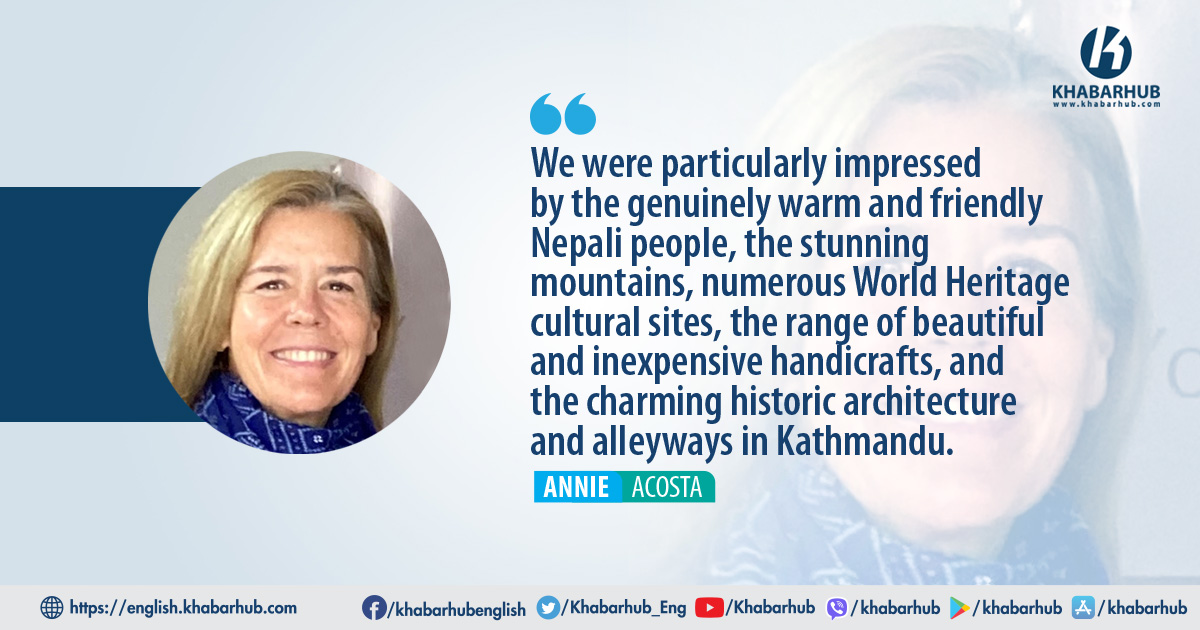
My husband and I recently visited your wonderful country from the U.S.
We went to Kathmandu, Chitwan, Lumbini, and did a nine day trek towards Mount Everest during our month-long stay.
We were particularly impressed by the genuinely warm and friendly Nepali people, the stunning mountains, numerous World Heritage cultural sites, the range of beautiful and inexpensive handicrafts, and the charming historic architecture and alleyways in Kathmandu.
There was one thing, however, about Nepal (Kathmandu in particular) that makes me reluctant to recommend travel here – motor vehicle traffic and its attendant pollution.
This one factor made for an often stressful and unpleasant experience.
It was particularly shocking in the prime tourist attractions like Kathmandu Durbar Square and Swayambhunath and makes a mockery of the exceptionally peaceful nature of these places.
Pilot programs should include seeking out concerns and suggestions from affected residents and businesses as well impact data on these stakeholders.
Sadly, it comes as no surprise that Kathmandu retains in ranking as the most polluted city in the world.
Extreme traffic and pollution are what caused us to cut our trip short to India a few weeks before.
Fortunately, Nepal can make policy changes to address this problem that are very low cost, immediate, and would benefit Nepalis and tourists alike.
Street Closures are Popular and Good for Business
Select street closures have increased significantly in cities globally, particularly since the Covid-19 epidemic.
More than 200 cities around the world are investing in temporary or permanent walkways and cycle lanes.
These experiments show that properly designed and implemented street closures are strongly supported by residents and do not harm area businesses, according to research reported by Bloomberg.
For instance, a first-of-its-kind national study in six U.S. cities found largely positive effects on both sales and employment for adjoining businesses, with particular benefits for restaurants.
The Time to Act is Now, Especially for Nepal’s Children
Nepal’s projected demographics promise increasing congestion and pollution. These harmful effects will most affect its youngest residents.
The science has advanced significantly in recent years on the connection between air pollution and harms to developing brains during the prenatal period and early childhood.
In addition, the lack of safe outdoor places for children to gather and play affects their social and physical development.
More tragically, Nepali children are being injured or killed in record numbers while playing in heavily trafficked streets.
Nepal’s Tourism Industry Can Greatly Benefit from Street Closures
Western tourists in particular flock to trekking sites and to walkable cities.
Nepal excels in the former, but falls unnecessarily short in the later.
The latest survey from the UN World Tourism Organization reveals that the current priority of its members is to “rethink, reposition, and rebrand destinations.”
The Nepali tourism industry should include select street closures in this priority for Kathmandu and its other developing cities and towns.
Pilot Programs are Essential and Feasible
Changing behavior is often difficult, at least initially.
Therefore, small scale street closure programs may be the best way to start.
Pilot programs should include seeking out concerns and suggestions from affected residents and businesses as well impact data on these stakeholders.
A concerted effort by the tourism sector in conjunction with NGOs and universities could make such data collection and analysis very feasible.
Not too long ago cars were seen as a sign of increasing development. But things have changed.
The most advanced cities in the world are now putting meaningful limits on where cars can go.
Their residents are happier, healthier, and safer as a result. Nepal’s cities deserves no less.
(Annie Acosta, based in Washington D.C., has been doing work on climate change and environmental issues)



Comment