




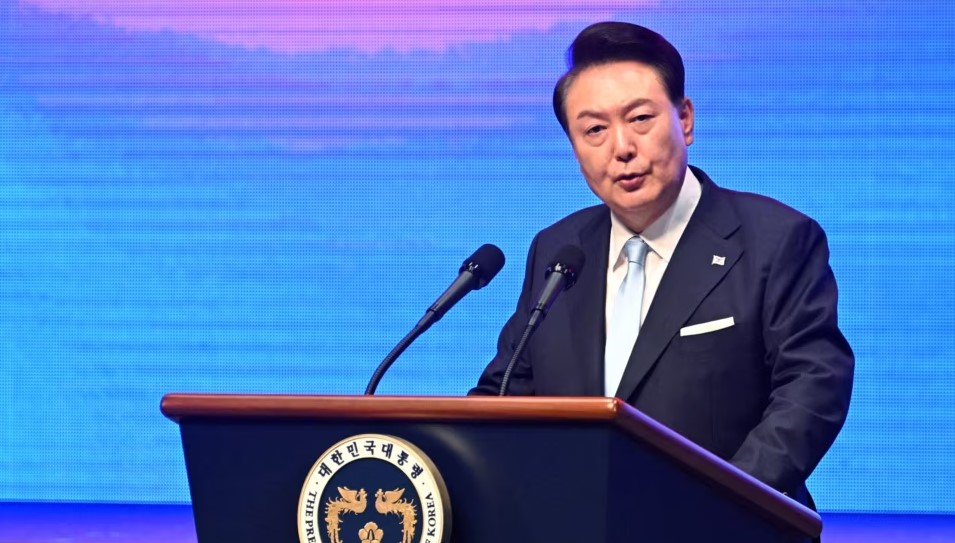
WASHINGTON: South Korean President Yoon Suk Yeol’s freedom-based approach toward unifying the two Koreas could chart a bold path signaling a departure from the policies of his predecessors, experts in Washington said.
In a speech commemorating South Korea’s Liberation Day on Thursday, Yoon introduced the “August 15 Doctrine,” his vision for achieving a “freedom-based unification” of the Korean Peninsula.
Made up of incremental strategies, the doctrine seeks a dialogue between South and North but puts much weight on addressing the North Korean human rights issue.
“Testimonials from numerous North Korean defectors show that our radio and TV broadcasts helped make them aware of the false propaganda and instigations emanating from the North Korean regime,” Yoon said during his speech.
The seven key steps under the doctrine include expanding North Koreans’ rights to access information, supporting endeavors to inform the international community of North Korea’s human rights situation, incorporating the roles of North Korean defectors into unification efforts, and providing humanitarian aid to North Korea.
Accent on rights
Sung-Yoon Lee, a fellow with the Wilson Center’s Indo-Pacific Program, said Yoon broke from the South Korean presidents before him by accentuating North Koreans’ human rights.
“None of his predecessors made the explicit connection between freedom for all North Koreans and final liberation of the Korean Peninsula,” Lee told VOA Korean on Thursday via email.
Lee said Yoon was “boldly emphasizing North Korea human rights and the protection of the right to speech and information of North Koreans, while seeking talks” with Pyongyang.
Evans Revere, who served as acting U.S. assistant secretary of state for East Asian and Pacific affairs, agreed that North Korean human rights were at the core of the Yoon doctrine.
“Seoul is clearly planning to make these ideas the centerpiece of its approach to North Korea going forward,” Revere told VOA Korean on Thursday via email.
Revere said that the new approach has “the potential to create schisms” inside North Korea and accelerate the process of political and social change if South Korea is “successful in delivering this message to the people of North Korea through its radio and television broadcasts and by other means.”
Andrew Yeo, the SK-Korea Foundation chair at the Brookings Institution’s Center for Asia Policy Studies, said that Yoon was intently focused on the notion of freedom of people on the Korean Peninsula, noting that the words “free” or “freedom” appear over 50 times in his speech.
“I don’t see this as contradictory to reinforcing the idea of freedom-based unification,” Yeo told VOA Korean on Thursday via email.
Strong protest
Yeo, however, expressed skepticism about how the North Korean regime will respond to Yoon’s proposal.
“The call to establish an inter-Korean working group to discuss people-to-people cooperation and humanitarian engagement will ring hollow to Kim Jong Un given the Yoon government’s emphasis on freedom before unification,” he said.
Revere said he was “highly pessimistic” that Pyongyang will react well to the proposal.
Revere explained that words such as “freedom” and “democracy,” which are highlighted in the new unification vision, are “anathema to the DPRK, as is the idea that the ROK intends to boost its efforts to get information to the North Korean people.”
DPRK stands for the Democratic People’s Republic of Korea, North Korea’s official name, while ROK is an abbreviation of South Korea’s official name, Republic of Korea.
Robert Rapson, who served as chargé d’affaires and deputy chief of mission at the U.S. Embassy in Seoul from 2018 to 2021, cautioned that Yoon’s vision could result in the escalation of tension.
“If anything, it is bound to elicit sharp negative reactions in Pyongyang, and likely in Beijing, too, and lead to a heightening of tensions along the DMZ and across the peninsula,” he told VOA Korean on Thursday via email.
The United States voiced support for Yoon’s proposal.
“The long-standing, ironclad alliance between the United States and the Republic of Korea has contributed to peace, security and prosperity for Northeast Asia, the broader Indo-Pacific and beyond,” a State Department spokesperson told VOA Korean on Friday via email.
“We support President Yoon’s aim to open a path for serious and sustained diplomacy with the DPRK,” the spokesperson said, adding that “we are committed to working with allies and partners to promote human rights, accountability and access to information in the DPRK.”
China, North Korea’s closest strategic partner, took a more reserved view.
“DPRK and ROK are the main parties to the Korean Peninsula issue, which should ultimately be resolved through dialogue and cooperation,” a spokesperson for the Chinese Embassy in Washington told VOA Korean on Friday in an emailed statement.
“China supports all measures that are conducive to peace and stability on the Korean Peninsula,” the spokesperson said. “We sincerely hope that the North-South relations will continue to improve and that the Korean Peninsula will maintain peace and stability.”
North Korea has not responded to Yoon’s speech on its major state media outlets.
VOA





Comment