




KATHMANDU: Despite being a major coffee-producing region, the number of coffee connoisseurs is steadily increasing in Nepal.
From the youth to the elderly, more people are embracing the “café coffee culture.”
Cafes have sprung up across the country, particularly in the main cities, with the number of cafes now reaching around 7,000 nationwide.
This shift reflects a growing trend of choosing coffee over tea in daily life. More and more people are drinking coffee to relieve physical and mental fatigue or to combat sleepiness.
Nepal imports coffee worth crores of rupees every year. In the current fiscal year (2081/082), coffee imports totaled 492.845 million rupees.
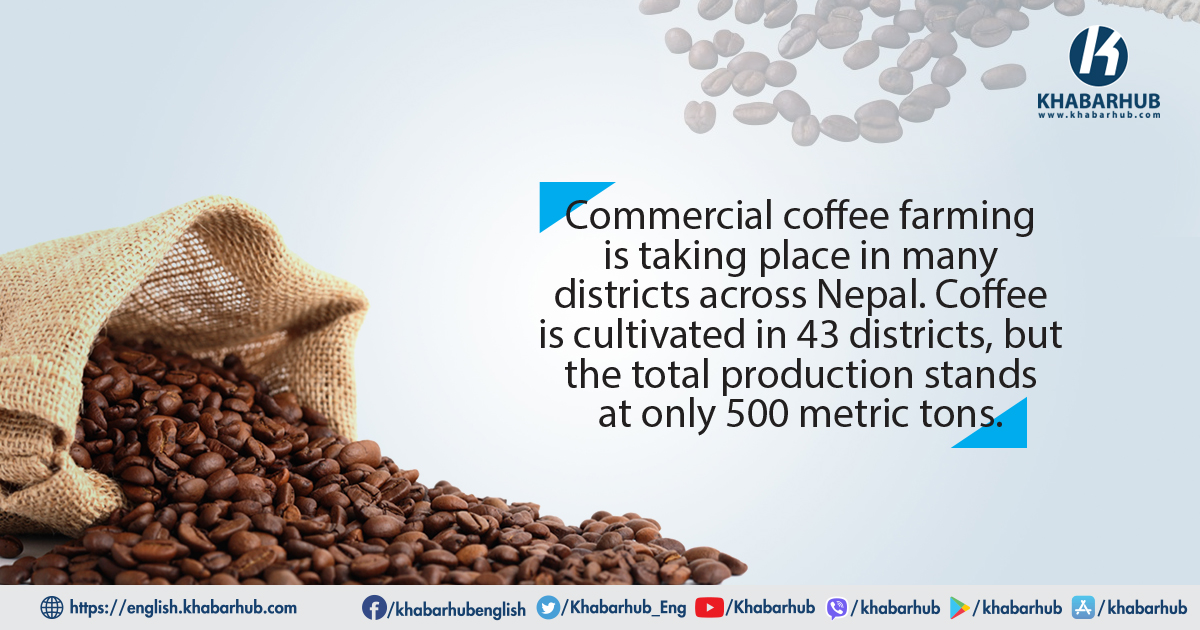
Commercial coffee farming is taking place in many districts across Nepal. Coffee is cultivated in 43 districts, but the total production stands at only 500 metric tons.
Meanwhile, the country’s annual coffee consumption is approximately 6,000 metric tons. This indicates a significant gap between local production and domestic demand.
While past coffee production was almost sufficient to meet market demand, this is no longer the case.
In the fiscal year 2077/078, imports rose to 392,994 kilograms, worth 282.2 million rupees. During this period, 72,388 kilograms of coffee worth 96 million rupees were exported.
Laxman Pokharel, Executive Chief of the Tea and Coffee Development Board, noted that the rapid increase in demand has outpaced local production.
According to Pokharel, coffee is currently grown on just 4,300 hectares of land in Nepal.
However, the country has the potential to cultivate coffee on 1.3 million hectares, with 61,000 hectares of land suitable for high-quality coffee production. Unfortunately, the actual output remains minimal.
Around 31,000 farmers are engaged in coffee farming in Nepal, and the demand for organic Nepali coffee is high in global markets.
However, the country still struggles to meet both domestic and international demand.
“The demand for organic Arabica coffee from Nepal exceeds 15,000 metric tons abroad. Domestically, demand is also over 6,000 metric tons. Yet, production remains very low,” Pokharel explained.
He further pointed out that the government has not done enough to encourage coffee farming, and farmers are struggling with the high cost of production.
He suggested that if the government, in coordination with central, provincial, and local authorities, could provide low-interest loans to farmers, coffee farming could see significant growth.
Pokharel also emphasized the importance of welcoming foreign investors interested in coffee farming in Nepal.
Additionally, he highlighted the need to establish consultancy centers to provide technical advice to farmers and improve production. One key area he identified for boosting output is the importation of higher-quality coffee seeds.
“The price of Arabica coffee produced in Nepal is currently at an all-time high. If we can increase production and export more, we stand to gain significantly. With lower imports, more of the money stays within Nepal,” Pokharel said.
In the fiscal year 2080/081, the import of coffee increased further to 862,191 kilograms, valued at 1.53 billion rupees. Meanwhile, exports totaled 89,959 kilograms, worth 271 million rupees.
“It is also crucial to organize coffee conferences in Nepal to further expand the sector.”
A review of coffee import statistics over the past five years shows a steady rise in imports.
In the fiscal year 2076/077, coffee worth 272.167 million rupees was imported, totaling 42,263.5 kilograms.
During this year, Nepal exported 57,913 kilograms of coffee valued at 47.7 million rupees.
In the fiscal year 2077/078, imports rose to 392,994 kilograms, worth 282.2 million rupees. During this period, 72,388 kilograms of coffee worth 96 million rupees were exported.
In the fiscal year 2078/079, imports of coffee totaled 36,199 kilograms, valued at 145.2 million rupees.
Exports reached 69,516 kilograms, worth 117 million rupees. Imports surged again in the fiscal year 2079/080, with 819,432 kilograms of coffee valued at 1.2 billion rupees, while exports amounted to 77,861 kilograms, worth 134 million rupees.
In the fiscal year 2080/081, the import of coffee increased further to 862,191 kilograms, valued at 1.53 billion rupees. Meanwhile, exports totaled 89,959 kilograms, worth 271 million rupees.





Comment