



In an era heavily influenced by Western powers, our foreign policy has adopted a stance that strives for equilibrium.
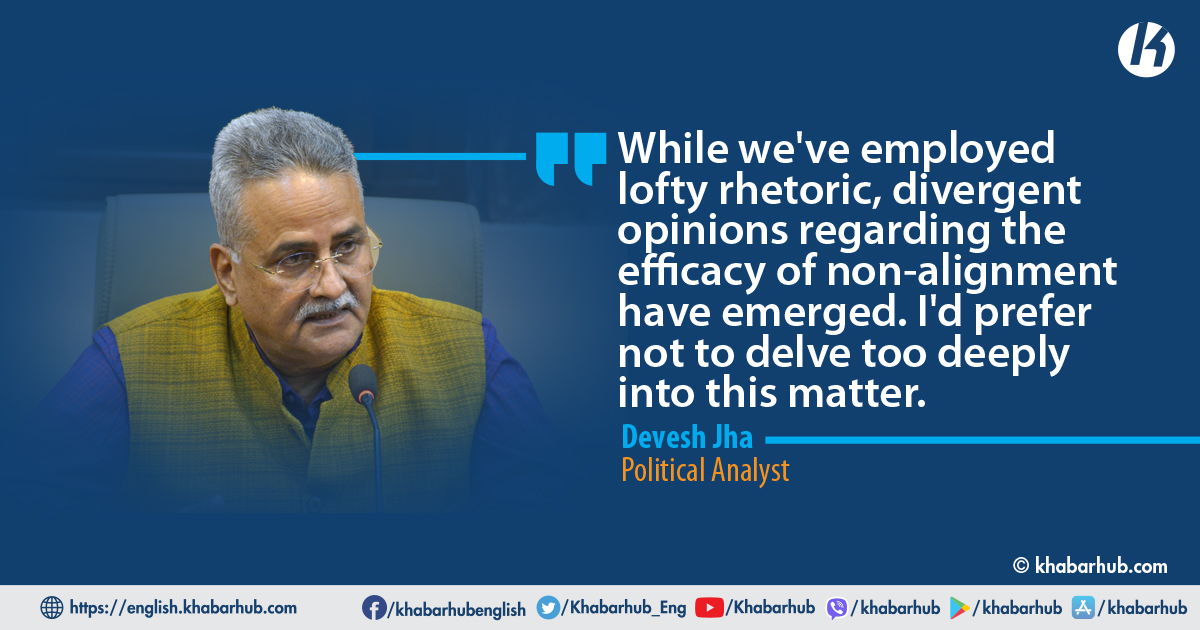
While we’ve employed lofty rhetoric, divergent opinions regarding the efficacy of non-alignment have emerged. I’d prefer not to delve too deeply into this matter.
During the tenure of the Nepal Communist Party government, a foreign policy shift was inevitable.
The term “equidistance” was embraced within our foreign policy lexicon. But is it practically viable? Is it merely a geographical analogy—akin to the equidistance between Khasa and Jogbani? The concept warrants clarification.
Presently, two pivotal projects hold our attention: the Millennium Challenge Corporation (MCC) and the Belt and Road Initiative (BRI).
MCC arrives as a grant, while BRI carries the weight of a loan. Pertaining to BRI’s scope, a tweet from the Chinese ambassador linked Pokhara Airport to the initiative, a claim contested by our foreign minister.
A minor correction to this stance would be judicious. The same principle should extend to those who display neutrality towards us and to those who provide assistance—an approach predicated on reciprocity and goodwill.
We hold optimism that such discrepancies won’t mar Pram’s impending visit to China.
The term “equidistance” necessitates a lucid definition—concise yet inclusive. Nations like Tajikistan, Laos, Angola, Pakistan, Sri Lanka, and the Maldives receive considerable grants, potentially ensnaring them. Let’s correlate this to the MCC.
Striking a balance demands maintaining equal distance between MCC and BRI. Inception promised nearly a billion dollars in Foreign Direct Investment (FDI).
Is this a feasible proposition? Nepal’s foreign policy is rooted in safeguarding national interests. Who might impede it? Who could possibly trigger turmoil? I’m skeptical of such a scenario.
In a recent program commemorating India’s Independence Day, KP Oli emphasized that nationalism isn’t synonymous with anti-Indian sentiment. The need to reiterate this notion raises questions.
He articulated that he refrained from drawing divisive borders between North and South.
A minor correction to this stance would be judicious. The same principle should extend to those who display neutrality towards us and to those who provide assistance—an approach predicated on reciprocity and goodwill.
(Opinion based on the speech by Devesh Jha, a political analyst at a program “Challenges and Opportunities in Nepal’s Foreign Policy” in Pavilion Hall, Kathmandu)





Comment