




This week marks a very important milestone for the Middle East and North Africa: three years since the signing of the Abraham Accords between Israel and the United Arab Emirates (UAE) and Bahrain, under the auspices of the US government.
Three months later, in December 2020, Morocco joined the process, signing a normalization agreement with Israel.
The catalyst that enabled these historic accords was the conscious decision taken by the parties to promote a stable and prosperous future for the Middle East.
The agreements have ushered in a new era of normalization and peace that not only connects governments but also brings people together, despite differences in language, religious beliefs, cultures and more.
So far, the Abraham Accords have offered a mere glimpse into the full potential of regional cooperation. Even so, the scope of trade between Israel and other Middle Eastern countries increased 74% between 2021 and 2022.
Another example is tourism, mostly non-existent in the past, which has skyrocketed. In 2021, visits from Israel to the UAE increased by 172%. Meanwhile, the number of Israelis flying to Bahrain since the establishment of direct flights has increased exponentially.
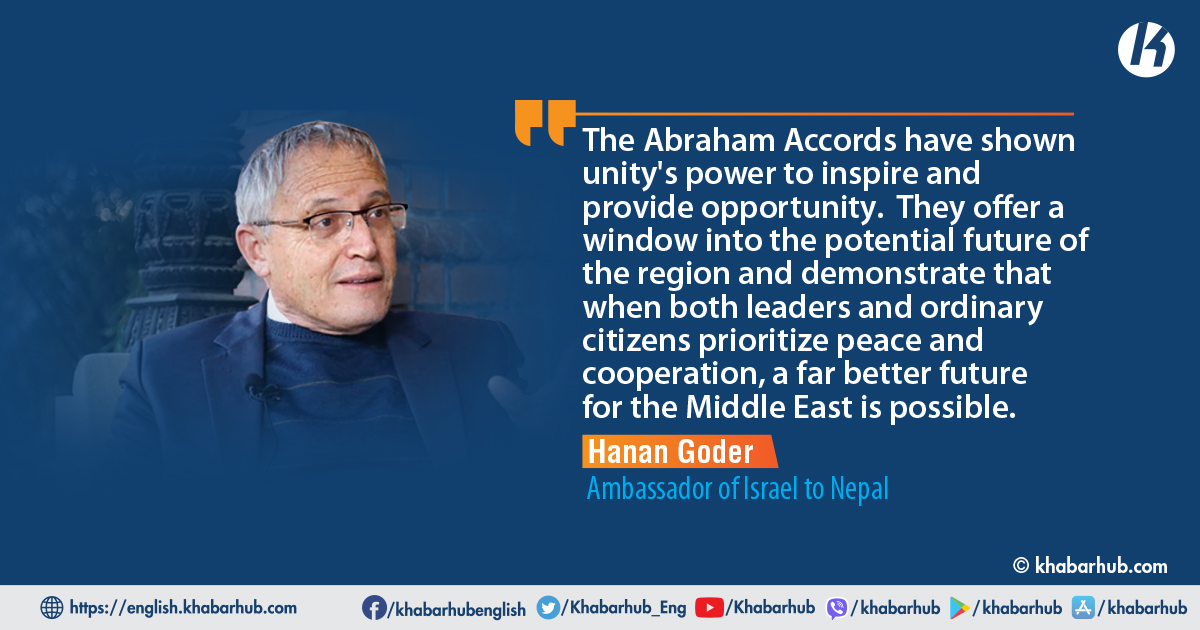
The Abraham Accords have shown unity’s power to inspire and provide opportunity. They offer a window into a potential future of the region and demonstrate that when both leaders and ordinary citizens prioritize peace and cooperation, a far better future for the Middle East is possible.
The accords have also had a significant influence on reinforcing Israel’s relations with neighboring countries, thereby enhancing regional stability.
For example, the Prosperity Green & Blue agreement between Israel, the UAE, and Jordan determined that a solar field to supply 600 megawatts of green electricity to Israel will be established in Jordan, while in return, a desalination plant in Israel will deliver 200 million cubic meters of water to Jordan.
In a region where 65% of the population is under 30, providing the younger generation with opportunities is a key factor in preventing instability.
To that end, youth delegations have been initiated, encouraging bonds between tomorrow’s leaders and laying the foundation for cooperation in the decades to come.
Delegations in which young influencers experience each other’s cultures and visit important religious and historic sites while focusing on community building are an effective tool in strengthening ties.
Importantly, the youth of the relevant countries have subscribed wholeheartedly to the principles of acceptance, cooperation and peace highlighted in the accords, communicating to the region that these ideals are the building blocks of the future.
The Abraham Accords encourage collaboration and education. In the summer of 2022, Ben-Gurion University welcomed students from Morocco.
Additionally, a number of Emirati students have enrolled in Israeli universities. Bahrain has also embraced the prospects for shared educational activities and signed a number of agreements with Israel to advance student and professor exchanges.
In a notable example of how these initiatives can foster mutual understanding after Emirati Foreign Minister Sheikh Abdullah bin Zayed Al Nahyan visited the Yad Vashem Holocaust Remembrance Center in Jerusalem, the UAE incorporated Holocaust education into its school curriculum as a mandatory subject, attestation to the ability of the Abraham Accords to foster coexistence and religious tolerance.
The Abraham Accords have shown unity’s power to inspire and provide opportunity. They offer a window into a potential future of the region and demonstrate that when both leaders and ordinary citizens prioritize peace and cooperation, a far better future for the Middle East is possible.
Israel hopes that many more countries will join this endeavor, creating a brighter tomorrow for the sake of all our children.
(Hanan Goder is Ambassador of Israel to Nepal)






Comment