




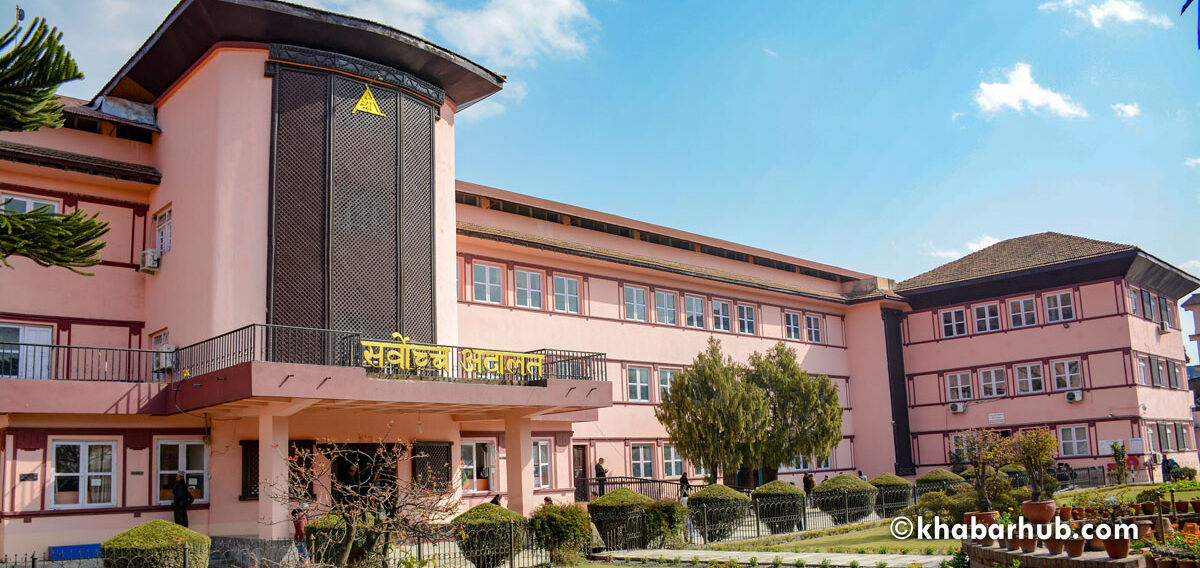
KATHMANDU: The Supreme Court (SC) has issued an order directing the government to address the longstanding border dispute with India.
This move comes in response to growing concerns about illegal and criminal activities along the open 1800-kilometer border shared by the two nations.
Senior advocate Dr. Chandrakanta Gyawali, among others, filed a writ petition urging the Supreme Court to intervene in resolving the border dispute.
In response, the Supreme Court has taken a decisive stance, emphasizing the need to clarify the border area based on historical documents and treaty agreements.
The SC’s order instructs the government to initiate diplomatic efforts with India to demarcate the disputed border accurately, using past treaties and historical records as guidance.
Additionally, it has also prioritized the reconstruction of missing border posts and the restoration of the ‘no-man’s land’ area as part of the long-term resolution strategy.
To address the risks associated with the open border, the Supreme Court has mandated the enhancement of security and surveillance measures for border management.
The order also specifies that certain land routes must be demarcated, eliminating the provision for unrestricted border crossing.
Individuals entering Nepal will be required to present their official identity cards to immigration or security authorities, with records maintained to regulate and monitor border movement.
The Supreme Court has underlined the necessity of curbing illegal and criminal activities that exploit the porous border and has called for the establishment of a robust traffic management system to achieve this goal.
Furthermore, the court’s order has emphasized the importance of safeguarding Nepal’s independence, sovereignty, geographical integrity, and nationality.
It has also called for political and diplomatic initiatives to protect these vital interests.
The judgment has also recognizedthe executive’s role in boundary determination and demarcation while emphasizing the need for intelligent resolution to prevent long-term disputes based on maps, treaties, and expert opinions.
The Supreme Court also noted that the Nepal-India border has historically been characterized by unrestricted movement, akin to one’s own country, necessitating a shift toward more regulated practices.






Comment