




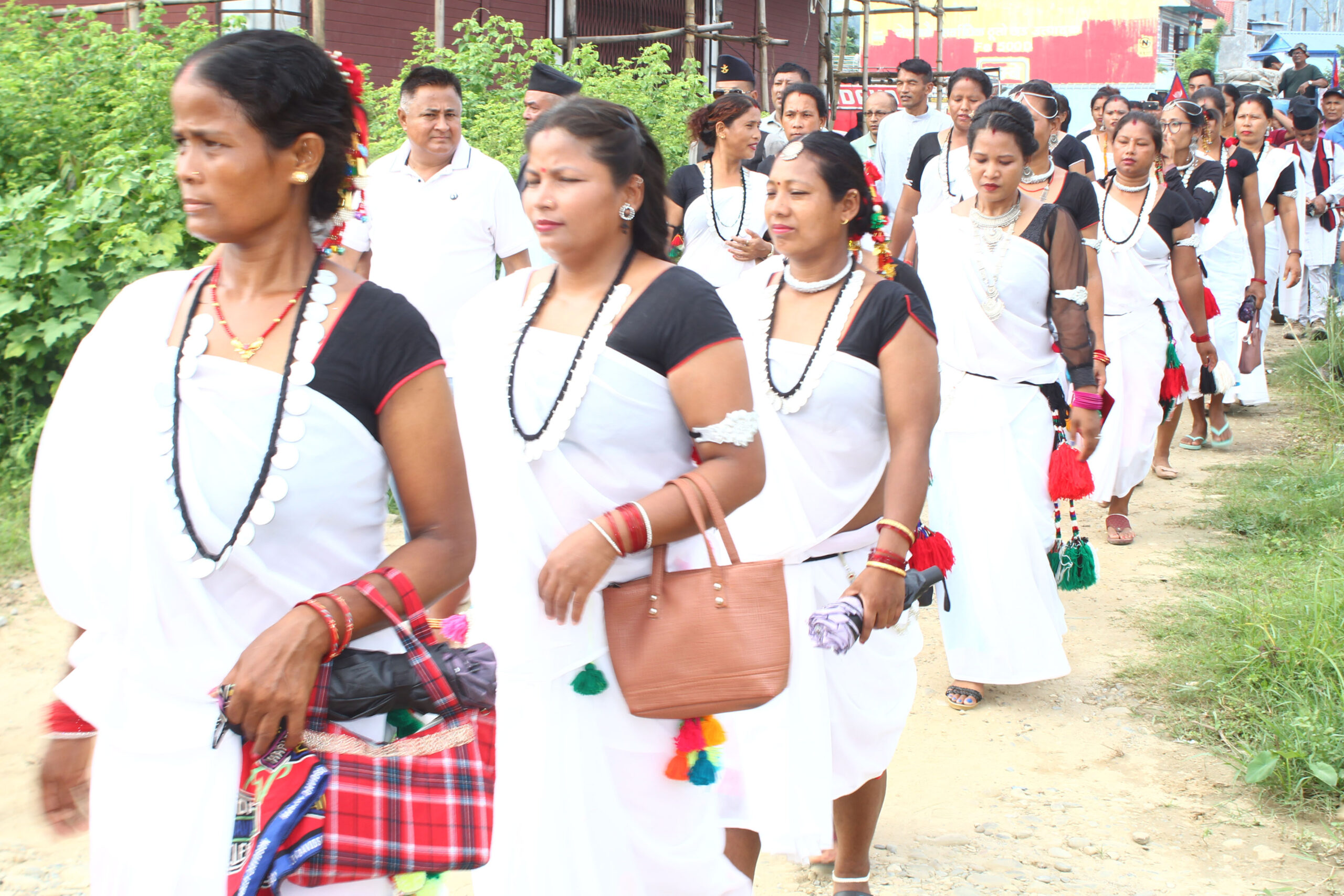
KANCHANPUR: The Tharu community of Kanchanpur district has observed Ashtimki (Shree Krishna Janmashtami) festival with joy.
The community observes the festival in its own way. In their houses, they celebrate the festival by drawing and worshipping a picture depicting the human lifecycle from birth to death along with worshipping the god Shree Krishna.
The tradition of drawing and worshipping pictures has continued for ages. On the occasion of Ashtimki, in meeting rooms of the houses of the community, human lifecycle from birth to death is shown through pictures, said a local resident, Ram Prasad Chaudhary. Both men and women draw pictures on the occasion. Especially fasting women do so.
“At Brahma Muhurta or the early morning hours considered auspicious, in the meeting rooms of houses, after taking a meal, Tharu women draw folk pictures along with that of god Shree Krishna with their own hands. Men teach them in need,” he said.
On the occasion, pictures of the moon, the sun, fish, stick, crab, snake, dog, monkey, earthworm, turtle, elephant, horse, ox, camel, chicken, peacock, and scorpion are made.
“In the past, only women would draw pictures on Ashtimki. Nowadays, men also make pictures.” In the past, a paste of rice and paddy chaff ground on a stone, cotton, and bamboo sticks would be used to draw the pictures. But nowadays, various colors available in the market are used, he said.
Folk art holds significance in the Tharu community as art has remained as a means of communication since the creation of human civilization.
The Tharu community is known as the worshippers of nature and the culture of painting in the community began some 5,000 years ago, according to Dhan Bahadur Kushi.
The Tharu community used to create paintings during the Ashtimki festival by using specific colors extracted from nature: plants and vegetables. They used to extract green color from the bean leaves, brown from Khayar (senegalia catechu) black from burning the dried bottle gourd, and so on. The use of colors in the painting also holds symbolic meaning and significance.
The black color is for emptiness or nihilism, red signifies enthusiasm, green for patience, yellow for intellectuality, brown for emotional status and blue signifies the importance of tradition and culture.
According to the people who are known to the Tharu culture, the Ashtimki paintings are featured in geometrical shapes: the oval shape is used for heads, cubical or triangular form is for emotions, and conical shape for hands and legs. Such paintings are simple but beautiful.
Following the creations of Ashtimki paintings and preparing the necessary offerings for worship, women observe fast by adorning themselves with cultural jewels and cladding on special dresses. They perform worship by offering rice, fruits, and rice plants to the lord Shreekrishna.
The entire family members gather in the place of worshipping and they receive delicacies and fruits from the women who observe the fast as Prasad.
The entire members of the family spend the whole night during the Ashtimki by singing devotional songs in the name of Shree Krishna. In the second of Ashtimki, the women visit the nearby rivers and ponds to immerse the remains of offerings.
They get back home after taking a bath. They offer delicacies prepared back at home to the lord and consume to conclude the festival.
RSS






Comment