



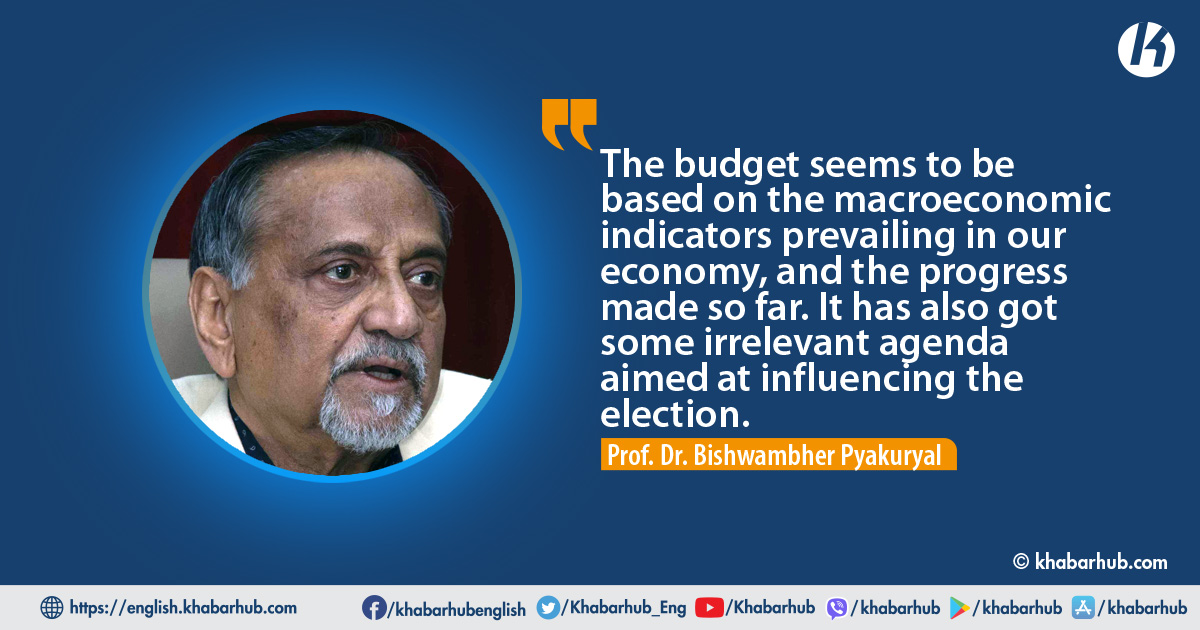
KATHMANDU: When the budget for the fiscal year 2022/23 came, we initially saw two ‘schools of thought’. The current macroeconomic indicators are moving at a fast pace.
The budget is based on the progress that can be made provided the indicators go ahead at the same pace.
One school of thought says the budget is over-burdened with election consciousness, and another school of thought is of existing consultants.
Considering the basic indicators of the national economy and the concerns of economic stability, fiscal deficit, budget deficit, etc, one school of thought says the Central Bureau of Statistics issued a revised statement justifying the GDP of around Rs 4.1 trillion.
Similarly, If Nepal is to upgrade itself from the least developed countries (LDCs) and provided it meets the other three indicators, the per-capita income is increasing.
In a situation where the previous budget is reduced by 5.3 percent or Rs. 86-87 billion and the given size is not also timely spent, it is natural to have two schools of thought.
The way inflation is currently assessed and the rate of GDP is presented reflects the lack of calculation on our part.
Despite the joint effort of the Ministry of Finance and the Reserve Bank of India (RBI), the inflation rate has reached 6.7 percent. If the barrel rises by 10 UAE dollars, the influence will increase by 25 basic points.
Some say that 100 percent of public debt has reached the proportion of GDP. But looking at the World Bank’s record, despite the change in public debt percentage from 36 to 42 and again 44 percent, the Nepal Development Update says the financial stability is not out track yet.
We have to be cautious while making plans as we have been regarding that there is still ample space for public debt in proportion to the GDP.
If we think that the remittent percentage has been increased, hence, the budget can be planned accordingly, we are likely to take a fatal risk.
Some say that 100 percent of public debt has reached the proportion of GDP. But looking at the World Bank’s record, despite the change in public debt percentage from 36 to 42 and again 44 percent, the Nepal Development Update says the financial stability is not out track yet.
Even in this budget, looking at the overall amount, the amount is allocated everywhere. The 70-year-old age group used to get a senior citizenship allowance but now it has been reduced to 68 years.
There has been a lot of discussion on this as well. 5.4 percent of the total population is in the 65 or above age group. That means about 1.7 million people are eligible for this facility.
It is said that there is the provision of honoring the senior citizens who voluntarily declares not to take the amount, we are in a wait-and-see position in this regard.
Some say that 100 percent of public debt has reached the proportion of GDP. But looking at the World Bank’s record, despite the change in public debt percentage from 36 to 42 and again 44 percent, the Nepal Development Update says the financial stability is not out track yet.
It has been said that the rate is 70 percent. As it is growing fast, provided the pace remains the same soon it will reach 100 percent. Various indicators are not so healthy.
(This article is prepared by Khabarhub on the basis of Prof Dr. Pyakuryal at an interaction organized by ISSR in Kathmandu)





Comment