




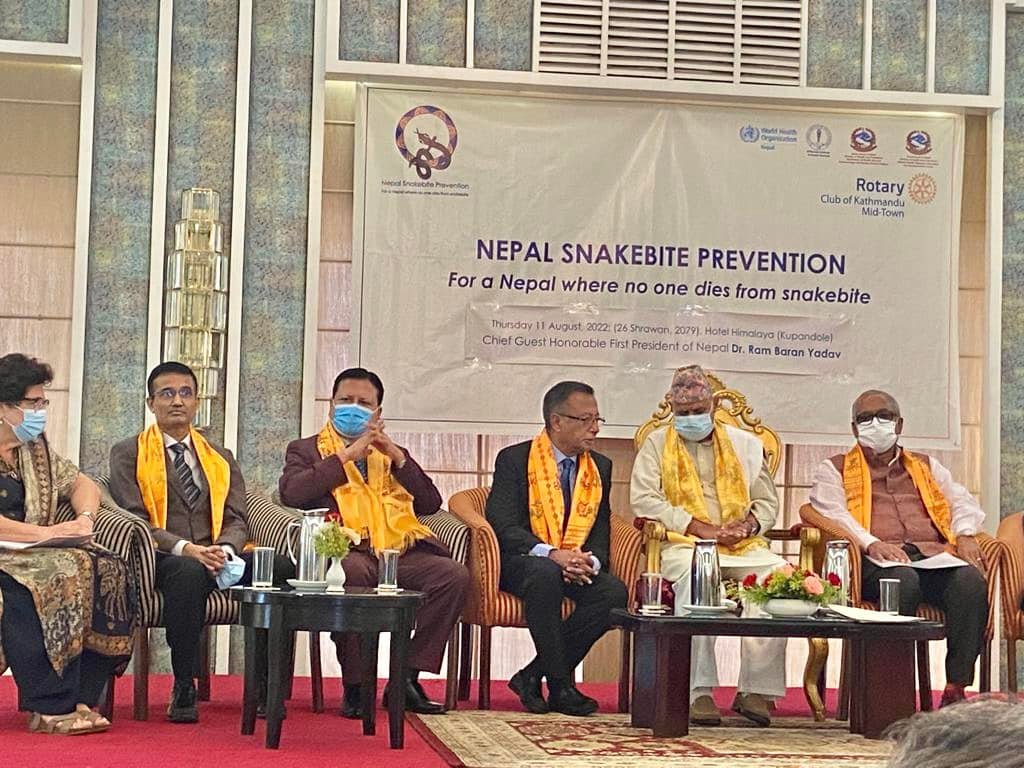
KATHMANDU: A four-year campaign has kicked off to increase public awareness for the prevention of snakebite.
The very first and former President Dr Ram Baran Yadav launched the campaign amidst a program in the capital on Thursday.
On the occasion, he said the campaign would focus on increasing public awareness for preventing and controlling snakebite. He said human-snake conflict is an increasing phenomenon due to the loss of habitat for animals including snake.
Expressing concern over the downsizing of forest areas in Nepal and thus the animal habitats loss, he insisted on the need of protecting animal life to keep biological diversities intact.
“The density of Charkoshe and Chure forests is shrinking,” he said, adding that this had led to the loss of habitats for animals residing there. “As a result, human-animal conflict is increasing.”
World Health Organization Representative to Nepal, Dr Rajesh Sambhajirao Pandav, said cases of snakebites are common in the Terai, expressing his hope the campaign would contribute to preventing probable incidences of snakebite.
Epidemiology and Disease Control Division director Dr Chuman Lal Das said there are 90 treatment facilities for snakebite (government-run, community and Nepali Army-run) across the country and this number is not sufficient to deal with the cases of snakebites.
He pressed an idea of increasing human resources, well-equipping treatment facilities and conducting training to deal with the snakebite problem effectively.
“Snakebites are unavoidable, but it is preventable.” He shared that there were 10,000 snake bite cases last year. Krait and cobra are poisonous snakes found in Nepal.
Vice-Chancellor of BP Koirala Institute of Health Sciences, Dr Gyanendra Giri, said prevention and control of snakebite would be carried out within 2030.
Saying mostly people of Tarai have become victim of snake bite, he expressed the view that prevention of snakebite should be dome through public awareness.
Dr Sanjeev Kumar Sharma of BPKIHS shared that farmers, those looking after their cattle and school going age children are found most at risk of snakebite. Eighty percent people died from snakebite before reaching hospital.
Out of the total number of people suffering from snakebite in Nepal, 7.6 percent people die from it. Snakebite could be prevented if education and public awareness could be spread in villages.
Rotary Club Kathmandu Mid-Town Chairperson Dr Nirmal Rijal said a campaign has been launched to save lives from snakebite as many people die untimely due to this at different places of Tarai.
Information about snakebite would be shared in Tharu, Awadhi, Bhojpuri and Maithali languages in course of campaign.





Comment