




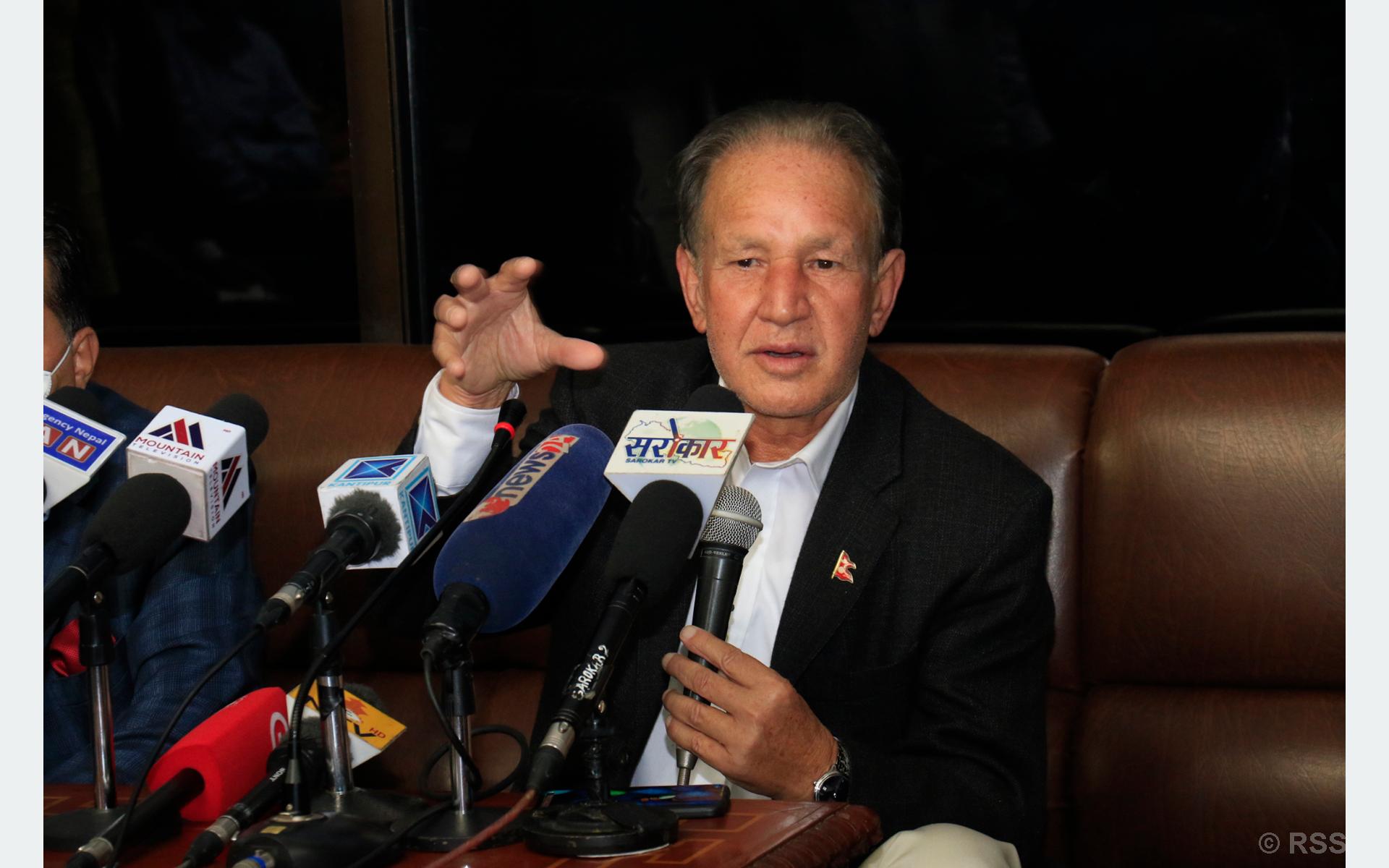
KATHMANDU: Minister for Foreign Affairs Dr Narayan Khadka returned home today after attending the 76th Session of the United Nations General Assembly (UNGA).
The Minister reached New York on September 24. While in New York, he addressed the General Debate of the 76th session of the UNGA as the head of the Nepali delegation.
On the occasion, Nepal presented its views on the current issues of global concerns including of Nepal and on the affairs of bilateral and multilateral interests.
Nepal raised the issues of the COVID-19 crisis, easy access to vaccines for its elimination, and unhindered availability of health supplies.
The Minister apprised the UNGA forum about Nepal’s concerns on climate change, issues of mountainous countries, and common problems and challenges of Nepal-like landlocked and least developed countries (LDCs) as well as its views on human rights, terrorism and disarmament were also raised.
Talking to media persons at Tribhuvan International Airport (TIA) about his New York official visit and bilateral meetings with his counterparts from various countries, he said Nepal reiterated its commitment to the UN Charter, its principles, and objectives.
More, Nepal applauded the role of the UN in the promotion of world peace, goodwill, and development, insisting on the strengthening of multilateralism and on the improvement and restructuring of the UN in the present challenges.
He went on to say that Nepal drew the world’s attention towards the issues of the LDCs and the landlocked countries, and also stressed the need of tackling with poverty and inequalities facing such countries through the means of international cooperation, technology handover, and investment for the development of such nations.
Minister Khadka has asserted that the country’s foreign policy should be focused on promoting the national interest.
He said the foreign policy promoting the national interest should be formulated through national consensus.
“The foreign policy should be made by maintaining national consensus. We cannot have party-specific foreign policy and I will direct my efforts on formulating foreign policy promoting the common national interest by fostering consensus among all political parties,” he said, stressing on the need for a foreign policy to foster balanced relations with all countries including the neighboring ones.
The Foreign Affairs Minister also pointed out that the political parties should not be divided on conducting the country’s foreign policy and all should have a common view on this.
Stating that he had not expressed an opinion on the need of amending the American grant assistance Millennium Challenge Corporation (MCC) compact in the program organized by the Nepali diaspora in New York, he said he had rather stated that there were slim chances of the United States of America agreeing to amend the compact reached four years back as suggested now by Nepal.
He expressed his dismay that misleading news on MCC was disseminated from New York and urged the media to give objective news.
Regarding his meeting with his Indian counterpart S Jaishanker, Minister Khadka said the Indian Minister for External Affairs had informed him that India was going to lift the ban on the export of vaccines from tomorrow and it would give priority to the neighboring countries in the export of vaccines.
He added that only general discussions were held on the projects operated through Indian assistance in Nepal in the brief meeting with Jaishanker. Dr Khadka said that the Indian Minister for External Affairs informed him that ‘India was ready to resolve the bilateral issues through dialogue and collaboration.’
The Minister said detailed discussions on the matter would be held in the Nepal-India Joint Commission’s Seventh Foreign Ministerial Meeting scheduled to be held in Kathmandu in the near future.
He shared that discussions were held on collaboration on increasing energy and trade in his meeting with the Bangladesh Foreign Minister AK Abdul Moman, on the promotion of trade, tourism, investment, and on the rights and welfare of Nepali migrant workers in his meetings with his counterparts from Kuwait and Bahrain.
The Minister for Foreign Affairs said in his meeting with the UN high officials he raised the issues, among others, of the peacekeeping forces, their security, timely compensation, and release of funds for expenditures made on logistics materials as well as the appropriate representation of Nepal in responsible and high posts of the peacekeeping mission in recognition of Nepal’s unrelenting and highest level contribution.
On the sidelines of the Session, the Minister held meetings with counterparts from India, Bangladesh, Kuwait, and Bahrain. He had meetings with the President of the 76th session of the UN General Assembly, Under-Secretary-General for Peace Operations, and Under-Secretary-General for Operational Support. Further, he participated at the interactive program with the Nepali diaspora.
Officiating Foreign Affairs Secretary Prakash Kumar Subedi and Ministry’s senior officials were at TIA to welcome the Foreign Minister and the members of the Nepali delegation.
The delegation was seen off at the John F. Kennedy International Airport by Amrit Bahadur Rai, Permanent Representative of Nepal to the UN, and other officials of the Permanent Mission and Consulate General of Nepal in New York, the Ministry of Foreign Affairs said.




Comment