




KATHMANDU: Joint Attorney Sanjeev Raj Regmi has said the Court is not expected to oversee the decision taken by the President with prudence and constitutionally in regard with the appointment of Prime Minister.
During a hearing of the case relating to the May 22 dissolution of the House of Representatives (HoR) before the Constitutional Bench today, Regmi argued that the President had the constitutional right to appoint a Prime Minister.
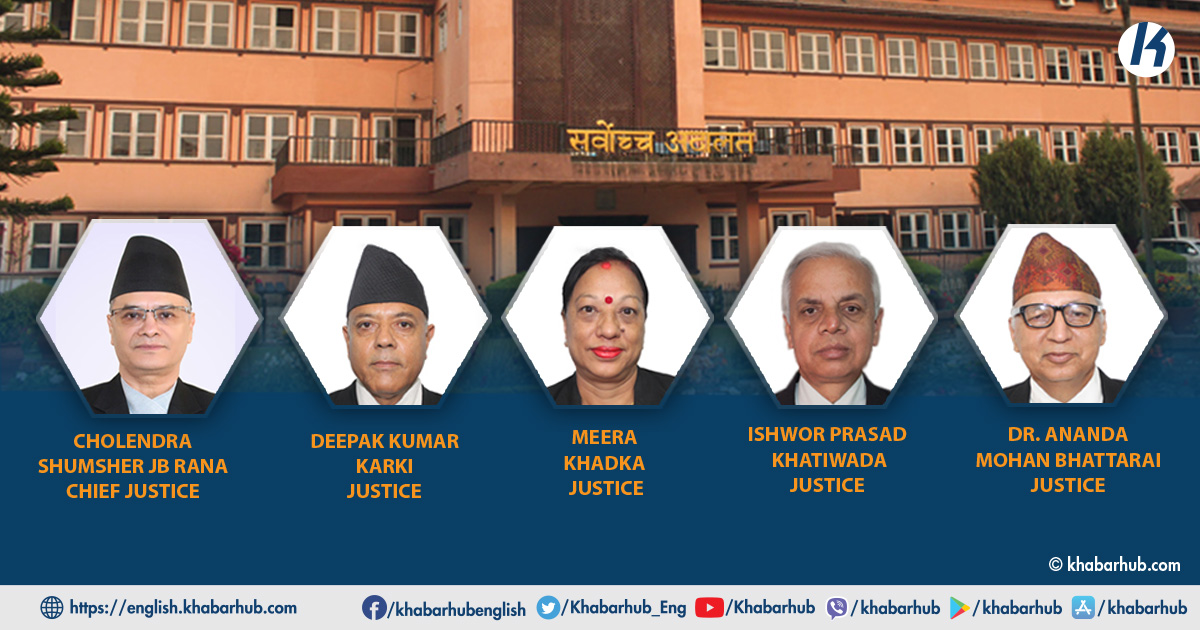
The Constitutional Bench comprises Cholendra Shumsher JB Rana and senior judges Deepak Kumar Karki, Meera Khadka, Ishwar Prasad Khatiwada and Dr Ananda Mohan Bhattarai today and he was pleading on behalf of the government.
“Article 76 (5) of the constitution is about the prerogative of the President and the decision made by the President with prudence being based on the same article can’t be examined in the court,’’ he claimed.
According to him, the constitution has granted the right to assess whether a person to be appointed on the Prime Ministerial has adequate ground for winning a confidence vote while making the appointment and the Article 76 has not imagined that the President should consult with anyone for the same.
“The constitution itself grants the president the right to give a vote of confidence or not when appointing a prime minister and the President took the decision exercising same right.”
Pleading on the case on behalf of the government side continues. Joint Attorneys Rijal, Sanjeev Raj Regmi, Lok Raj Parajuli, Khem Raj Gyawali, Uddhav Prasad Pudasaini and Deputy Attorney Dasarath Pangeni will be pleading.
After the government attorneys are done with their pleading, Prime Minister KP Oli’s lawyers will start their pleading.
Twenty three lawyers will be pleading on behalf PM Oli and they have been allocated a total seven hours for the same.
After the pleading of the government side, the lawyers from the Speaker’s side will be given one hour to plead.
Thereafter the plaintiff side will respond. After the response from the plaintiff side, the amicus curiae will start their pleading.
Then only will the Constitutional Bench give its verdict on the case. Thirty writs were filed against the dissolution of the House of Representatives.
On May 22, President Bidya Devi Bhandari had, on the recommendation of the Council of Ministers, dissolved the House of Representatives and fixed November 12 and 19 as the date for mid-term election.
The writs seek declaring the President’s this decision as unconstitutional and illegal, and reinstatement of the House of Representatives.
RSS






Comment