




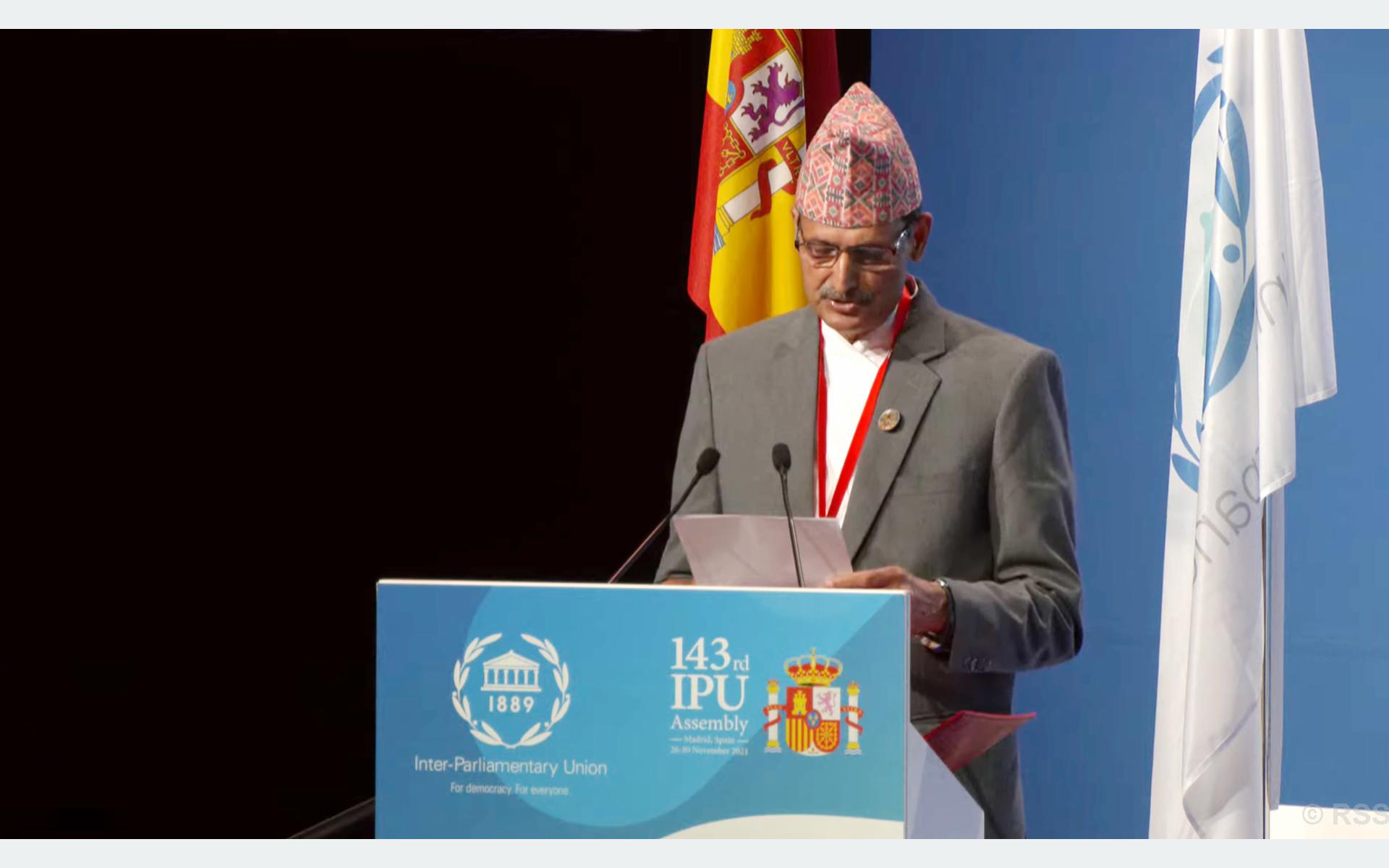
KATHMANDU: Speaker of House of Representatives (HoR) Agni Prasad Sapkota has said parliament is the living embodiment of democracy and it is where people can change their rulers in a peaceful manner.
“It is where people’s representatives earn trust and respect by ensuring justice and fairness to the weaker section, in absence of which people question whether this democratic system even works at all,” Speaker Sapkota said while addressing the 143rd Inter Parliamentary Union (IPU) Assembly in Madrid, Spain on Sunday.
In his remarks on the theme “Contemporary challenges to democracy: Overcoming division and building community”, Speaker Sapkota mentioned democracy works; and it has to, adding, “We have to raise people’s engagement in the democratic processes.”
“Discussions on overcoming division to strengthening international community will go a long way in addressing national, regional and global issues in the interest of all.
Throughout history, people have strived to participate in decision-making. This explains why democracy has evolved to be the ultimate form of governance as it gives people as much role in the national policy-making as practically possible,” the Speaker added.
He, however, said that while prevalent as the most preferred form of rule, democracy is not without challenges.
Similarly, Speaker Sapkota was of the view that heated exchanges, false data, misleading statistics, anger, and frustrations that spread fast and wide have weakened the trust of people towards political institutions. He suggested that the political institutions should respond effectively to regain public trust In light of these challenges.
Stating that division is not good for the democracy, Sapkota has mentioned that marginalization as the root cause of the division “It is important to include them (marginalised groups) in decision making. Marginalized groups should be brought into the mainstream of national life.”
He also shared that Nepal’s initiatives towards strengthening democratic institutions by addressing the challenges of marginalisation led to the formation of an inclusive Constituent Assembly, adding that the Constituent Assembly promulgated a rights-based Constitution in 2015 that embodies the fundamentals of participatory and inclusive democracy.
“Nepal has made full commitment to establish a society founded on the proportional inclusive and participatory principles,” Sapkota reminded.
In his speech, the Speaker said that the result of Nepal’s new constitution so far has been promising towards building of a cohesive and inclusive society.
Women now make up one third in the Federal Parliament and about 41 percent at the provincial and local levels, Speaker Sapkota mentioned.
RSS



Comment