




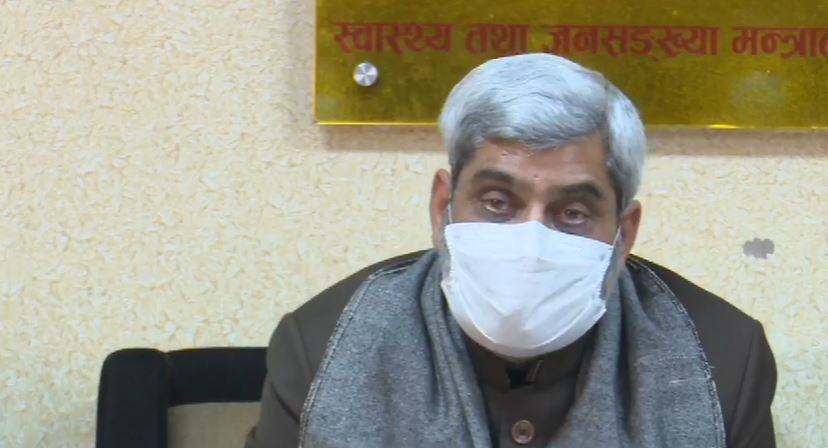
KATHMANDU: Minister for Health and Population Hridayesh Tripathi has pledged more investment to enhance capacity for the women and girls to ensure their meaningful participation in the public and political sphere.
Addressing the High-level Inter-Ministerial Dialogue Addressing Gender-biased Sex Selection (GBSS) jointly organized by the UNFPA, European Union, and the government of Norway on Friday evening, Minister Tripathi said that his Ministry, which is a lead government agency, was committed to coordinating the effort with other ministries to implement the strategy so that root causes of GBBS could be addressed.
Tripathi shared that the Nepal government had formulated various national strategies to eliminate gender-based discrimination in all sectors and to end son preference and GBBS.
In a press statement released by UNFPA, it was shared that participants find the high-level dialogue included the representatives from Nepal, Armenia, Azerbaijan, Bangladesh, Georgia, India, Norway, and Vietnam.
Minister Tripathi briefed the other high-level representatives about efforts and initiatives undertaken by Nepal to end the ill-tradition of preference to son.
“In a patriarchal power structure, GBBS in favor of sons is a manifestation of gender inequality and embedded in tradition, culture, religion, social, economic and legal injustices that undervalue girls and women.”
He called for a multi-dimensional approach and programs to end the GBBS in favor of sons and gender-based discrimination.
UNFPA study has found that Sex Ratio at Birth (SRB) was imbalanced in 12 districts in the country. The study concludes that there is a strong pressure on women to bear a son which hampers their right to choice, health, and may even lead to violence.
The constitution of Nepal-2015 has ensured women’s right to safe motherhood and right to reproductive health. There are many constitutional and legal provisions to ensure gender equality.
Despite all these, many Nepali women were still facing gender-based discrimination in all sectors.
“There is a positive legal framework in Nepal such as the Constitution of Nepal, Civil Code, Penal Code, and Safe Motherhood and Reproductive Health Rights Act, but Nepali women face discrimination in various walks of life,” remarked the Minister.
RSS





Comment