




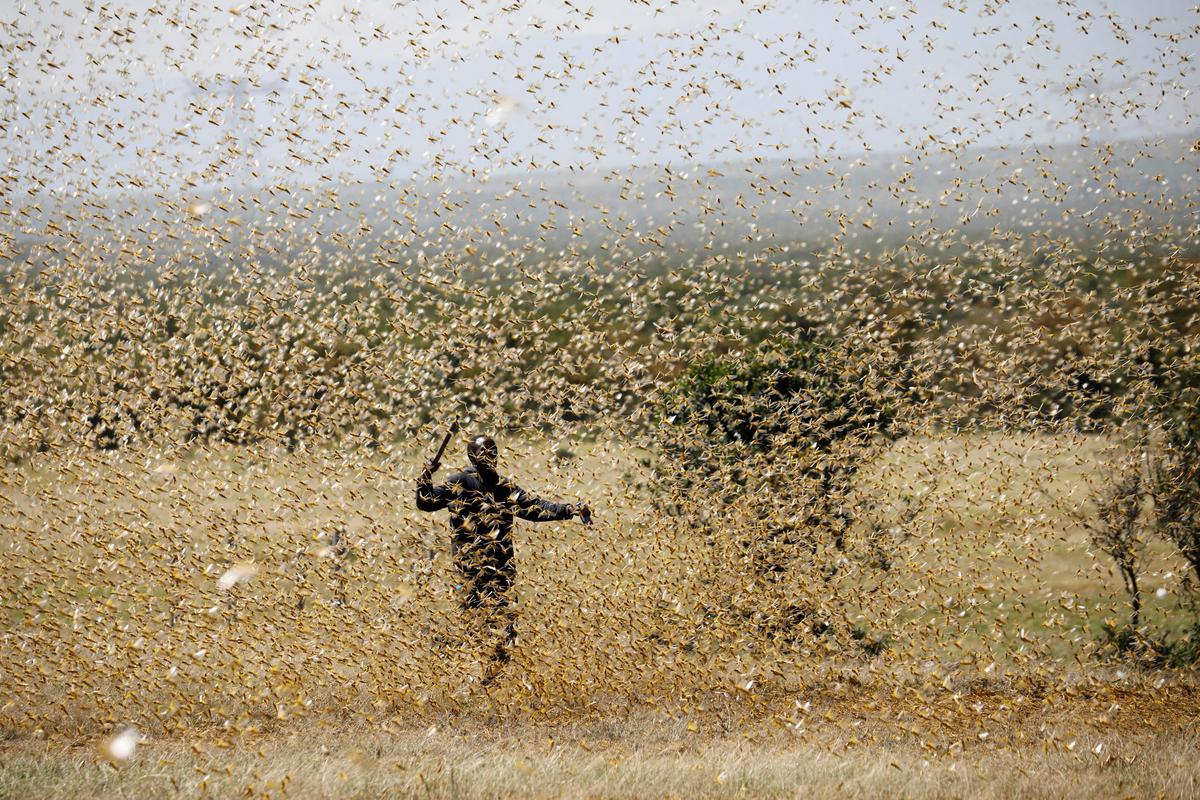
KATHMANDU: The Ministry of Agriculture and Livestock Development has called an emergency meeting after locusts entered four districts of Nepal – Bara, Parsa, Sarlahi and Rupandehi on Saturday morning.
The meeting has been called to dwell on how to minimize the possible damage to be caused by insects.
A swarm of locusts entered Bara, Parsa and Sarlahi from India on Saturday morning, informed Sahadev Humagain, chief of Plant Quarantine and Pesticide Management Center under the Ministry of Agriculture and Livestock Development. Locusts have been seen in Rupandehi as well.
According to Humagain, the locusts are currently sitting on the leaves of trees and on the grassy land of Dumarwana, Parsagadhi and Nawalpur of Sarlahi.
The locusts which were originated in East Africa had arrived in India and Pakistan via the Middle East few days ago, which have incurred a heavy loss on crops across the state.
The Ministry of Agriculture had formed a committee to minimize the loss when the locusts reached Uttar Pradesh.
Locusts are a swarm of certain species of short-horned grasshoppers that damage crops such as wheat, maize mustard among others.
They follow the direction of wind and travel for 130 km in a swarm of 40 to 80 million, said agricultural scientists.
It is said that they damage crops equivalent to the foods that suffice for 35,000 people in a single day.
What is locust?
Locust is a short-horned grasshopper. Generally a solitary insect, under certain circumstances they change their behavior and habits and turn destructive.
Drought followed by the rapid vegetation growth makes plays catalyst in the production of serotonin in their brains, which changes their nature making them more gregarious and voracious. Generally, its hazard is high in deserts or desert-like plains.
The swarms of locusts can travel great distances and destroy the vegetation wherever they land. Each swarm consists of more than 40 million insects in it. Nepal had witnessed the locust attack 70 years before.
“There is nothing specific for the locusts to eat, wherever they see something green, they land there and spoil it all,” said Dr. Dilli Ram Sharma, former Director-General of the Department of Agriculture, “some insects target specific plants or crops, but locusts spare nothing green.”





Comment