




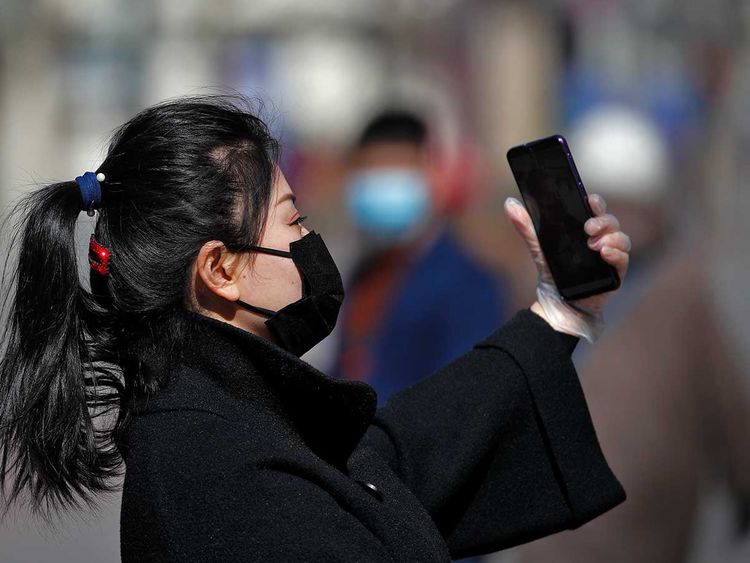
LONDON: The coronavirus is not yet a pandemic, but it’s become the first true “infodemic”.
There has been so much overload of information on social media and the traditional media that the World Health Organisation, on February 2, termed it an “infodemic”.
Why is there such an overabundance of information? Because there is an appetite for it. In these times of coronavirus, people are driven by fear. Fear of the unknown.
Fear of an unseen pathogen. And fear travels faster than infection.
COVID-19 has been zipping around the world at such an astonishing pace that people are eager for information.
Any information that would assuage their fears.
This is the age of social media and 24/7 news cycles.
Information overload
People are constantly bombarded with information, which may or may not be useful. That’s a recipe for panic in times of an outbreak.
While social media feeds people’s hunger for news, it also magnifies their fears.
Some of this information is accurate. It helps raise awareness. But there’s plenty of misinformation as well. And they come with dramatic headlines, ratcheting up the fear factor.
Which is worrying?
Previous viral outbreaks like Sars, swine flu, bird flu and Mers too were alarming.
But they never matched the global anxiety wrought by COVID-19. It is also true that none of them compares with the coronavirus in the speed and scale of transmission.
Yet COVID-19 is not as deadly as Sars.
So the media, especially social media, has been instrumental in sowing fear.
“A link between social contagions and real biological contagions are a feature of modern outbreaks because of misinformation and fake news,” says Samuel Scarpino, a business professor of network science at Northeastern University College of Science in Boston, United States.
Fake news on social media
The spread of fake news has been so rampant that Andrew Pattison, a digital business solutions manager for the WHO, visited the Silicon Valley tech giants to seek help to fight the deluge of misinformation.
Pattison said: “The spread of misinformation and false information about the virus itself is spread faster than the virus. And it’s got into more people’s lives and infected more people than the actual virus itself.”
Several social media have acted swiftly, removing fake news and conspiracy theories from their sites. And that’s encouraging.
At a time when people are scared, accurate information should be made available across all media platforms.
An information void leaves the door open for an avalanche of half-truths, conspiracies, magic cures and remedies.
That can only be disastrous.
The best recourse is to fact-check every piece of information that comes through social media.
An appropriate level of concern is desirable, but not panic.
(with inputs from Agencies)






Comment