




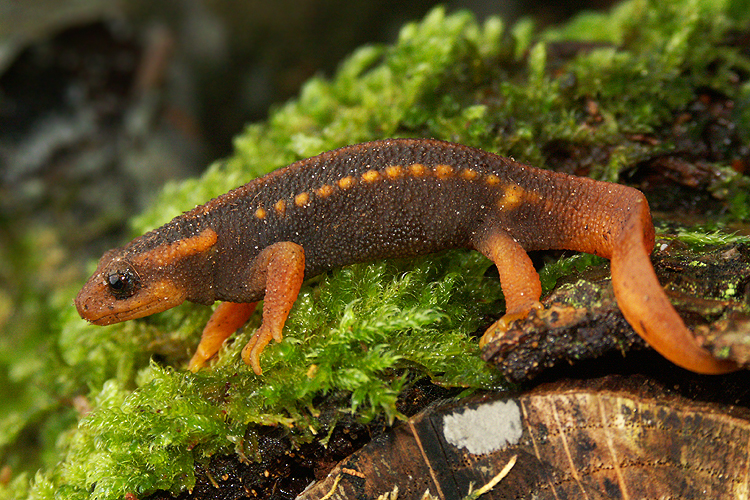
PASHUPATINAGAR: The endangered Himalayan Salamander is on the verge of extinction due to the growing human encroachment in its habitat, the use of pesticides in cereal crops and its trafficking.
The Himalayan Newt Tylototriton verrucous considered one of the most primitive species among living Salamanders. It lives in water and wetland areas.
The locals also call this amphibian as ‘Pani Kukur (water dog)’. It is light brown in color.
As per a study conducted in 2004, the Himalayan newt which is in the IUCN red list is found in Ilam, Panchthar and Taplejung of Nepal.
It is also found in India, China, Bhutan, Myanmar and Thailand. However, biologists have not been able to determine its population.
Another study done in the period from 1980 to 2000 showed that the Himalayan newt is highly endangered due to deforestation, human encroachment and use of harmful pesticides in cereals. Although this species is highly in danger, no initiation has been taken so far to protect it.
Found at an altitude of 1,000 to 3,000 meters, the Himalayan Salamander lives in the forest full of lichen, freshwater bodies, ponds, wetland and water sources, according to KR Khumbu, a doctor who has studied this animal. It hibernates during winter and is seen in the summer.
It is stated in the study that the local communities kill the Himalayan salamander for making medicines out of its body parts and it is used for killing fish in Myanmar.
Kamal Mukhiya of Maipokhari in Ilam said that this amphibian is used as medicine for back pain.
Researchers have pointed out that the smuggling of this amphibian is also increasing from Nepal as its demand for domestication is increasing in the world.
The male of the species is 15.3 centimeters while the female is16.4 centimeters long, as per a study conducted in 2004 by Haz and Duty.
The study pointed out that the Himalayan salamander will become extinct from Nepal if steps were not taken for its conservation. Another study on it was conducted in the Maipokhari of Ilam in 2016. Even children kill the animal.
The study also showed that the population of Himalayan salamander is declining due to the pollution of the wetlands, water sources and water bodies resulting from the rampant infrastructure construction going on these days.
Another reason for the decline in its population in Darjeeling area is the expansion of tea plantation, development of tourism areas and building construction and rapid urbanization.
Although the non-governmental organizations have been conducting awareness-raising programs on the protection of Himalayan salamander, these efforts are not adequate. There are no programs for its conservation from the government side.
Chief administrative officer of Sandakpur Rural Municipality in Ilam, Mahesh Rai said initiatives are being taken from at the rural municipality level for conservation of the Himalayan salamander in and around Maipokhari area, a major habitat of this species.
Maipokhari is the first Ramsar site in Ilam. He said efforts are also underway to protect this species of salamander in other habitats in the district as well.






Comment