




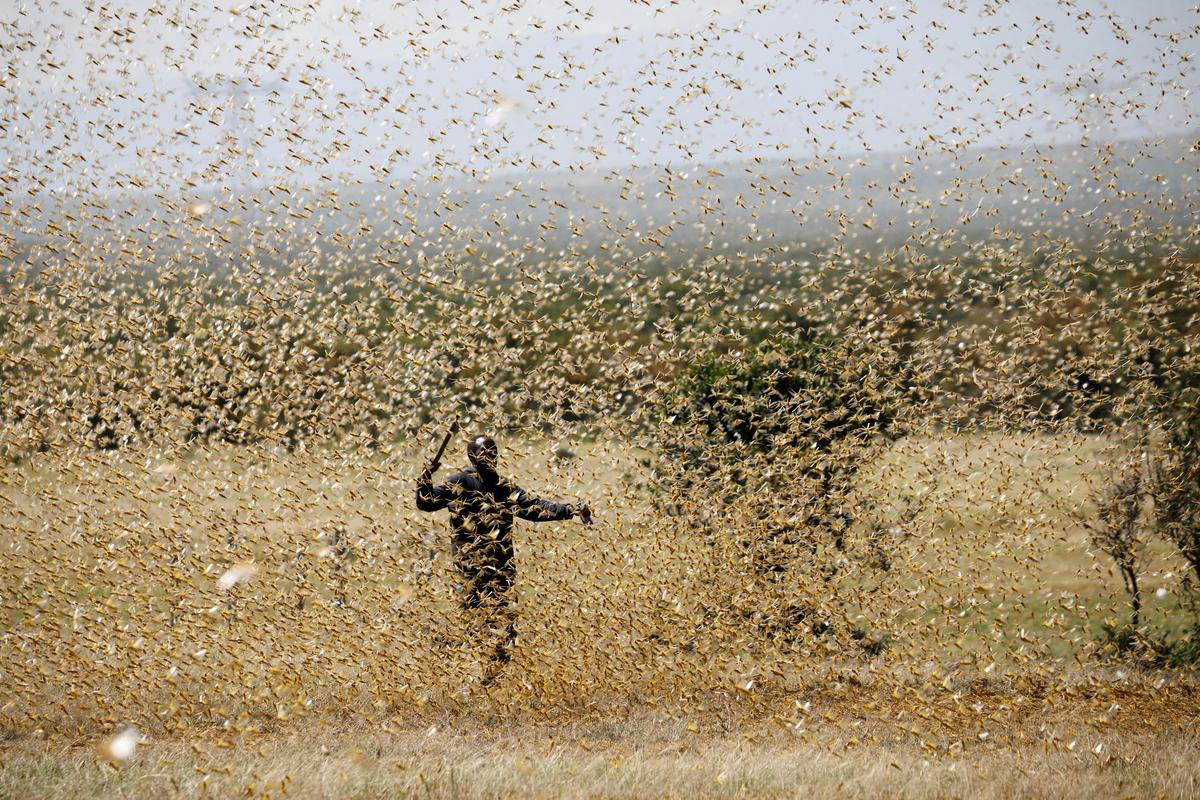
Locusts are collection of particular species of short-horned grasshoppers. Types of locusts are Desert locust, Red locust, Migratory locust, Australian plague locust, Rocky Mountain locust, American Bird grasshopper, Patanga succincta.
At present the havoc is created by Desert locust. These species are generally solitary, but under favorable conditions of drought and fast vegetation growth, they become gregarious.
During rainy seasons, abundant green plants favor their lifecycle. Locusts form gigantic swarms and consume crops, damaging the entire agriculture.
Adult locusts can travel far distances and consume entire vegetation on their path of migration. At present swarm of locusts have travelled through Sudan, Iran, Pakistan and India.
These swarm might travel to Nepal very soon in search of vegetation.
These swarm consume all types of fruits, vegetables, crops and grass. A square kilometer of these swarm consists of about 40 million locusts and they can consume food equivalent to the food consumed by 35,000 people in a single day.
Common solutions used in the control of these swarm of locusts include:
(i) Chemicals and pesticides.
(ii) Loud Noise.
(iii) Trap and used as chicken feed.
(iv) Human consumption.
At present chemicals such as Chlorpyrifos and Malathion 96 are being sprayed with the help of drones and fire brigades to kill the swarm. In human even small levels of chlorpyrifos can cause headache, nausea, tears, runny nose.
Overdose can cause vomiting, abdominal muscle cramps, diarrhea or blurred or darkened vision. Extreme dose can cause unconsciousness, loss of bladder and bowel control, difficulty in breathing or paralysis.
Malation 96 can cause numbness, headache, dizziness, breathing difficulty, worsen asthma, abdominal cramps, skin itching, or even death in human beings. Directly or indirectly chemicals have side effects on human beings and animals.
Loud noise just scares these swarms and they move to a different location and causes same loss of vegetation in other areas.
Trapping locust and using either for chicken feed or human consumption is not very effective for mass control of these insects.
These locusts (insects) are repelled by certain type of high intensity sound waves during day time and agricultural crops can be saved.
High intensity sound waves at night time causes stress in them and continuous exposure to the wave can even lead to death of locusts.
Adverse effect of these high intensity sound waves is seen in rats, lizards, mosquitoes, fleas, house fly, spiders, cockroaches and other insects.
These waves will certainly be a boon to save the agriculture in present scenario of COVID-19 pandemic. These waves has no effect on human beings.





Comment