




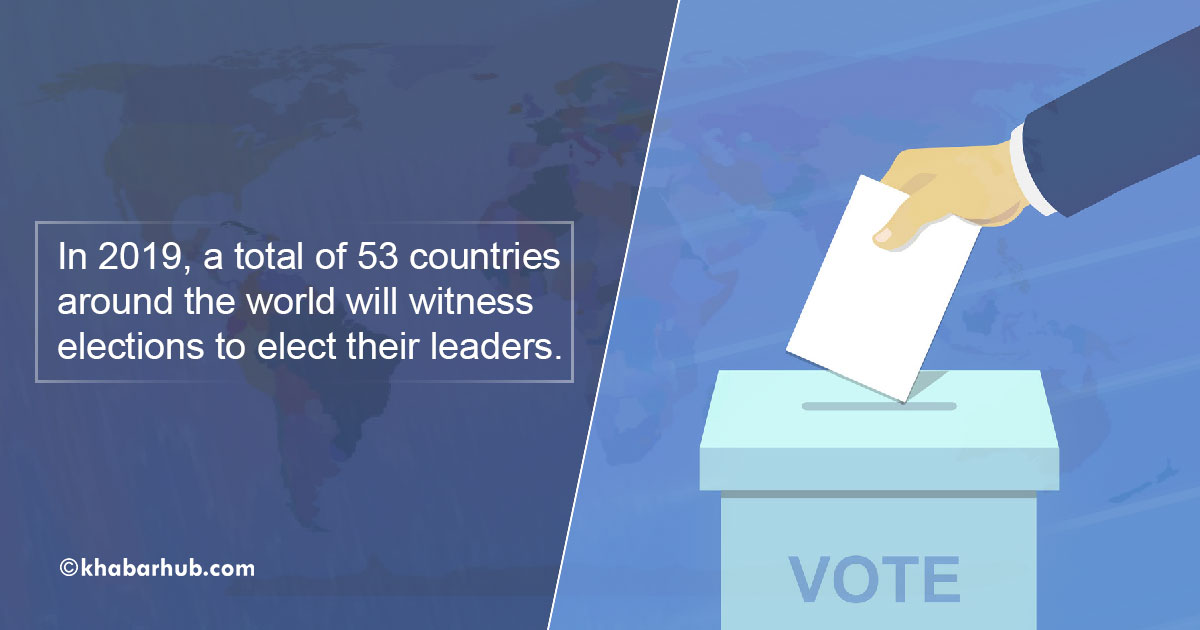
In 2019, a total of 53 countries around the world will witness elections to elect their leaders. Some of the elections having significance include polls in India, Indonesia, and Nigeria. According to data, India has 800 million eligible voters, while Indonesia and Nigeria have 187 million and 84 million registered voters respectively.
Three major types of elections:
Presidential election
Voters elect the country’s head of state or a president. The president holds the highest political position and officially represents the country.
Parliamentary election
The legislative body is elected by the people and, in turn, chooses the head of the government or prime minister. The legislative body implements laws and runs the government on a day-to-day basis.
In countries without a prime minister, such as South Africa, Brazil, and the United States, the president is both the head of state and head of government.
General Election
Voters elect the head of state as well as federal and local representatives.
Eligible to vote:
An adult of 18 years of age and above is eligible to cast the ballot in ninety percent of the countries. If you’re 16, you’d be eligible to vote in 7 countries such as Argentina, Austria, Brazil, Cuba, Ecuador, Malta, and Nicaragua.
Voters can vote at the age of 17 in Ethiopia, Indonesia, South Sudan, Timor-Leste.
In Lebanon, Malaysia, Samoa, Singapore and Tonga, a voter has to be at least 21.
South Korea is the only country where voters are considered eligible at the age of 19.
Likewise, in Cameroon and Nauru, a voter has to be at least 20 years old.
Women’s right:
In 1893, New Zealand became the first country in the world to grant women the right to vote.
The last European country to allow women to vote was Switzerland in 1971.
In 1994, South Africa became the last African democracy to give equal voting rights to all following the end of apartheid.
In Afghanistan, women gained and lost the right to vote several times. They have continuously held the right to vote since 2004.
How often are elections held?
San Marino is only the country where the election is held every year. Countries like Australia, Fiji, Nauru, New Zealand hold elections in every three years. Similarly, 48 countries such as Argentina, Brazil, Germany, Japan, USA have elections in every four years.
Likewise, 104 countries, including Nepal, India, Maldives, Malaysia, Afghanistan, Cuba, France have elections in every five years. Six countries have the electoral process in six years where nine countries hold elections in seven years. Countries like Denmark, Greece, Jordan, Montenegro, Tuvalu, and Vanuatu do not have fixed term for elections.
How many terms can each leader serve?
Most leaders can either serve one or two terms in office. It’s not uncommon, however, for a country’s leader to have an unspecified term limit.
Leaders can serve only one term in 34 nations, 2 terms in 85 nations, including Nepal as per the current constitutions and unlimited term in 59 nations.
Cameroon’s President Paul Biya is the world’s longest-serving, non-royal leader. He’s been in power for almost 44 years. He’s followed by Equatorial Guinea’s Teodoro Obiang Nguema Mbasogo – 40 years – and Cambodia’s Hun Sen – 34 years.
Likewise, 52 countries have given the permission to cast vote to the prisoners. In 65 countries, only ‘selected’ prisoners can cast their vote. Prisoners cannot vote in 60 countries.





Comment