




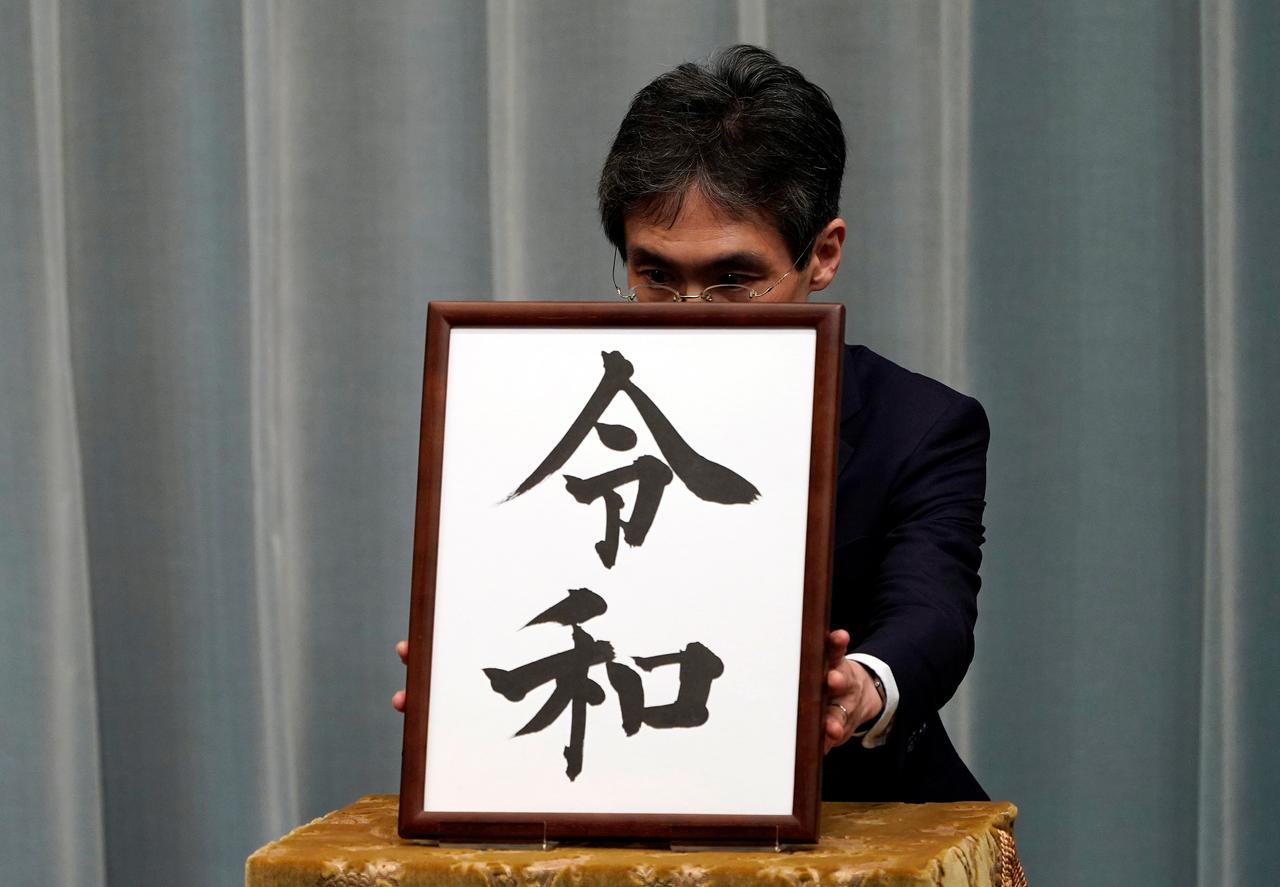
Japan has unveiled a new name “Reiwa” for the imperial era that begins on May 1.
Japan’s Crown Prince Naruhito will ascend the Chrysanthemum Throne on that day.
“Reiwa” will be the name for the new era when Crown Prince Naruhito succeeds his father, Emperor Akihito.
Emperor Akihito’s abdication will end the 31-year Heisei era on April 30.
The imperial era name — “gengo” — is used on documents, calendars, newspapers, and coins. This is the way Japanese count years.
Gengo
Japan imported the imperial calendar system some 1,300 years ago from China.
Likewise, starting with the Meiji era — 1868-1912 — it adopted the practice of “one emperor, one era name.”
In Japan, there have been four era names: Meiji, Taisho (1912-1926), Showa (1926-1989) and the Heisei.
Selection
The era name, under the modern guidelines, should be appropriate to the ideals of the nation. They consist of two Chinese characters, and should be easy to read and write. It should not have been used in a previous combination.
Japan’s emperor does not choose the “gengo”. The cabinet will decide from a list of names suggested by bureaucrats and scholars.
Earlier, the characters were selected from ancient Chinese texts. However, this time, they were extracted from a collection of Japanese poetry called Manyoshu.
The first character is understood to mean “order” or “command”. However, it can also mean “good” and “beautiful”. The second character is understood as “peace” or “harmony”.
Fading
The use of the imperial era name is gradually declining as Japan adopts global economy.
A recent poll carried out by Mainichi newspaper showed 34 percent of people used mainly gengo in daily life. Likewise, 34 percent used both gengo and the Western calendar, while a quarter used mostly the Western system.
Meanwhile, 82 percent used mainly gengo in 1975, while 13 percent used both and only 4 percent mainly the Western system.
Similarly, government agencies and offices mostly use the imperial era in their paperwork or computer systems. However, several companies generally use the Western calendar. (Agencies)






Comment