




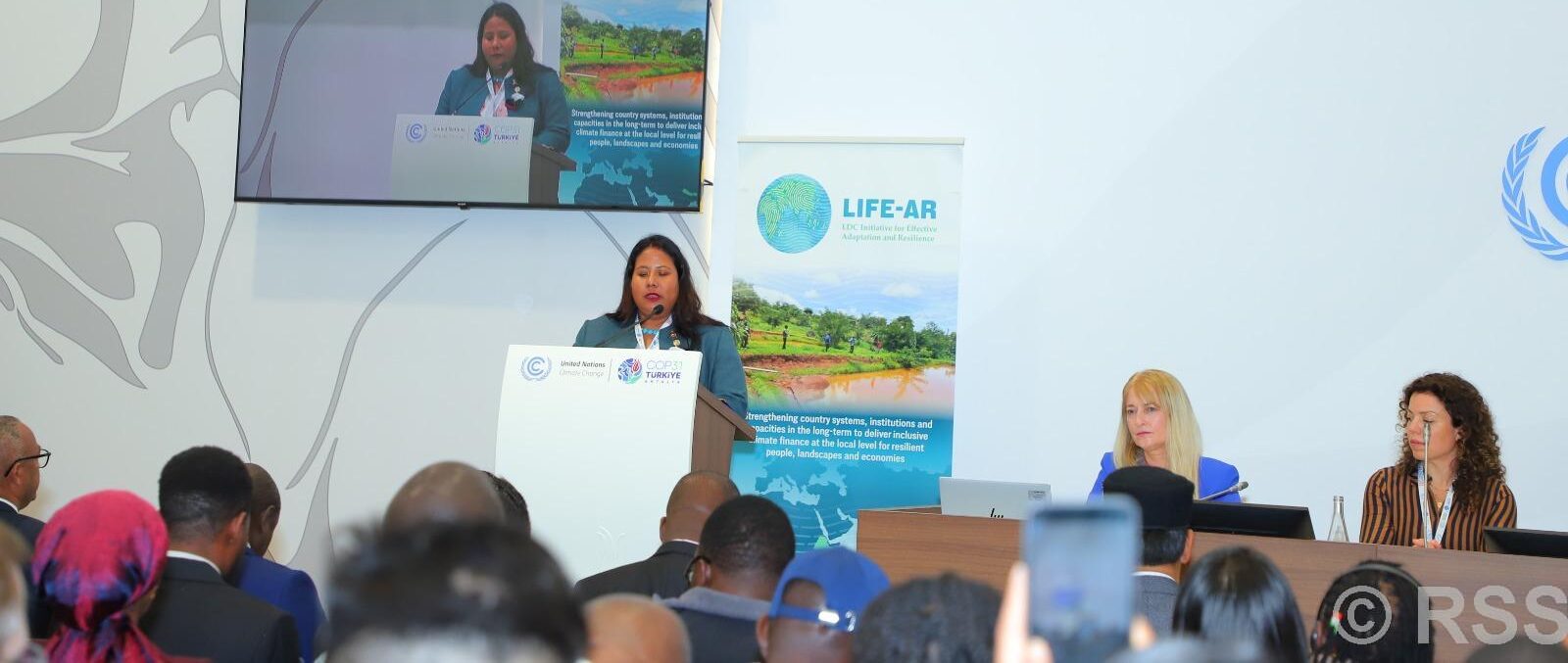
ANTALYA: Minister for Agriculture, Forest and Environment Geeta Chaudhary has called for stronger international solidarity and grant-based climate financing to protect the Himalayan ecosystem and communities increasingly vulnerable to climate change.
Addressing a discussion titled ‘Living Everest: Global Solidarity and Mobilization of Climate Finance’ at the Nepal Pavilion during the ongoing 31st United Nations Climate Change Conference (COP31) in Türkiye, Chaudhary described the Himalayas as a vital life-support system for humanity and urged the international community to step up efforts to safeguard the region.
She noted that the Himalayas provide water, clean air and essential biodiversity resources to more than two billion people living downstream, while the impacts of climate change are becoming increasingly severe across the mountain region.
Although Nepal contributes less than 0.1 percent of global greenhouse gas emissions, it continues to suffer disproportionately from climate-induced disasters, she said, describing the situation as a clear example of climate injustice.
Referring to the Rasuwa-Bhotekoshi disaster of August 26, Chaudhary said the glacier- and rockfall-related disaster had caused enormous human, economic and social losses.
According to her, around 1,500 people lost their lives, more than 5,000 remain missing, and recovery, rehabilitation and reconstruction require resources equivalent to nearly 10 percent of Nepal’s gross domestic product (GDP). She also referred to similar disasters along the Budhigandaki Corridor.
Chaudhary said Nepal had introduced the ‘Living Sagarmatha: Nepal Mountain Resilience Strategy’ to address the growing climate crisis. The strategy integrates climate action, biodiversity conservation, economic development, protection of social and cultural heritage, and regional diplomacy.
Emphasizing the need for international cooperation to implement the strategy, she called for global warming to be limited to 1.5 degrees Celsius above pre-industrial levels. She warned that every additional degree of warming would further threaten the survival and livelihoods of communities in the Himalayan mountains and downstream regions.
Stressing that mountain resilience could not be built through debt, Chaudhary urged international partners to provide predictable, direct and grant-based climate finance to support adaptation efforts.
She also called for a dedicated mechanism to ensure rapid disbursement of financial assistance through the Fund for Responding to Loss and Damage (FRLD), enabling climate-affected countries and communities to recover from disasters.
Similarly, she urged the inclusion of a permanent mountain agenda in the United Nations Framework Convention on Climate Change (UNFCCC) process and proposed an annual high-level dialogue to regularly assess and discuss the growing risks facing mountainous and snow-covered regions.
“What happens on Mount Everest is not limited to Mount Everest; the water flowing from the high peaks reaches the ocean,” she said, emphasizing the interconnectedness of mountain and coastal ecosystems.
“From Mount Everest to the sea, we are partners in one planet, one water system and a common future,” she added.
The minister also urged international development partners, financial institutions, civil society organizations and other mountain nations to work with Nepal to protect vulnerable mountain communities and strengthen climate resilience.
Concluding her remarks, Chaudhary stressed that the Living Everest Strategy should not remain confined to a policy document but must be translated into immediate action to safeguard mountain and downstream communities and secure a sustainable future for coming generations.






Comment