




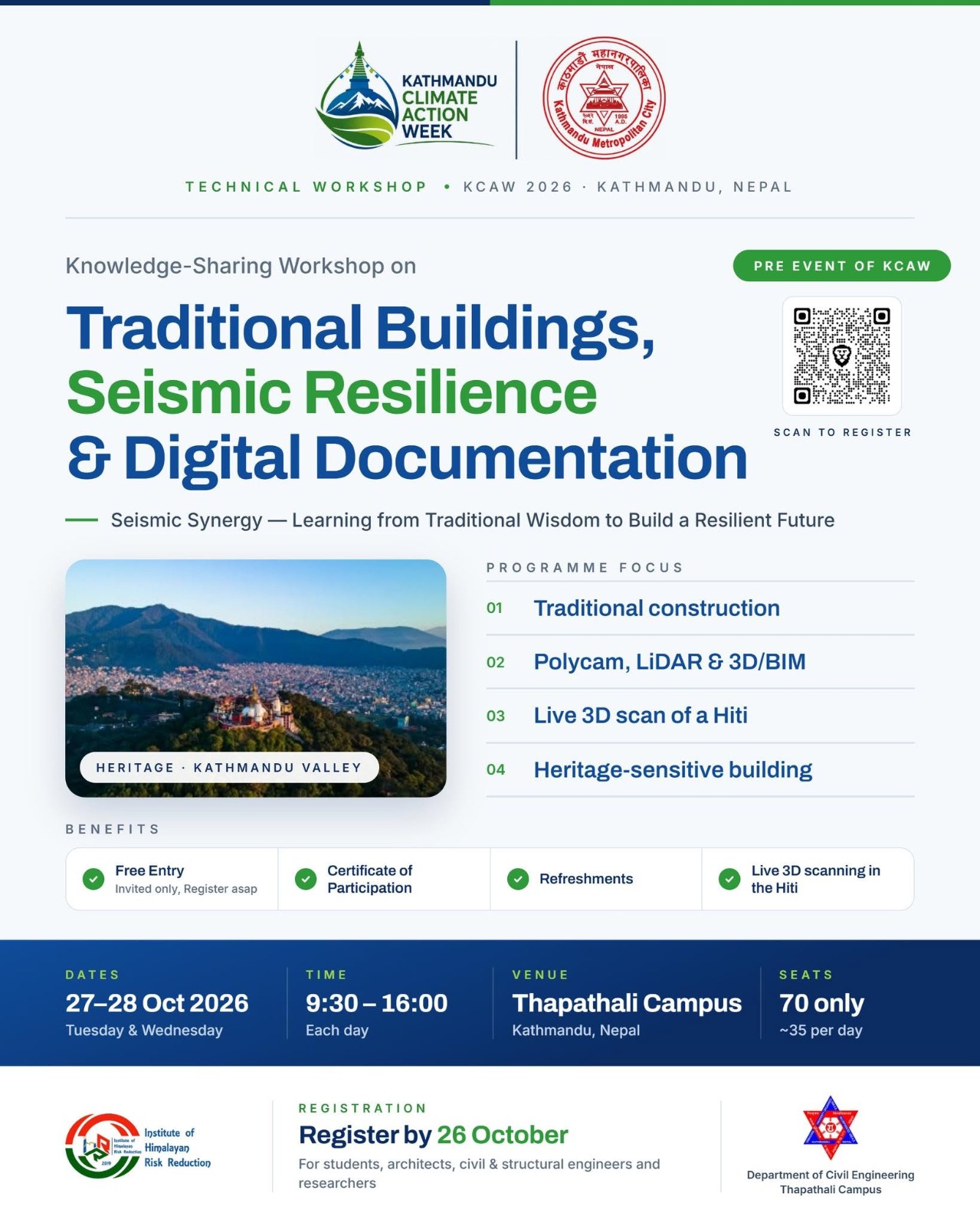
KATHMANDU: The Institute of Himalayan Risk Reduction (IHRR), in coordination with the Department of Civil Engineering at Thapathali Campus, organized a two-day technical knowledge-sharing workshop on Traditional Buildings, Seismic Resilience and Digital Documentation on 27–28 October 2026.
The workshop was organized as a pre-event of Kathmandu Climate Action Week (KCAW) 2026 under the Toyota Foundation-supported Seismic Synergy project.
The event brought together 58 participants, including students, engineers, architects, researchers and project personnel, to explore ways of integrating traditional construction knowledge with modern engineering technologies.
The sessions focused on traditional Newari construction techniques, heritage conservation and seismic resilience. Er. Ranjan Dhungel shared insights into built heritage, preservation challenges and relevant policy considerations.
Similarly, Er. Mantu Shrivastav and Er. Dipika Pandey presented digital documentation techniques, including Polycam/LiDAR scanning, 3D and Building Information Modelling (BIM), structural analysis and the Seismic Synergy project website.
Interactive discussions and a practical field-scanning demonstration at Thapathali Campus provided participants with hands-on insights into documenting and assessing traditional buildings using modern digital technologies.
The workshop highlighted the importance of combining traditional architectural and construction knowledge with contemporary engineering approaches to enhance building safety, preserve cultural heritage and promote sustainable urban development.




Comment