




WALING: The Agricultural Development Resource Center in Waling-1, Syangja, has emphasized the use of modern machinery and equipment to reduce agricultural production costs.
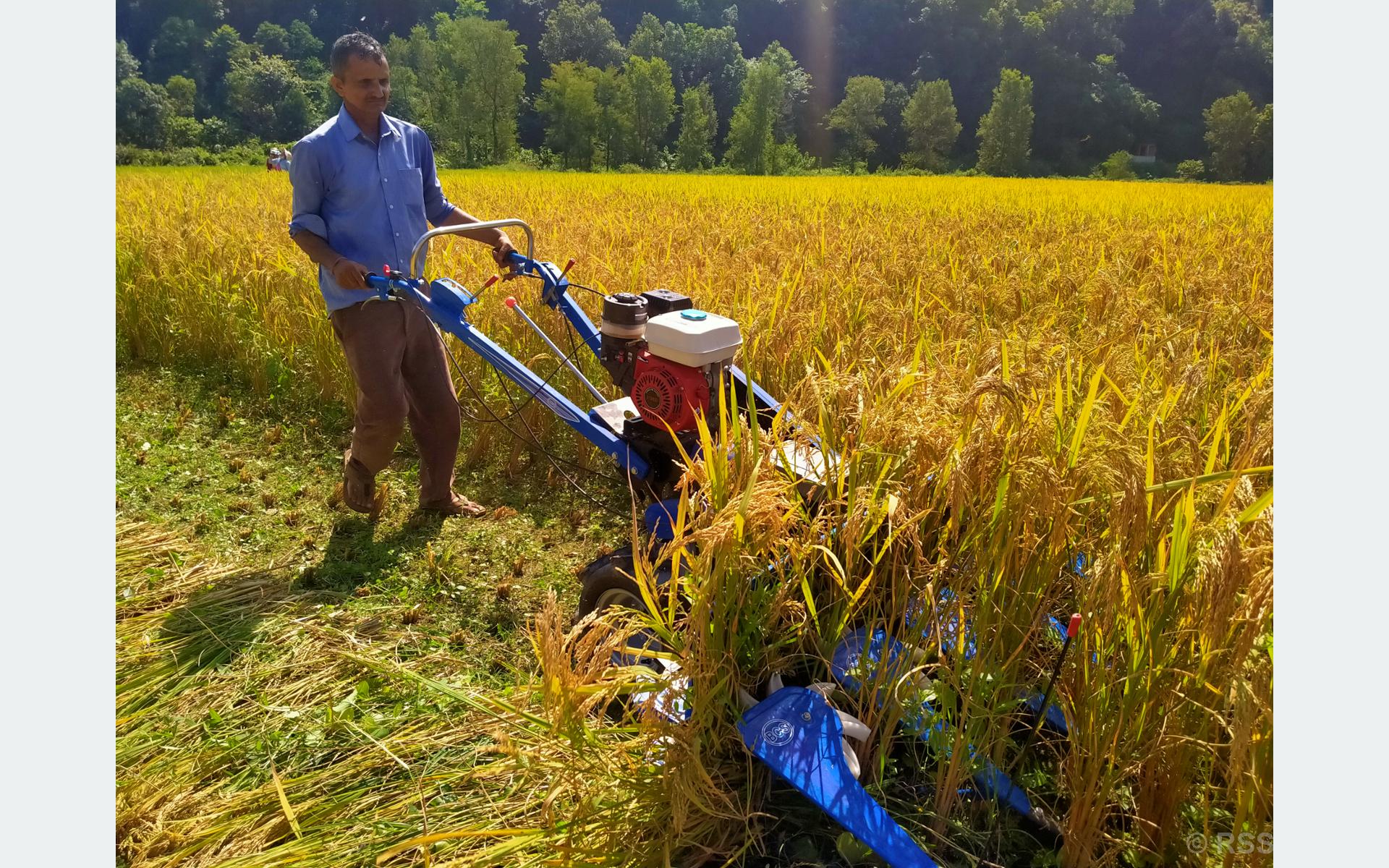
The center, which serves 11 districts in Gandaki Province, has begun using modern rice harvesting machines for the first time. According to office chief Sudip Regmi, the rising cost of agricultural production has made the adoption of modern technology necessary to ease the financial burden on farmers.
“The production costs of agricultural commodities have increased significantly in recent years,” Regmi said. “Reducing these costs will directly benefit both farmers and consumers.”
The center produces seeds of improved varieties of paddy, wheat, millet and various vegetable crops. Regmi said the shortage of agricultural labourers has become a major challenge, particularly in seed production.
“We have prioritized modern machinery and equipment because hiring labourers significantly increases production costs,” he said. “Recently, we introduced a rice reaper that can harvest a large area in a short period.”
According to Regmi, the machine can harvest rice from three ropanis of land in just 10 to 15 minutes, making the process faster and more economical. Work that would otherwise take an entire day can be completed in approximately an hour, saving considerable time and labour.
He added that production costs could be reduced by nearly 50 percent if farmers could overcome the shortage of paid labourers during the rice harvesting season.
The machine also cuts paddy plants evenly at a uniform height, making it easier to collect and bundle the straw after harvesting.
Regmi said the center expects farmers’ groups, cooperatives and agricultural enterprises engaged in seasonal farming to benefit from the technology, particularly through reduced production costs and improved efficiency.
The center currently produces paddy seeds commercially on 22 ropanis of land within its premises and an additional 83 ropanis in Baguwa, Waling-1. It produces improved rice varieties, including Ramdhan and Hardinath.
The seeds are sold and distributed after undergoing the required production and processing procedures.






Comment