




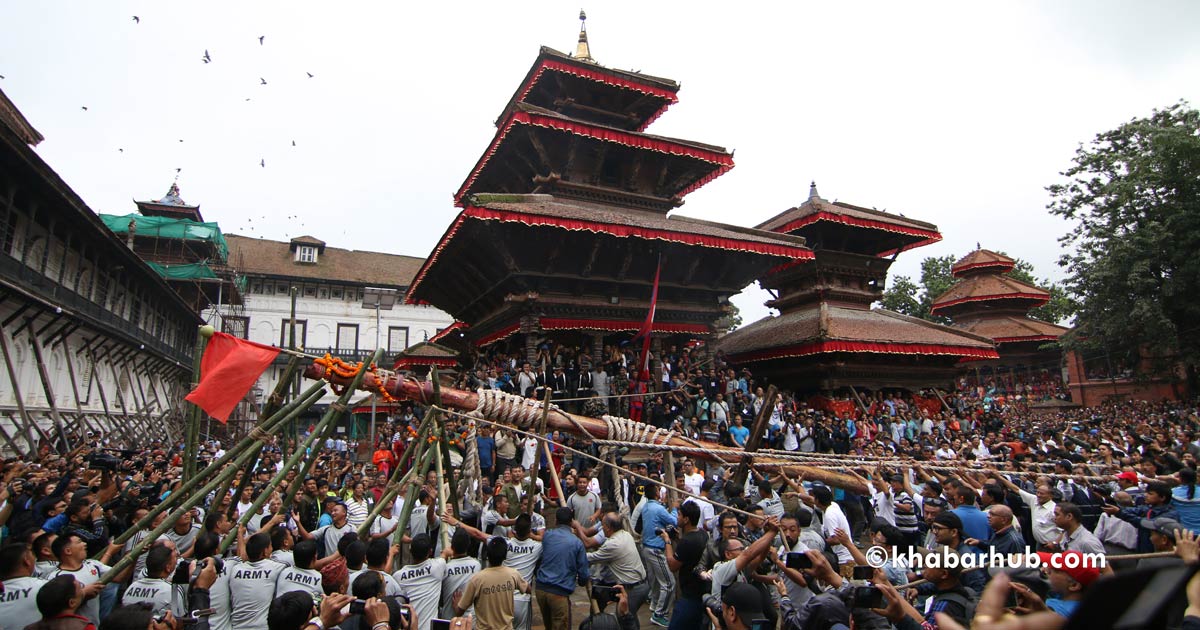
KATHMANDU: The Indrajatra festival is being celebrated today with traditional rituals and worship of Indra, the god of rain and prosperity.
The festival, celebrated annually on the Chaturdashi of Bhadra Shukla, is observed in Kathmandu, Lalitpur, Bhaktapur, Dhulikhel, Dolakha, and other parts of the country. Beginning on the Dwadashi of Bhadra Shukla, the festival formally starts with the ritual erection of a lingo bearing the rainbow flag in front of Hanumandhoka. It continues for eight days with various dances, songs, chariot processions, and the worship of deities.
The lingo (pole) erected on the Dwadashi of Bhadra Shukla is known as Indradhwajotthan. Bhairav is worshipped at its base. Indrajatra is traditionally celebrated as a festival commemorating victory over enemies and is also regarded as an occasion to seek strength through the worship of the rainbow flag.
According to tradition, a tree selected through Tantric rituals in the Nala Community Forest of Bhaktapur is cut down on the day of Bhadra Shukla Dwitiya. The tree, which is symbolically touched by a goat as part of the ritual, is then brought to the Kathmandu Valley. After being brought into the Valley, it is kept at Bhotahiti overnight, and the Indradhwaja lingo is ceremonially prepared on Ekadashi.
One of the major attractions of Indrajatra is the chariot procession of Ganesh, Bhairav, and Kumari, the living goddess. There is a tradition of the President observing the procession from the Gaddi Baithak at Hanumandhoka. During the monarchy, the same tradition was followed by the king.
After the Indradhwaja lingo is erected, various traditional dances are performed throughout the festival, including Bhakkunach, Mahakaal Nach, Lakhenaach, Dashavatar, and Pulukisi, which represents Airavata, the elephant associated with Indra.
According to religious scholar Prof. Dr. Devmani Bhattarai, the Indra flag is traditionally lowered on the eighth day after it is erected, on Ashwin Krishna Chauthi. He said the flag is lowered at night under the Bharani Nakshatra, in accordance with the classical tradition referred to as “Bharanyam Nishi Patayet.”
On this occasion, devotees also gather at Indradaha in Dahachowk, west of the Kathmandu Valley. They observe an overnight vigil, take a ritual bath on the full moon day of Bhadra Shukla, and participate in the associated fair.



Comment