




Nepal is at a crossroads, shifting its geopolitical position. Nepal claims to be a “vibrant bridge” rather than a buffer state between the two giants, but after the Gen-Z movement, it turned into a superpower vassal state, creating an existential crisis. This was demonstrated during the backdoor visit of the Prime Minister’s adviser to Delhi.
The bridge concept is the outcome of a Cold War mentality, choosing a balancing policy rather than bandwagoning. Nepal’s superiority complex (arising from an inferiority complex) did not accept the bandwagoning policy of following dominant powers’ rules in exchange for security or rewards. Nepal instead took the opposite extreme of balancing, inviting other states (China) to counter-push and restore equilibrium.
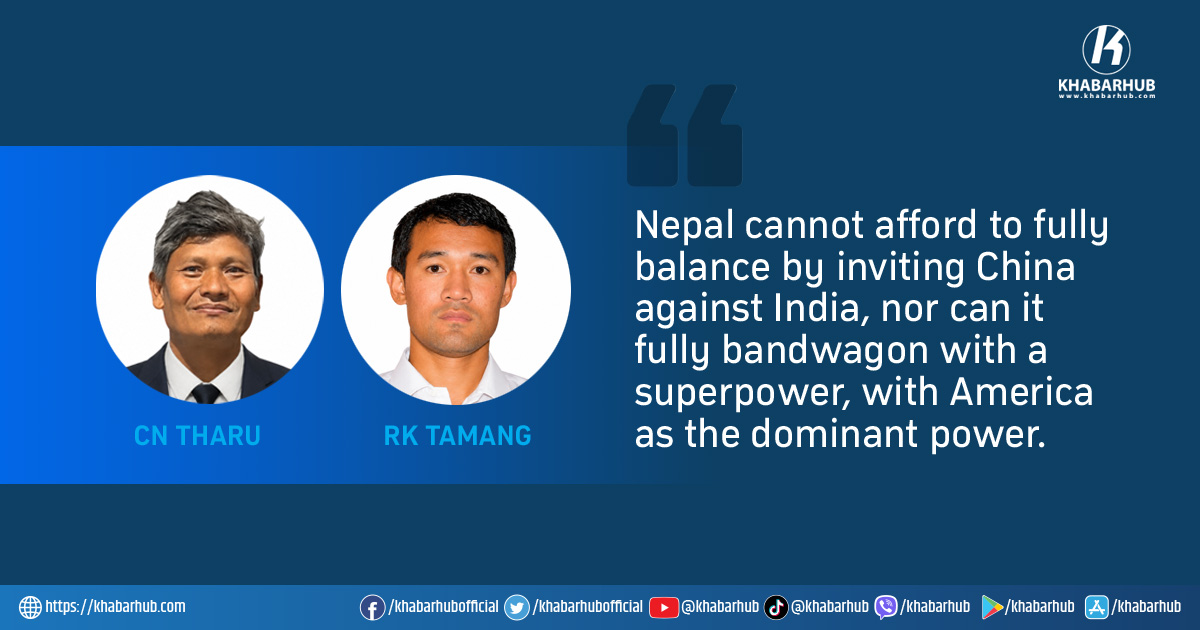
The resistance to giants such as the USA, China, and India by small states like Nepal in the 21st century has not only proved counterproductive but has also created an existential crisis. Nepal cannot afford to fully balance by inviting China against India, nor can it fully bandwagon with a superpower, with America as the dominant power. Rather, experts propose a hedging policy that cultivates economic ties with one giant while maintaining security ties with another.
Nepali public intellectual and leader Buddha Tsering Moktan advocates for a “kin-state diplomacy” between India and Nepal. This vision moves beyond traditional realist methods toward a civilizational paradigm. The power of kinship politics goes beyond the limitations of modern sovereignty, thereby restoring Nepal’s historical role as a custodian of civilizational relations between the Indic and Sinic civilizations in the 21st century.
Civilizational consciousness
Moktan critiques the Westphalian paradigm that underpins modern statehood. Following thinkers such as K.M. Panikkar and Ashis Nandy, he argues that South Asian political boundaries are colonial legacies that dismantled a historically integrated civilizational continuum.
Moktan’s vision offers a path forward in a fragmented global order where political community begins with cultural intimacy. The Himalayas, long imagined as barriers, may yet reemerge as bridges of moral and civilizational renewal.
India and Nepal are separated by modern political borders but inherently linked by an Indic civilizational philosophy and spirituality. According to Moktan, this represents a “civilizational turn” in international relations theory, in line with Samuel Huntington, Shmuel Eisenstadt, and Tu Weiming, yet departing from them by rejecting civilizational clash in favor of civilizational symbiosis.
For Moktan, kinship is not a tool of soft power; it is the ontological basis of political relations itself.
Indic model of kin-state diplomacy
Moktan asserts that sovereignty and kinship are not mutually exclusive, especially in relation to “civilizational sibling” states such as Nepal and India. This relational paradigm draws upon the Indic philosophical concepts of dharma (moral order) and sahajata (natural affinity).
This framework of political engagement reflects the moral continuity of civilization rather than the transactional calculus of statecraft. India’s foreign policy toward Nepal must shift from hegemonic paternalism to fraternal partnership, and Nepal must embrace its role as a bridge state that embodies a shared cultural heritage.
This civilization-based “kin-state diplomacy” seeks to affirm historical belonging while safeguarding modern autonomy. Moktan fuses Rabindranath Tagore’s cosmopolitan universalism with Kautilya’s pragmatic realism, producing “dharmic realism,” in which the art of statecraft becomes a moral obligation rather than a strategic vulnerability.
Civilizational bridge
Throughout history, the Licchhavi (c. 450–750 CE) and Malla (c. 1200–1779 CE) dynasties successfully served as a civilizational bridge. The political and cultural heart of these eras mediated and transmitted languages, art, religious ideas, and commerce between Indic and Sinic cultures.
For example, Pratap Malla (1641–1674 CE) minted silver coins for Tibet, negotiated commercial privileges, and maintained embassies that engaged both Mughal India and the Qing sphere.
Throughout history, China and India were undisputed hyper-economies, together accounting for over half of the world’s GDP. Nepal was neither a peripheral frontier nor a passive recipient of influence; rather, it was a civilizational conduit, actively shaping ideas.
History legitimizes Moktan’s claim that Nepal is not a buffer state caught between powers, but a kin-state that integrates two great civilizations. After 1950, anti-Indian rhetoric became intertwined with Nepali nationalism.
Kin-state models
Moktan’s vision resonates with several global analogues of cultural kinship in interstate relationships.
The Nordic Council (1952) demonstrates kin-state solidarity, where Denmark, Norway, and Sweden operate on the basis of cultural kinship, shared historical consciousness, and political cooperation without dissolving sovereignty.
Pan-Arabism persists through linguistic and cultural kinship despite state rivalries.
Pan-Africanism, by contrast, has succeeded primarily as a moral framework emphasizing shared identity, anti-colonialism, and mutual aid.
Right-wing populist movements are actively advocating a pan-European “White, Christian Europe” and are shifting from nation-state nationalism toward civilizational populism. They frame Europe not as a bureaucratic union of markets (the EU), but as an exclusive ancestral fortress rooted in an ethno-cultural matrix of White and Judeo-Christian identity.
Moktan’s model also echoes the ancient Chinese interconnected matrix of Tianxia (All Under Heaven), Sanjiao (the Three Teachings—Buddhism for inner peace and the afterlife, Confucianism for the social mind, and Taoism/Daoism for the cosmic soul), and Sanjie (the Three Worlds), imagining a moral order that integrated diversity through cultural virtue and shaped East Asia.
Nepal as a civilizational mediator
In the 21st century, Moktan envisions Nepal renewing its historical role as a mediating civilization. Situated between rising global powers, Nepal can model civilizational pluralism and ethical sovereignty, asserting independence not through isolation but through service as a cultural and moral interlocutor between Bharata and Zhongguo.
Moktan’s kin-state paradigm transforms Nepal–Bharat relations into a civilizational dialogue grounded in shared memory, mutual respect, and ethical interdependence. Reinterpreting history through a moral lens, Moktan positions Nepal not as a small state surviving in the shadow of great powers, but as a custodian of civilizational balance in South Asia.
Moktan’s vision offers a path forward in a fragmented global order where political community begins with cultural intimacy. The Himalayas, long imagined as barriers, may yet reemerge as bridges of moral and civilizational renewal.






Comment