




Nepal stands at a defining strategic moment, the crossroads of history. For more than three decades, the country has experienced repeated political transitions, yet genuine national transformation has remained elusive.
The current administration, armed with an record parliamentary mandate and high public expectations, has perhaps the greatest opportunity since 1990 to change this trajectory. Whether it succeeds will determine if Nepal finally enters an era of strategic stability or once again descends into strategic drift or another cycle of political uncertainty.
Consecutively “National Strategic Confidence”—vital for Nepal—grows directly from political stability, institutional credibility, economic resilience, effective governance, and a shared national vision. Nepal urgently needs this strategic confidence because national credibility policy cannot succeed without strong solidarity and assurance at home.
Ultimately, only a confident nation can pursue an independent, consistent, and resilient national policy, making this domestic trust the foundational bedrock upon which Nepal must build its international engagement.
Nepal’s Democratic Journey: Four Phases of Political Transition
Nepal’s political evolution/transition since the restoration of democracy from 1990 can be understood through four distinct phases: “expectation and aspiration”; “resistance” both geopolitical and structural; “strategic confusion”, and finally, the choice between “strategic breakthrough” for success or “strategic breakdown” with another national crisis.
The Politics of Expectation: Three Decades of Democratic Aspirations
The first period generated extraordinary optimism. The restoration of democracy with the 1990 Constitution establishing a multi-party democracy and constitutional monarchy, King Gyanendra dismisses the government, declares a state of emergency, and assumes absolute power in February 2005, Mainstream political parties (Seven Party Alliance) and Maoist rebels sign a 12-point understanding in Delhi: November 2005, the 2006 Comprehensive Peace Agreement following Janandolan-II, transition to Federal Republic in 2008, the Constitution of 2015, the Gen Z uprising, though not for the first time, the emergence of the current two-thirds government all vowed a new political beginning.
Rather, it serves as a decisive phase that offers the first indication of the direction in which the government intends to lead the country. For this reason, the first hundred days are best understood as an initial test of policy priorities, leadership style, governance, and administrative culture.
Citizens expected accountable governance, economic opportunity, institutional reform, and a state capable of delivering results. Each milestone raised hopes that Nepal had finally found a stable political destination. But in vain presented three constitutions; the 9 November 1990, promulgated by King Birendra, which ended the absolute Panchayat system and introduced a multiparty parliamentary democracy with a constitutional monarch.
The 2007 interim constitution, which brought the warring factions the Maoists into the democratic framework replaced by the second constituent Assembly 2015 constitution embarking as a federal secular republic.
The Dynamics of Strategic Resistance (Political Change Meets Structural Resistance)
Yet every wave of optimism encountered a second phase: “strategic resistance”. Nepal’s transformation has been constrained by both external and internal forces. In Nepal, every political shift carries the seeds of its own immediate resistance, ensuring that no political settlement is ever truly final. These institutional transitions trigger strategic counter-mobilizations by marginalized or rival factions, as seen in the immediate after the declaration of the 2015 constitution instantly triggered intense Madhesi and Tharu resistance and border blockades due to representation grievances.
The frequent coalition shift when swapping or reshuffling the cabinet, the newly displaced parties instantly launch street agitations or parliamentary obstructions.
Geopolitically, the country has had to navigate the competing interests of China, India, and the U.S. led west while preserving its strategic autonomy. Domestically, however, the greater challenge has often been structural rather than political. Entrenched political interests, bureaucratic inertia, weak state institutions, fragmented governance, and deeply embedded patronage networks have repeatedly resisted meaningful reform. Governments changed, constitutions were rewritten, and new political coalitions emerged, but the underlying institutions that citizens depended upon evolved far more slowly.
The Erosion of Public Expectations
This structural resistance has steadily diminished public expectations. Many Nepalis have witnessed successive governments promising prosperity, employment, better public services, and accountable governance, only to encounter the same obstacles: delayed infrastructure projects, politicized public institutions, inconsistent policy implementation, institutional corruption, weak service delivery, and limited accountability for poor performance.
The frequent turnover of governments has often interrupted long-term reforms before they could take root, while the politicization of the bureaucracy has reduced institutional continuity. As a result, reform has become episodic rather than sustained.
The consequence is not merely slower economic development but a gradual erosion of public confidence. When ambitious policies repeatedly fail to translate into visible improvements in daily life, citizens begin lowering their expectations of what the state can realistically deliver.
This helps explain why increasing numbers of young Nepalis seek opportunities abroad, why trust in public institutions remains fragile, and why each new political transition is often met with cautious hope rather than enduring confidence. Changing governments proved easier than changing the system itself; the real challenge has always been transforming the institutions, incentives, and governance culture that shape national outcomes.
The Era of Strategic Confusion
This resistance gave birth to a third phase: “strategic confusion”. Rather than pursuing a coherent national vision, successive governments have largely reacted to immediate political pressures. Foreign policy has often oscillated instead of following a consistent long-term strategy, while domestic politics has prioritized coalition survival over state-building.
Governments increasingly became reactive rather than strategic. Coalition arithmetic replaced long-term national planning. Foreign policy oscillated between competing pressures instead of pursuing a coherent national strategy. State institutions focused on managing crises rather than preventing them. Politics became tactical; governance lost its strategic direction.
Strategic confusion in Nepal’s political transition has unfolded through repeated cycles of hope followed by national crisis. The restoration of democracy in 1990 was soon overshadowed by the Maoist insurgency, which erupted in 1996 against a democratically elected government and ultimately claimed more than 17,000 lives while profoundly weakening state institutions.
The 2006 People’s Movement and the Comprehensive Peace Agreement created another historic opportunity, yet the First Constituent Assembly, elected in 2008 with a strong public mandate to draft a new constitution, was dissolved in 2012 after failing to produce one despite four extensions of its tenure. Even after the Constitution of 2015 established a secular federal democratic republic, expectations of political stability and effective governance remained largely unmet.
Frequent changes of government, coalition instability, inconsistent policy implementation, bureaucratic inertia, politicization of public institutions, weak administrative capacity, corruption, and patronage politics repeatedly prevented governments from translating political change into institutional transformation and improved public services.
As a result, citizens increasingly witnessed governments changing while the governance system itself remained largely unchanged. The lesson from the past three decades is therefore clear: Nepal’s principal challenge has not been a lack of political change but a failure to build capable institutions that can consistently implement reforms, deliver public services, and sustain long-term national development.
It is against this historical backdrop that the new administration is being judged. The public expects not simply another government with a new political mandate, but one capable of breaking the cycle by transforming political commitment into durable institutional reform, effective governance, and measurable improvements in citizens’ lives.
The democratic mandates needed in a national crisis.
The First 100 Days: From Public Mandate to Strategic Direction
Nepal’s new administration has reached a decisive crossroads. Like previous political transitions, this period reflects the convergence of public expectations, organized resistance, and rising strategic confusion.
Marking the completion of its first 100 days and 100 foundational objectives, Rastriya Swatantra Party (RSP) government led by Prime Minister Balen Shah led new administration now faces its most consequential moment yet: a fragile balancing act between a historic breakthrough and a total breakdown. A decisive crossroads where the government must balance high public expectations against rising public confusion and organized resistance.
The strategic outcome of this high-stakes period will depend on the administration’s ability to convert its aggressive anti-corruption momentum into stable, rules-based institutional governance. If the government manages to successfully navigate the thin line between an institutional breakthrough and a systemic breakdown, it can institutionalize its digital and economic policy reforms, cement long-term stability, and permanently dismantle entrenched political patronage.
Conversely, failing to overcome the overlapping forces of bureaucratic and structural resistance will stall its ambitious roadmap, triggering a breakdown that deepens societal confusion and risks fracturing the administration’s populist.
The first 100 days of any new government are often viewed as an indicator of its early success or failure. From a broader strategic perspective, however, this period is not intended to provide a final assessment of a government’s performance.
Conversely, a failure to defeat the overlapping forces of bureaucratic and structural opposition risks a breakdown, fracturing the government’s populist mandate and stalling Nepal’s national roadmap once again.
Rather, it serves as a decisive phase that offers the first indication of the direction in which the government intends to lead the country. For this reason, the first hundred days are best understood as an initial test of policy priorities, leadership style, governance, and administrative culture.
A Historic Opportunity to Redefine Governance
This is more than a mere change of government. It represents the first real test of an alternative governance culture that citizens have long sought-after decades of political instability, weak governance, institutional corruption, excessive politicization, and bureaucratic inertia. The public did not vote simply for a change of government; they expected a change in the political system and the governance model or the way the country is governed.
The current government possesses political legitimacy, parliamentary strength, and a public mandate that few administrations have enjoyed. These advantages create an opportunity not merely to govern but to redefine governance itself. However, mandates and trust alone do not produce transformation or achievements. They merely create the conditions under which transformation becomes possible only if it can be translated into institutional reform, effective public service delivery, transparency, professionalism, and results-oriented administration.
From Political Management to Strategic Governance
From a strategic perspective, the government’s first few months have demonstrated both promise and warning signs. Political energy has been invested in establishing authority and managing competing expectations, but the country now requires a shift from political management to strategic governance. Citizens are no longer impressed by rhetoric.
They are looking for institutional/administrative reform, economic revival, good governance through better public services, predictable foreign policy, and restored confidence in the state. These pillars will ultimately determine the government’s political credibility over the next five years.
The government has already sent several important signals. Administrative restructuring, the review of ministries, investigations into public assets, expansion of digital public services, a strong public commitment to combating corruption, and decisions challenging long-established administrative practices all indicate that this government does not intend to preserve the status quo.
Nevertheless, the true measure of these initiatives lies not in the policies announced but, in their implementation, institutional impact, and administrative capacity. The challenge is therefore no longer to formulate new policies, but to demonstrate the ability to implement existing commitments effectively. The success of any reform should be measured not by declarations but by tangible institutional outcomes.
The Choice Between Strategic Breakthrough and Strategic Breakdown: Implementation Will Determine Success
History suggests that governments often fail not because they lack political power but because they lack strategic objectives. Nepal has repeatedly mistaken political success for national success. Winning elections, forming governments, or commanding parliamentary majorities are only means; they are not the end. The true measure of success lies in whether institutions become stronger than personalities, policies outlast governments, and national interests prevail over partisan calculations.
The choice before Nepal is therefore straightforward. The government can pursue a strategic agenda that strengthens institutions, restores public trust, modernizes governance, and positions Nepal confidently within an increasingly competitive geopolitical environment. Or it can become another administration consumed by short-term political calculations, leaving the underlying structural problems untouched.
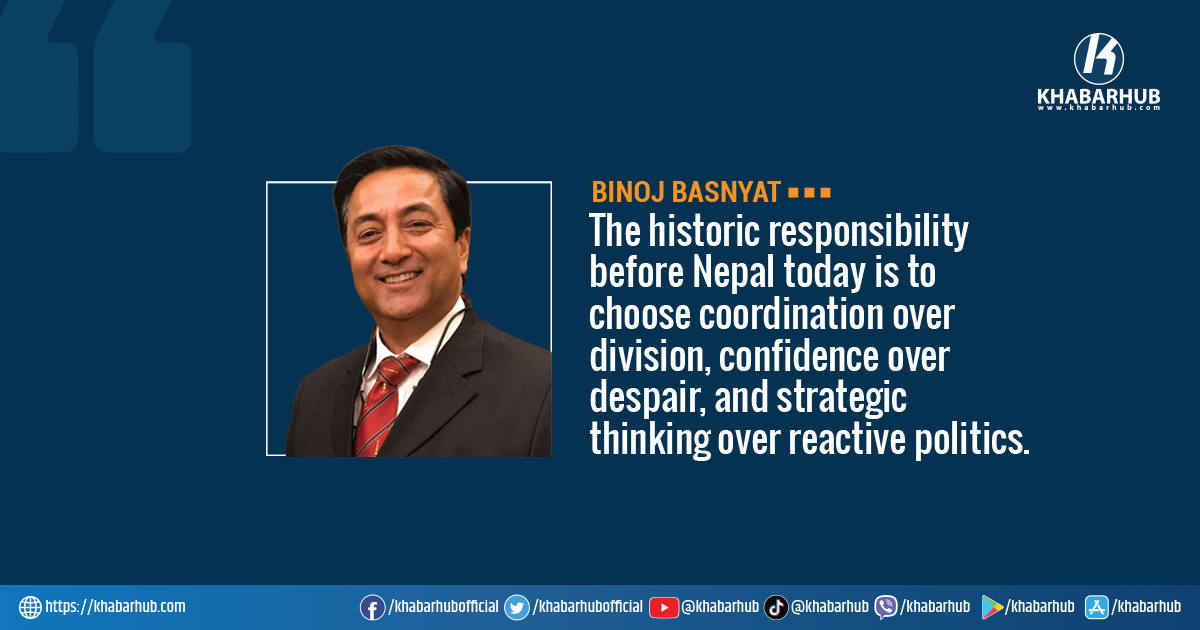
The historic responsibility before Nepal today is to choose coordination over division, confidence over despair, and strategic thinking over reactive politics. If Nepal can effectively leverage its geography, capabilities, and opportunities, strategic success will not remain merely a possibility—it will become a national necessity.
This critical milestone represents a high-stakes crossroads where the state must balance surging public expectations against systemic, organized resistance and deep-seated political confusion. Moving past the historical cycle of rapid, fragile power shifts, the administration’s core challenge is to convert its intense anti-corruption momentum and institutional reform agenda into a lasting rule-based governance model.
If the administration successfully navigates this precarious boundary, it can institutionalize its digital and economic policies, dismantle entrenched patronage networks, and achieve a historic breakthrough. Conversely, a failure to defeat the overlapping forces of bureaucratic and structural opposition risks a breakdown, fracturing the government’s populist mandate and stalling Nepal’s national roadmap once again.
The coming months will determine whether Nepal’s latest political transition becomes the country’s long-awaited crowning achievement or merely another chapter in its recurring cycle of instability. The opportunity is historic. So too is the responsibility.
The question today is not merely about changing a government; it is about transforming the nation. If the necessary transformation does not take place today, the nation may have to pay a profound substancial strategic retribution. Continuously postponing change does not only mean losing opportunities; it risks pushing Nepal’s future into greater volatility, uncertainty, complexity and ambiguity.
However, Nepal’s journey is not merely a story of expectations, resistance, confusion, or crisis; it is also a journey of possibility, confidence, and strategic success. The need of the hour is not to remain trapped in past structural constraints and strategic ambiguity, but to pursue a “Strategic Breakthrough” through a clear national vision, capable institutions, strategic structures, and long-term strategic thinking.
The core objective of Nepal’s national interest is not to move toward fragmentation or decline, but to build “National Strategic Confidence” by bringing together all stakeholders, sectors, and forces of society. Only such confidence can strengthen Nepal’s sovereignty, stability, prosperity, and international standing.
The historic responsibility before Nepal today is to choose coordination over division, confidence over despair, and strategic thinking over reactive politics. If Nepal can effectively leverage its geography, capabilities, and opportunities, strategic success will not remain merely a possibility—it will become a national necessity.
(Basnyat is a Maj. Gen. (Retd.) of the Nepali Army and writes on international affairs and geopolitical strategy. He is also a researcher affiliated with Rangsit University in Thailand)





Comment