




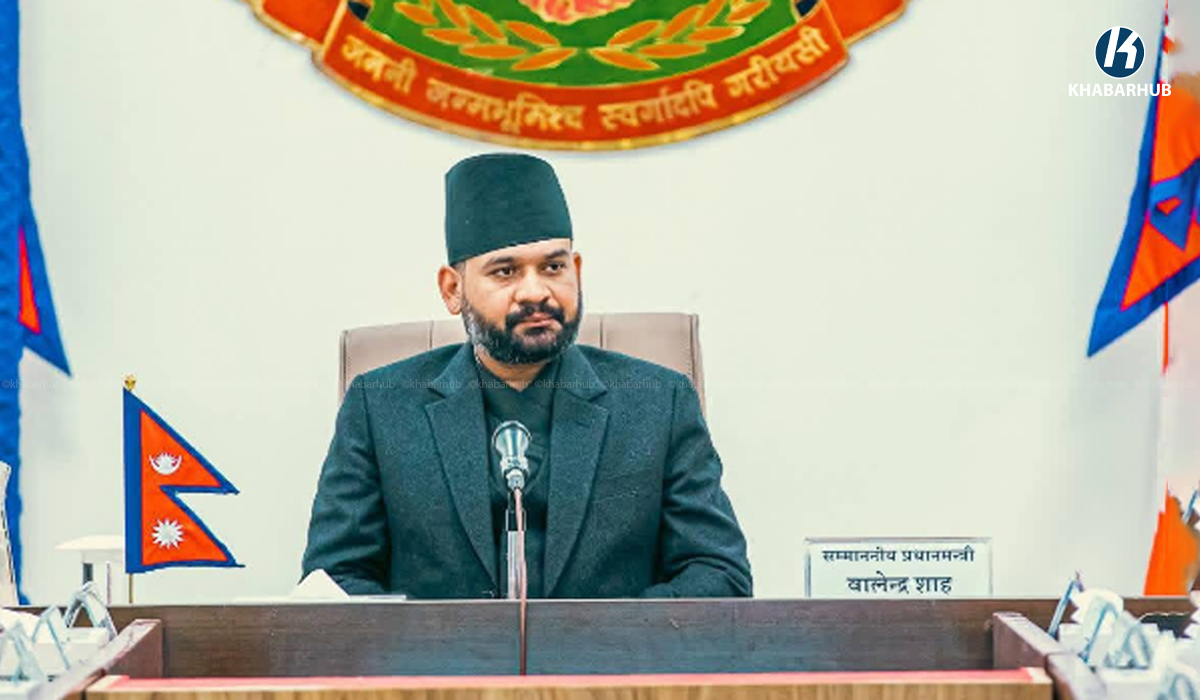
KATHMANDU: Since assuming office on March 28, Prime Minister Balendra Shah has significantly altered the working culture at both Singha Durbar and Baluwatar, reducing the long-standing practices of lobbying, backdoor influence, and informal “setting,” according to official sources.
Officials say the number of individuals visiting the Prime Minister for favors, recommendations, or informal dealings has sharply declined.
Since taking office, Shah has not formally accepted ceremonial offerings such as garlands or khadas at Singha Durbar or Baluwatar. His secretariat also confirmed that he has publicly urged visitors—including friends—not to bring such items or approach him for personal favors.
Employees at the Office of the Prime Minister and Council of Ministers say intermediaries and lobbyists no longer have access to the Prime Minister.
“Even earlier, during the tenure of Sushila Karki, such practices had been discouraged. But after Balen Shah became Prime Minister, the trend has declined even further,” an official said, adding that even leaders from ruling parties now visit less frequently.
According to officials, Shah has prioritized digital governance, encouraging people to submit grievances through online platforms instead of physical visits, further reducing crowding and influence-seeking behavior.
Secretariat members claim that access for individuals driven by vested interests has been completely restricted. “There is no place for garlands, lobbying, or middlemen. We are focused on clean governance,” a source said, adding that the government is working toward delivering results within three months.
Strict directives to civil servants
The Prime Minister has also issued clear instructions to government employees nationwide to remain in their offices during working hours.
He has held multiple meetings with Chief Secretary Suman Raj Aryal and other senior officials, directing them to ensure discipline and efficiency. Chief District Officers across the country have also been instructed through digital platforms to enforce the same.
Officials say employees are now required to be present from 9 am to 5 pm, with stricter monitoring in place.
“If someone fails to comply, they will first be warned, and repeated violations will lead to action as per rules,” a source said.
However, the government has not shown immediate intent to reshuffle secretaries or remove officials, as long as they comply with directives and maintain service delivery.
Ministers told to avoid unnecessary public appearances
The government has also instructed ministers to limit participation in non-essential events.
In the past, ministers were often criticized for attending ribbon-cutting ceremonies and social events. Taking note, Prime Minister Shah and Rastriya Swatantra Party chair Rabi Lamichhane have directed ministers to prioritize their official responsibilities.
Party General Secretary Kabindra Burlakoti said ministers and lawmakers have been instructed to follow discipline and attend events based on necessity and priority.
Sources say ministers have been warned against misuse of state resources and unnecessary public engagements.
A tightly managed daily routine
Prime Minister Shah begins his day early, leaving Baluwatar before 9 am and arriving at Singha Durbar ahead of office hours. He holds morning briefings with the Chief Secretary and other officials as required.
His schedule includes meetings with government officials, security agencies, provincial representatives, and diplomatic stakeholders. According to sources, he often works until 6–7 pm and sometimes up to 15–20 hours a day.
Officials say Shah has adopted a communication style that emphasizes listening. “He speaks briefly—around five to seven minutes—and focuses more on hearing others, taking notes, and recording discussions,” a secretariat member said.
Beyond office hours, Shah continues reviewing governance issues from Baluwatar. Sources also indicate that his spouse, Sabina Kafle, provides support in managing broader governance concerns.
With a focus on discipline, digital governance, and reduced political patronage, the Shah administration appears to be attempting a shift toward a more structured and results-oriented governing style.





Comment