




This Earth Day (April 22), under the theme “Our Power, Our Earth”, Nepal stands at a familiar yet uncomfortable crossroads. We contribute less than 0.1 per cent to global greenhouse gas emissions, yet remain among the most climate-vulnerable countries. Beyond statistics, climate change in Nepal is not abstract—it is lived daily.
It is the farmers of the Terai watching untimely rains destroy their harvests. It is the drying springs in the hills. It is rivers carrying increasing loads of plastic waste. It is the gradual degradation of soils that have sustained livelihoods for generations.
Local Solutions Rooted in Nature
Amid these challenges lies a powerful strength—local innovation.
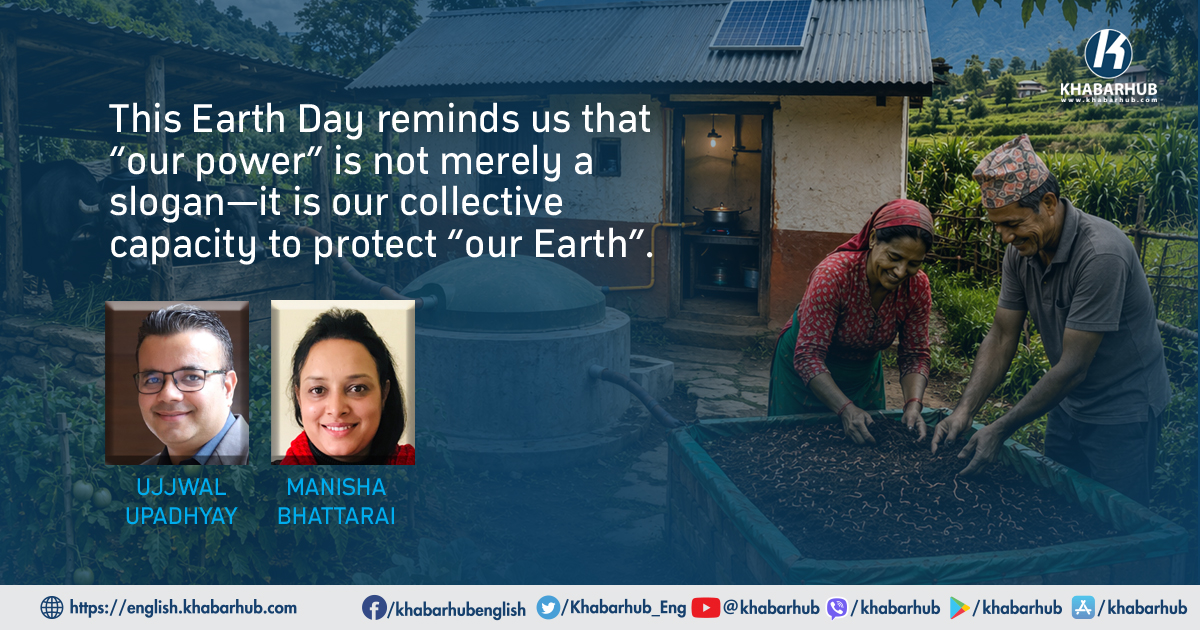
In rural Nepal, where soil degradation and climate pressures are intensifying, nature-based solutions are proving effective. Vermicomposting using tiger worms (Eisenia fetida) has emerged as a practical, climate-smart approach. It converts organic waste into nutrient-rich compost, reduces methane emissions, and restores soil health.
Importantly, one vermibed can reduce up to 12.5 tonnes of carbon annually while producing up to 10 tonnes of high-quality compost. This compost not only supplies essential nutrients to soil and crops but also gradually revives soil structure, fertility, and biological life.
Similarly, biochar—produced from agricultural residues such as straw—acts as a valuable nutrient catalyst. It enhances nutrient uptake, improves soil potassium levels, and supports long-term carbon sequestration.
Practical Pathways for Farmers
Field experience shows that farmers are not resistant to change—they are cautious. Many fear yield reductions when shifting entirely to organic systems. However, gradual transition strategies—such as combining compost with chemical fertilisers—have proven effective in encouraging adoption.
This underscores a critical lesson: climate solutions must be practical and adaptable, not merely idealistic.
Clean Energy from Local Resources
In a world facing geopolitical tensions, fossil fuel constraints, and a growing carbon crisis, climate-friendly energy has become inevitable. Nepal, however, holds solutions within its own communities. Livestock-based biogas systems convert manure into clean energy, reducing emissions and dependence on firewood, thereby helping to prevent deforestation and human–wildlife conflict.
At the same time, Nepal’s progress in hydropower presents an opportunity to expand clean electricity use across cooking, transport, and industry—significantly reducing reliance on fossil fuels.
Children and Schools: Building Future Resilience
Long-term resilience depends on education and awareness.
Schools across Nepal are becoming centres for climate action and disaster preparedness. Children are learning waste segregation, participating in eco-clubs, and engaging in disaster risk reduction (DRR) practices.
Because safeguarding the Earth will not come from grand declarations alone. It will come from clean rivers, healthy soils, empowered communities, renewable energy, and informed citizens.
These are not just activities—they are investments in a generation that will face even greater climate challenges. When children take these lessons home, they influence families and communities, turning awareness into action.
Waste, Workers, and the Circular Economy
Urban Nepal generates over 1,400 tonnes of solid waste daily, much of it unmanaged. Yet behind this crisis lies an often-overlooked workforce—informal waste workers—who sustain the recycling system.
Their contributions are critical. Recycling can save up to 95 per cent of energy for certain materials and reduce 1.5–3 tonnes of CO₂ emissions per tonne of plastic recycled. Strengthening their safety, awareness, and market access can improve both environmental outcomes and livelihoods.
Moreover, effective waste management is essential for protecting rivers. Plastic pollution flowing downstream threatens biodiversity, water quality, and human health.
In ecologically sensitive regions such as biodiversity-rich national parks—Chitwan, Parsa, Bardiya, Banke, and Shuklaphanta—this is not just an environmental concern but a direct threat to ecosystems and local economies.
The Power of Community
At the heart of all these efforts lies a simple truth: community participation is fundamental.
No policy, however well designed, can replace the role of people on the ground. Farmers, waste workers, teachers, and students all contribute to Nepal’s climate response. Supporting them is not optional—it is essential.
A Collective Responsibility
This Earth Day reminds us that “our power” is not merely a slogan—it is our collective capacity to protect “our Earth”.
In Nepal, that power already exists—in communities, local innovation, and the willingness to adapt. The real challenge is scaling and strengthening these efforts. Because safeguarding the Earth will not come from grand declarations alone. It will come from clean rivers, healthy soils, empowered communities, renewable energy, and informed citizens.
Our strength lies in our people. And together, that strength can protect our Earth for generations to come.
(Ujjwal Upadhyay is Project Coordinator at Project Climate Action under Konrad Adenauer Stiftung, Political Dialogue Asia Program; and Manisha Bhattarai is a Consultant, GESI and Community Outreach Specialist at Project Climate Action under Konrad Adenauer Stiftung, Political Dialogue Asia Program)






Comment