





KATHMANDU: Questions are increasingly being raised from multiple quarters regarding the working style of Home Minister Sudan Gurung.
Concerns have been voiced by all three security agencies, civil servants, lawmakers from his own party, government ministers, civil society members, and analysts. Critics say Gurung’s approach appears immature, often exceeding his mandate, with actions described as unnecessary and beyond his authority.
Earlier, lawmakers Madhu Chamlagain (Kavrepalanchok-1) and Ashika Tamang (Dhading-1) had raised concerns about the Home Minister’s conduct with the Prime Minister. Sources also claim that senior officials from all three security agencies have lodged complaints about his working style.
Gurung has been criticized for allegedly interfering in areas under the Ministry of Physical Infrastructure, taking punitive actions against security agency chiefs in the name of inspections, and issuing directives beyond his jurisdiction.
Party sources say some ministers have also complained to the Prime Minister, accusing Gurung of encroaching on other ministries’ mandates in pursuit of popularity. A member of the Prime Minister’s secretariat said concerns had been raised from the beginning, with allegations that the Home Minister has been acting without proper coordination.
Following mounting criticism, Prime Minister Balendra Shah and Rastriya Swatantra Party (RSP) Chair Rabi Lamichhane are preparing to hold discussions on the matter. According to sources, the Home Minister may be formally advised to adhere to his jurisdiction, with the possibility of further action if such behavior continues.
However, sources close to the Prime Minister say there is currently no plan to remove Gurung, though he may be warned. “If he continues to act beyond his jurisdiction, action will be taken,” the source said.
Gurung’s appointment itself had drawn reservations from some second-tier party leaders, who had opposed his nomination as Home Minister. He was later proposed for the role by Prime Minister Balendra Shah.
The Prime Minister is also said to be under pressure due to the controversy surrounding Gurung’s working style.
Party signals possible action
Senior leaders of the RSP say no minister or lawmaker is above their defined jurisdiction. Party General Secretary Kabindra Burlakoti emphasized that all officials must understand and operate within their legal responsibilities.
“We have already instructed our colleagues to clearly understand the duties, rights, and responsibilities of both MPs and ministers. So far, no formal complaint has been received, but if it is, we will take appropriate steps,” Burlakoti told Khabarhub.
Party sources indicate that RSP Chair Lamichhane and other leaders are engaged in serious discussions on the issue. The party is reportedly inclined to issue a warning and give the Home Minister an opportunity to improve his working style.
Party Treasurer Lima Adhikari also said that the party has previously recalled ministers who failed to perform within their jurisdiction and may consider similar action if necessary.
“The Prime Minister has already recalled a minister based on recommendations from the Disciplinary Commission. If serious concerns arise in other cases, the party will act accordingly. However, no such serious complaint has been formally registered so far,” she said.
Meanwhile, party sources say that complaints against the Home Minister have been raised multiple times. As these concerns have now reached Prime Minister Balen, both the Prime Minister and party leadership are said to be preparing to caution the Home Minister.
Home Minister’s working style undermining public trust: Former DIG Hemanta Malla
Former Deputy Inspector General (DIG) Hemanta Malla has said that each ministry and government body has clearly defined responsibilities, and the Home Minister’s working style should be improved to remain within those limits.
“All constitutional bodies, security agencies, and ministers have their own jurisdictions. If a road project is delayed, it may affect traffic, and public dissatisfaction is natural. However, it is not the Home Minister’s role to directly pressure contractors to complete work within a set deadline,” Malla said.
He stressed that such matters should be addressed through the concerned ministry and relevant authorities. “Issues related to road construction should be discussed with the Department of Roads and other responsible agencies. Visiting authorities and directing them to ‘open files’ raises serious questions about jurisdiction,” he added.
Malla further criticized what he described as unnecessary public appearances and “stunt-like” actions. “The Home Minister must act with maturity and within his mandate. Each ministry has its own responsibilities, and overstepping them creates confusion,” he said.
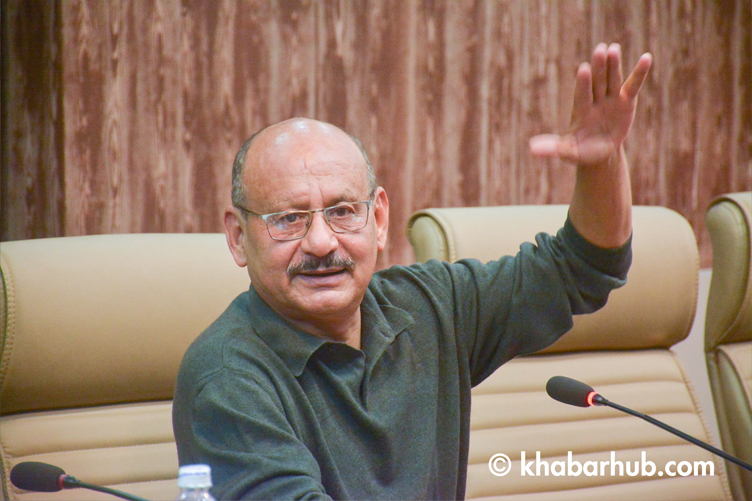
According to Malla, if a ministry is not performing, the appropriate course is to consult the concerned minister or escalate the issue to the Prime Minister—not to intervene directly. He warned that such actions could also raise questions about the Prime Minister and the government as a whole.
He also questioned the appropriateness of unscheduled inspections and late-night patrols without coordination. “While monitoring is important, it must be done within established boundaries and procedures,” he said.
Malla urged the Home Minister to clearly define his role. “At times, he appears to act like the Chief of Police rather than the Home Minister, which creates confusion among the public,” he said, adding that dignified and structured conduct is essential.
“There are proper procedures and dress codes when visiting security agencies. A minister should maintain decorum. This is not a casual visit—security institutions operate within a culture of discipline and professionalism,” he added.
Malla also warned that inconsistent behavior—sometimes acting like a contractor, sometimes like a minister—creates confusion within the police administration and other agencies. “Such actions weaken coordination and increase public distrust,” he said, calling the approach “irresponsible and questionable.”
He suggested that both the government and the National Independent Party should assess whether Gurung should continue in his role or be replaced, though he noted that this decision ultimately rests with the party.
“The concern is not to criticize, but to ensure accountability. Those in public office must act responsibly. The Home Minister leads a crucial ministry responsible for internal security and local administration across all 77 districts. This is a serious responsibility that requires sensitivity and discipline,” Malla said.
He further advised the Home Minister not to publicly pressure or reprimand police personnel. “The morale of security forces should not be undermined. Instead of public criticism, issues should be addressed through internal mechanisms and proper planning,” he added.
Wrong to act beyond law, justice, and procedure:Political analyst Indraa Adhikari
Political analyst Indraa Adhikari has said that there is ample ground to question the working style of the Home Minister, noting that his approach has also drawn criticism toward the government.
She emphasized that politics driven by revenge has no place in a democratic system and warned against the politicization of state institutions. While clarifying that her remarks are not personal criticism, Adhikari said the Home Minister’s actions appear to go beyond established rules and procedures.
“It is evident that the Home Minister has not adequately adhered to values, norms, and the defined jurisdiction of his ministry. In an effort to deliver quick results and gain popularity, he appears to have crossed institutional boundaries,” she said.
Adhikari noted that while inter-ministerial coordination is necessary, overstepping roles creates confusion. “Each ministry has its own responsibilities and authority. Although there can be overlap in certain areas, the Home Minister seems to have acted beyond his designated scope, particularly in matters such as infrastructure delays, which fall under other ministries,” she added.
She further observed that the Home Minister appears to be prioritizing visibility over routine governance and coordination. “It is not difficult to see a tendency toward populist actions at the expense of due process,” she said.
Adhikari stressed that in sensitive matters, political leadership should play a coordinating and supportive role rather than directly intervening. “The Home Minister’s responsibility is to build confidence among security agencies and guide them institutionally. Decisions regarding arrests, investigations, and enforcement must remain within the authority of professional security bodies,” she said.
She warned that direct interference in such matters undermines institutional independence. “The Home Minister does not have the authority to instruct agencies on whom to arrest or how to act in specific cases. Such actions fall outside his mandate,” she said.
According to Adhikari, excessive political involvement in security operations can create fear among citizens and erode trust in government institutions. “If security agencies are perceived as being influenced by political motives, public confidence will decline,” she cautioned.
She also raised concerns about the perception of political vendetta. “Even if there is no intention of revenge, such actions may create that impression. That is dangerous for democratic governance,” she said.
Adhikari further noted that political actors often struggle to maintain power, but warned against using state mechanisms for such purposes. “If security institutions become tools in political strategies, public distrust will inevitably grow,” she said.
Emphasizing the importance of institutional integrity, she added, “State structures must remain independent. That is a core principle people have fought for. Actions that undermine this do not ensure justice.”
She concluded by urging greater accountability and restraint. “If we are to practice responsible and civilized politics, institutions must be allowed to function within their legal mandate. Otherwise, today’s actions may invite tomorrow’s retaliation,” she said.





Comment