




The possibility of a coordinated or sequential military strike by the United States and Israel on Iran is no longer a distant, theoretical scenario. With nuclear tensions unresolved, proxy conflicts expanding, and military deployments increasing, the risk of escalation in West Asia is real.
For many in Nepal, such a conflict may appear geographically remote—another geopolitical crisis unfolding far beyond our immediate horizon. Yet history demonstrates a consistent pattern: wars in the Gulf do not remain regional. They transmit economic and strategic shocks across continents, affecting oil markets, labor mobility, trade routes, and financial systems.
If conflict erupts, Nepal will not be on the battlefield, but it will feel the consequences in fuel prices, remittance flows, food security, and overall economic stability.
Energy Security: Nepal’s Indirect Exposure
As of March 2026, Nepal remains 100% dependent on India for its petroleum product imports, primarily through the Indian Oil Corporation (IOC). All petroleum products arrive through India, not directly from the Gulf. At first glance, this may seem to insulate Nepal from Middle Eastern volatility. In reality, it deepens dependence.
Nepal’s energy imports in 2025/26 highlight both rising demand and structural vulnerability. Daily consumption stands at roughly 2.5 million liters of petrol and 5 million liters of diesel, with diesel accounting for the largest share of the import bill—about Rs 69.91 billion in the first seven months of the fiscal year—followed by petrol at Rs 38.13 billion.
A critical feature of this supply chain is infrastructure dependence: nearly 70 percent of total petroleum products enter Nepal through the Motihari–Amlekhgunj pipeline, underscoring the country’s reliance on a single transit corridor through India.
Cooking fuel demand continues to rise steadily, with liquefied petroleum gas (LPG) firmly established as the primary household energy source. Nepal imports approximately 45,000–46,000 tons of LPG each month, with total imports reaching around Rs 31.85 billion in the first seven months of 2025/26.
For Nepal, this reality has direct implications. The relationship with India becomes central not only diplomatically but operationally: ensuring continuity of fuel supplies, maintaining cross-border trade flows, facilitating financial transactions, and supporting evacuation logistics if required. A West Asian conflict thus reinforces a structural truth: Nepal’s economic security is closely tied to India’s strategic stability.
Although supply has remained broadly stable, minor shortages in March 2026 point to the system’s sensitivity to disruptions. At the same time, Nepal has begun modest diversification with the introduction of liquefied natural gas (LNG) imports from India under a five-year agreement, marking a gradual shift in the energy mix.
Despite these developments, price and supply stability remain fragile. In March 2026, the Nepal Oil Corporation raised petrol prices by Rs 15 per liter and diesel and kerosene by Rs 10 per liter in response to global market pressures.
More concerning is the limited buffer capacity: as of mid-March 2026, Nepal holds fuel reserves sufficient for only about 10 days if imports are disrupted. This narrow margin underscores the country’s exposure to external shocks and reinforces the urgency of building greater energy resilience.
The country is facing high import bills due to rising demand and global price volatility, with petroleum products accounting for over 16 percent of total imports.
Any escalation involving Iran would likely affect the Strait of Hormuz, through which a significant portion of global oil supplies pass. Even limited disruption—or the perception of risk—can push global oil prices sharply upward.
India, as a major energy importer, would face rising import costs, currency pressure, and domestic inflation. These pressures would inevitably transmit to Nepal. The consequences would be immediate: higher fuel prices, increased transportation costs, rising food prices, and pressure on foreign exchange reserves.
Unlike larger economies, Nepal has limited fiscal capacity to absorb prolonged shocks. It lacks extensive strategic petroleum reserves and diversified supply routes. As a result, an external conflict quickly becomes a domestic inflationary crisis.
Nepal’s energy landscape reveals three critical trends: a high degree of supply route vulnerability, a growing trade imbalance, and a gradual shift toward electrification. The country remains heavily dependent on India for fuel imports, while India itself sources around 85 percent of its fuel from global markets, much of it transiting through sensitive chokepoints such as the Strait of Hormuz—making Nepal indirectly exposed to external disruptions.
At the same time, rising fuel imports continue to be a primary driver of Nepal’s widening trade deficit. However, there is a modest but important structural shift underway, as increased adoption of electric cooking stoves is beginning to cushion LPG demand, reducing pressure on imported gas and offering a pathway toward greater energy resilience.
Remittance: The Hidden Strategic Vulnerability
If energy is Nepal’s economic artery, remittance is its bloodstream.
A substantial share of Nepal’s GDP depends on migrant workers, many of whom are employed in Gulf countries such as Saudi Arabia, the United Arab Emirates, and Qatar. As of March 2026, remittances remain a cornerstone of Nepal’s economy, contributing roughly 25 to over 28 percent of Gross Domestic Product (GDP). Inflows have surged significantly, with monthly remittances occasionally exceeding Rs 200 billion—such as in October 2025—and rising by over 30 percent in the early months of fiscal year 2025/26.
For fiscal year 2081–82, total remittances reached a record Rs 1.723 trillion, accounting for more than 28 percent of GDP, a trend that has continued into 2026.
Despite broader economic challenges and modest growth, strong labor migration has sustained these inflows, helping bolster foreign exchange reserves and domestic consumption. However, this also underscores a structural concern: Nepal’s heavy dependence on remittances reflects reliance on foreign employment rather than domestic production, exposing the economy to external shocks.
In the early stages of a conflict, oil-exporting economies may benefit from higher prices. However, prolonged instability presents serious risks of slowing construction and infrastructure projects, reduced private sector activity, and job losses among migrant workers.
More critically, escalation could disrupt financial systems, airspace, and maritime routes, temporarily interrupting remittance flows. Even short-term disruptions would strain Nepal’s foreign exchange reserves.
In extreme scenarios, evacuation may become necessary. Nepal’s capacity for large-scale evacuation remains limited and has historically depended on coordination with India. This creates an operational vulnerability that cannot be ignored.
Sea Lanes and Supply Chains: A Landlocked Illusion
Nepal’s geography does not shield it from maritime disruptions.
Global supply chains that sustain South Asia depend on secure sea lanes linking the Gulf, the Red Sea, and the Indian Ocean. Beyond Hormuz, chokepoints such as Bab el-Mandeb and the Suez Canal are equally critical.
Although landlocked, Nepal is highly dependent on global maritime trade, with more than 90 percent of its third-country imports and exports routed through Indian ports such as Kolkata/Haldia and Visakhapatnam.
This reliance means that any obstruction in sea lanes—whether due to geopolitical tensions, blockades, or disruptions in key shipping routes—has a direct impact on Nepal’s economic, logistical, and humanitarian stability.
The country’s geographic isolation does not insulate it from maritime risks; rather, it amplifies its vulnerability by concentrating access through limited transit corridors.
The consequences of such disruptions are immediate and far-reaching. Interruptions in maritime trade can lead to shortages of essential goods, including fuel, medicine, and food, all of which are largely imported via Indian ports. The 2015–2016 blockade demonstrated this vulnerability starkly, with severe supply shortages and fuel prices in the black market rising to several times their normal levels.
At the same time, transport costs for landlocked countries like Nepal are already significantly higher than for coastal neighbors, and any disruption further increases insurance premiums, transit delays, and the need for costlier alternative routes.
Energy security is particularly sensitive to maritime disruptions. Nepal relies entirely on refined petroleum imports from India, which are themselves dependent on global sea routes, including critical chokepoints such as the Strait of Hormuz. Any instability in these regions translates into fuel shortages and inflationary pressures within Nepal.
Additionally, Nepal’s dependence on Indian transit routes exposes it to political risks, as seen in past blockades in 1969, 1989, and 2015, where bilateral tensions restricted access to essential supplies.
These structural constraints also affect Nepal’s long-term economic prospects. Limited and uncertain access to global trade routes reduces the country’s attractiveness to foreign investors, particularly those reliant on export-oriented production.
In response, Nepal has sought to diversify transit options by securing access to Chinese ports such as Tianjin and Shenzhen and exploring alternative routes through Bangladesh. However, significant logistical and geographic challenges—especially across high-altitude terrain—mean that northern routes remain less efficient than traditional southern corridors, leaving Nepal’s dependence largely intact.
If conflict expands into maritime domains—through state or proxy actions—shipping costs could surge due to higher insurance premiums and rerouting. The consequences for Nepal would include delayed imports, increased freight costs, higher prices for essential goods, and reduced export competitiveness.
Particularly concerning is the vulnerability of fertilizer supply chains. Disruptions in nitrogen, phosphate, and potash markets would directly affect agriculture. This creates a dual shock: rising input costs and declining crop yields.
Combined with higher energy prices, this dynamic can trigger a systemic crisis—fueling inflation, straining public finances, and increasing the risk of social instability.
India: The Critical Transmission Node
Nepal’s exposure to global shocks is mediated largely through India.
India’s ability to manage energy imports, stabilize prices, and maintain supply chains will directly influence Nepal’s resilience. While India has diversified suppliers and maintains some strategic reserves, a prolonged conflict would still impose significant economic strain.
At the same time, India faces its own strategic dilemmas. It must balance relations with multiple actors—engaging Iran for connectivity interests, maintaining ties with Gulf states, and sustaining strategic partnerships with Western countries and Israel. This requires a careful policy of strategic autonomy.
In an increasingly polarized international environment, Nepal must maintain diplomatic balance, supporting de-escalation, engaging all sides, and avoiding overt alignment—a prudent strategy to avoid diplomatic entrapment. Strategic neutrality does not imply passivity—it requires active preparation combined with measured diplomacy.
For Nepal, this reality has direct implications. The relationship with India becomes central not only diplomatically but operationally: ensuring continuity of fuel supplies, maintaining cross-border trade flows, facilitating financial transactions, and supporting evacuation logistics if required. A West Asian conflict thus reinforces a structural truth: Nepal’s economic security is closely tied to India’s strategic stability.
The Broader Risk: Systemic Shock
Disruptions to global supply chains, combined with attacks on energy infrastructure and fertilizer routes, can produce cascading crises.
Energy shocks increase production and transportation costs across sectors. Fertilizer shortages reduce agricultural output. Together, they drive food inflation and erode purchasing power—especially in developing economies where food and fuel dominate household expenditure.
Such conditions can evolve rapidly into broader economic stress: inflationary spirals, fiscal strain, currency pressure, and social and political unrest.
In this context, supply chain disruptions are not merely economic events—they are strategic risks.
Nepal’s Strategic Response: Prepare and Act
Nepal’s response must be rooted in preparedness, not alarmism. Strategic stockpiling of fuel, fertilizers, and essential food items is critical, especially ahead of peak agricultural cycles. At the same time, supply chain contingency planning with India should be institutionalized to ensure uninterrupted transit during crises, while limited northern routes can be developed as backup options.
Energy diversification must accelerate, with hydropower and electrification positioned not just as development goals but as national security priorities. Financial resilience is equally important—building foreign exchange buffers, maintaining fiscal discipline, and closely monitoring remittance flows will help cushion external shocks.
Strengthening agricultural resilience through efficient fertilizer use, irrigation, and crop diversification will further reduce vulnerability.
Preparation, however, must translate into execution. Nepal needs structured, long-term coordination with India on fuel supply, transit guarantees, and fertilizer access, moving beyond ad hoc arrangements.
At the same time, measured diversification of trade and connectivity partnerships should be pursued to reduce overdependence without provoking geopolitical friction. A whole-of-government national resilience framework—linking energy, agriculture, finance, and security—is essential to ensure coordinated crisis response.
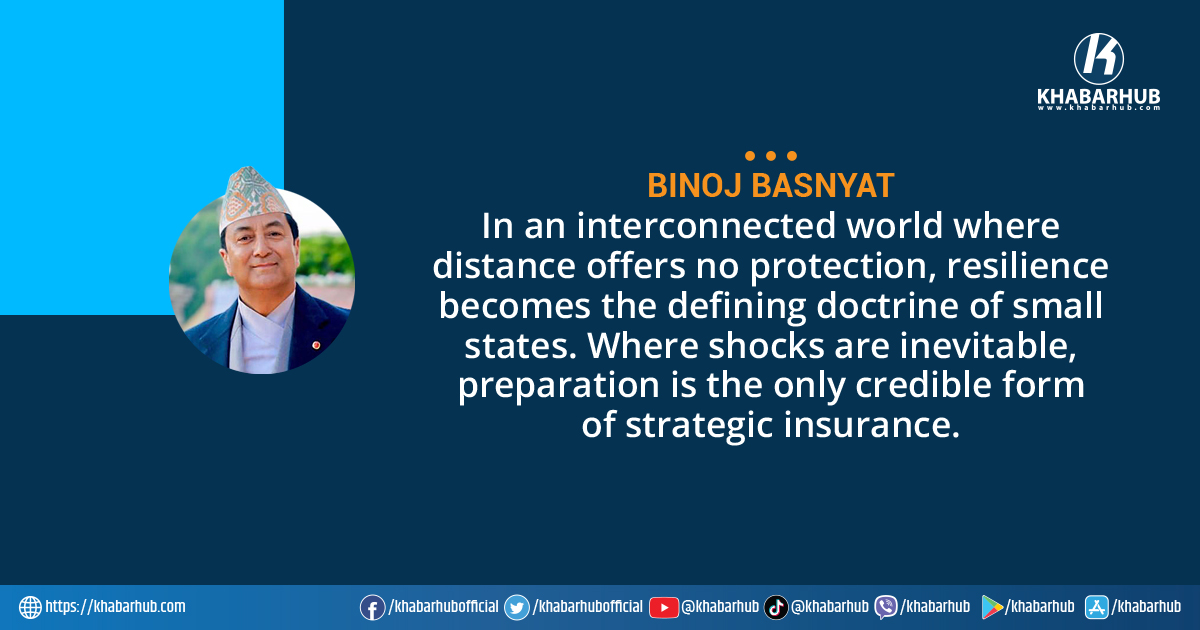
In an interconnected world where distance offers no protection, resilience becomes the defining doctrine of small states. Where shocks are inevitable, preparation is the only credible form of strategic insurance.
Finally, transparent strategic communication will be key to maintaining public confidence, preventing panic, and managing expectations during periods of economic or geopolitical stress.
In an increasingly polarized international environment, Nepal must maintain diplomatic balance, supporting de-escalation, engaging all sides, and avoiding overt alignment—a prudent strategy to avoid diplomatic entrapment. Strategic neutrality does not imply passivity—it requires active preparation combined with measured diplomacy.
Conclusion
The trajectory of a potential conflict involving Iran may range from a limited exchange—marked by calibrated strikes and temporary energy shocks—to a far more dangerous scenario of prolonged regional war, maritime disruption, and systemic instability.
For Nepal, the distinction matters less than the certainty that both pathways carry consequences. The lesson is clear: preparedness must account for the most likely outcome, but resilience must be built for the worst.
The deeper strategic reality is that globalization no longer insulates—it transmits. A crisis in West Asia can quickly manifest in Nepal through rising fuel prices, disrupted remittance flows, and food insecurity. In this context, energy dependence becomes strategic exposure, and reliance on external labor markets becomes geopolitical risk. These are not abstract vulnerabilities; they are structural features of Nepal’s economy.
A conflict involving Iran will not draw Nepal into the battlefield, but it will test the country’s economic stability, fiscal discipline, and strategic foresight. The choice, therefore, is not between involvement and neutrality—it is between reaction and preparation.
Nepal cannot shape events in distant theaters, but it can shape its readiness through coordination, diversification, and institutional resilience.
In an interconnected world where distance offers no protection, resilience becomes the defining doctrine of small states. Where shocks are inevitable, preparation is the only credible form of strategic insurance.
(Basnyat is a Maj. General (retired) of the Nepali Army and a strategic affairs analyst. He is also a researcher and is affiliated with Rangsit University.)





Comment