




KATHMANDU: Protests erupted across the country on Saturday following the arrest of former prime minister and chairman of the CPN-UML, KP Sharma Oli.
Party cadres and supporters took to the streets in various cities, accusing the government of engaging in revenge politics. Demonstrators chanted slogans demanding Oli’s immediate release and calling for the resignation of the Home Minister.
Amid the demonstrations in Kathmandu, a Gen-Z teenage protester drew widespread attention after expressing her views publicly, arguing that the arrest of the UML chairman was not lawful.
Holding placards and chanting slogans such as “Free KP Oli” and “Home Minister resign,” the young protester was seen leading a section of demonstrators in the federal capital.
Despite her young age, many observers said her remarks appeared politically aware and composed.
Speaking to media during the protest, the teenager said they were not protesting against the government itself but questioning what they saw as a violation of legal procedures.
“We are not here to condemn the government. We respect the public mandate and accept the government that people have voted for,” she said.
“But if anyone tries to place themselves above the law, we must warn them. The UML’s mass base will not remain silent,” she added.
She further questioned the legality of the arrest, arguing that political retaliation should not be disguised as legal action.
“We are not here to oppose the government that has a two-thirds majority. We have accepted the mandate,” she said.
“But arresting someone unconstitutionally and under political revenge is not a sign of political integrity. How was an arrest warrant issued on a Saturday? Does being the Home Minister mean you can do anything?” she asked.
Online backlash and cyberbullying
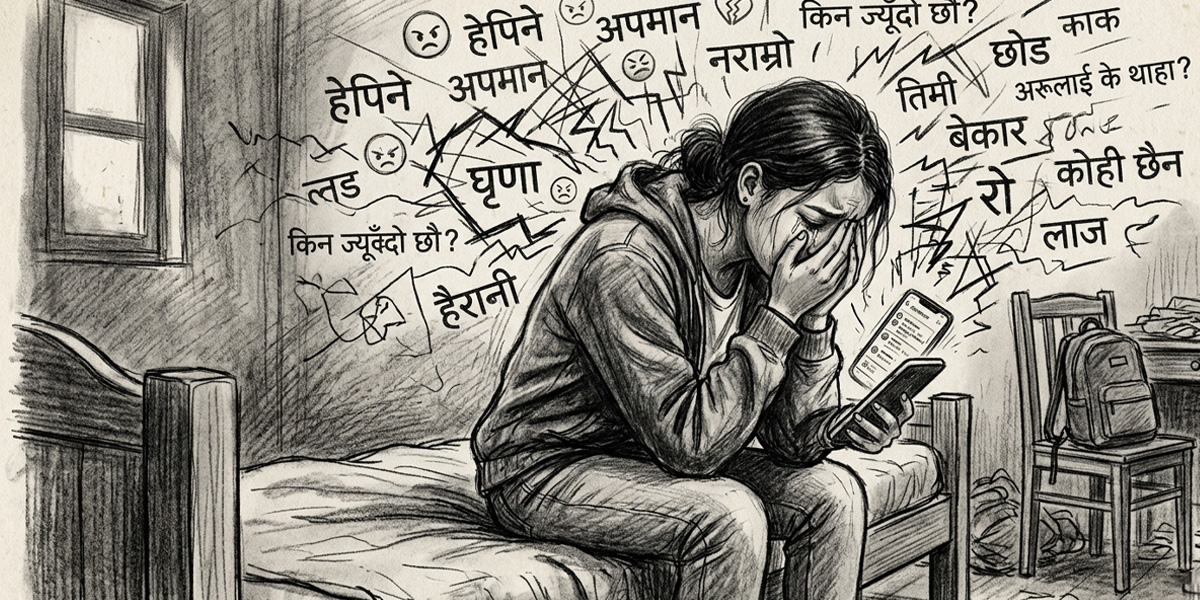
Soon after her remarks circulated widely on social media, the teenager became the target of a wave of online abuse and cyberbullying.
Numerous comments directed at her included obscene language and threats. Many of the remarks were widely condemned as inappropriate and abusive.
Some users even invoked past cases of sexual violence while issuing threats — comments referencing victims such as Nirmala Pant, a teenager whose rape and murder in Kanchanpur sparked nationwide protests in 2018.
Similarly, references were made to Inisha BK, who was recently killed in a sexual violence case in Surkhet.
Critics say such comments reflect a disturbing trend of misogynistic online behavior, particularly targeting women who express political views publicly.
Several YouTube channels also posted the teenager’s photo with provocative captions asking viewers to comment about her, which further fueled online trolling.
Activists condemn the abuse
Gen-Z activist Tanuja Pandey strongly criticized the online harassment, calling it a reflection of a hypocritical society.
Writing on Facebook, Pandey said the backlash exposed the contradiction within society that claims to support justice for victims of sexual violence while tolerating abusive behavior online.
“In a so-called democratic society, when a woman expresses her opinion, people openly discuss raping her — how, where, and by whom,” she wrote.
“This same society claims to demand justice for victims like Inisha and Nirmala. What we see is a deeply hypocritical mindset,” she added.
Pandey also stressed that the issue should not be viewed through a partisan political lens.
“I am not talking about any political party. I am talking about society. This society is you, me, and all of us. Patriarchy is not the property of any single party,” she said.
Similarly, social media user Laxmi Khanal criticized the abusive reactions, saying that a society that resorts to insults and discrimination cannot realistically expect good governance.
“When someone expresses an opinion, responding with personal attacks — especially against women — raises serious questions about our own values,” she wrote.
“We often demand peace, good governance and corruption-free systems, but do we practice those values in our own behavior and language?” she asked.
According to her, true reform begins with individual conduct and respect for others.
Questions raised to the law minister
Meanwhile, some activists have also questioned newly appointed law minister Sobita Gautam regarding the online abuse.
They have asked whether she has taken note of the offensive comments circulating online and demanded stronger legal action against those responsible.
“You had pledged to introduce laws against sexual harassment. When will those who issue such threats online be brought to justice?” activists asked on social media.
UML supporters question legality of arrest
Meanwhile, UML supporters continue to argue that Oli’s arrest was politically motivated.
They claim the recommendation of the commission led by former justice Gauri Bahadur Karki cannot automatically justify an arrest, arguing that the commission is not a constitutional body.
Protesters have also questioned whether legal procedures were properly followed, asking whether a person can be arrested solely on the basis of a commission’s recommendation without court proceedings.
They also questioned the timing of the arrest, claiming it took place before the newly formed government had even convened a cabinet meeting.
“Does the rule of law not apply? What kind of legal practice is the government trying to establish?” protesters asked during demonstrations.
Rising concern over cyberbullying
Mental health counselor Rani Didi said the incident reflects a broader social problem of rising cyberbullying and declining sensitivity in online spaces.
“Our society is increasingly losing its sense of empathy due to the misuse of social media and digital platforms,” she said.
“Disagreeing with someone’s views should not lead to insults or harassment,” she added.
According to her, cyberbullying has become a serious social issue, and the absence of strong legal mechanisms to address digital violence remains a major challenge.
“If someone feels pleasure in humiliating or harming others, it is not a normal psychological response,” she said.
Legal provisions against cyberbullying
Under Nepal’s Electronic Transactions Act, cyberbullying is considered a punishable offense.
Section 47 of the Act states that using electronic platforms to harass, threaten, defame, or insult someone constitutes an electronic crime.
Those found guilty can face up to five years in prison, a fine of up to Rs 150,000, or both.
Victims of cyberbullying can file complaints with the Cyber Bureau of Nepal Police.






Comment