




Nepal’s political landscape after three decades appears to be entering another moment of transition. The rise of the Rastriya Swatantra Party (RSP) reflects a growing public desire for political renewal after years of frustration with governance failures, corruption, and institutional stagnation. Yet interpreting this political moment purely as an electoral victory would miss its deeper meaning. The momentum behind RSP is less about ideology and more about a demand for competent governance.
In moments of political transition, societies often imagine their future in sweeping and hopeful terms. A recently circulating vision of “Nepal five years from now” paints such a picture: clean rivers, seamless digital governance, modern infrastructure, returning youth, thriving industries, and a nation that stands confidently among prosperous states. It is an inspiring portrait—one where corruption disappears, public services become efficient, and development reaches every village.
However, interpreting this development merely as the success of a new political party would underestimate its broader significance. What Nepal may be witnessing is not simply an electoral shift but the emergence of a corrective political wave—an attempt by voters to recalibrate a democratic system that many believe has drifted away from its original promises.
Today, however, the national mood appears different. The aspiration reflected in the imagined “future Nepal” is not about ideological victory or political symbolism. It is about delivery. Citizens want efficient public services, transparent administration, reliable infrastructure, and economic opportunity at home. In short, they want a state that works.
Whether this moment leads to meaningful governance reform or becomes another episode in Nepal’s cyclical political dissatisfaction will depend on whether public frustration can be translated into durable institutional change.
The Legacy of Nepal’s Traditional Political Order
For more than three decades, Nepal’s democratic politics has been largely shaped by three major parties: the Nepali Congress (NC), the Communist Party of Nepal-Unified Marxist–Leninist (UML), and the The Nepal Communist Party (NCP) formerly Maoists.
These parties were not merely political organizations; they were central actors in Nepal’s historical transformations. The NC and the UML played a pivotal role in the democratic movement of the early 1990s. The Maoist forces were central to the ideological and political struggles that influenced to shape Nepal’s transition from Constitutional Monarchy to a Secular Federal Republic.
Their legitimacy was built on political struggle, ideological identity, Raising arms against a democratic constitution, and leadership during moments of national upheaval.
The rise of the RSP is less an ideological realignment than a governance revolt. Nepalis have not yet chosen a new political doctrine; they have issued a warning to the old order. Whether this moment becomes a democratic renewal or another cycle of disillusionment will depend not on electoral victory but on the state’s capacity to reform itself.
Yet over time, the political system that emerged from these historic struggles gradually developed structural weaknesses. Citizens increasingly perceived a gap between political rhetoric and governance performance. Coalition instability, bureaucratic inefficiency, corruption scandals, and slow economic reform began to erode public trust in political institutions.
For a generation of young Nepalis confronting unemployment, migration pressures, and limited economic opportunities, ideological debates between left and right began to feel disconnected from daily realities. What many citizens increasingly demanded was not ideological purity but administrative competence.
Public Aspiration to State Capacity
The growing popularity of reform-oriented figures such as Balendra Shah reflects a broader shift in Nepal’s political mood. Balen’s rise from municipal politics was not driven by traditional party machinery but by a public desire for technocratic competence and visible results. His appeal lies in the belief that governance should prioritize practical solutions, meritocratic leadership, and implementation rather than rhetoric.
Yet the aspirations attached to such figures must be viewed against the structural realities of state capacity. Transformations of the scale often imagined in public discourse rarely occur within a single electoral cycle. Countries frequently cited as development models—such as Singapore and Japan—achieved their progress not through sudden political shifts but through decades of institutional strengthening, disciplined bureaucracy, and consistent policy continuity.
Nepal’s challenge, therefore, is not simply about leadership but about the ability of the state itself to design policies, implement them effectively, and maintain public trust. Roads, railways, efficient digital services, and well-managed cities are not merely products of political ambition; they are the outcomes of functioning institutions, predictable regulations, sustainable financing systems, and a culture of accountability.
For Nepal, strengthening these foundations must become the central national project, shifting the national debate away from personalities and toward the institutions that sustain long-term development.
This institutional challenge is closely tied to some of Nepal’s most pressing social and economic realities. One of the most telling indicators is the continued out-migration of young workers. Millions of Nepalis currently work abroad, particularly in the Gulf region and other international labour markets, sending remittances that sustain a large portion of the national economy. Yet this migration also reflects the limited opportunities available at home.
If Nepal were able to create an economic environment where its youth could build stable careers domestically, it would represent a profound national transformation—one requiring industrial expansion, a vibrant private sector, and an education system aligned with modern economic demands.
At the same time, expectations for digital governance are rising rapidly. Younger generations increasingly expect government services to be accessible through mobile platforms, reducing bureaucratic delays and corruption. Countries like Estonia have demonstrated how digitalization can streamline public administration and strengthen transparency, and Nepal already possesses a strong technological foundation through widespread mobile connectivity and expanding digital payment systems.
Environmental renewal is another critical expectation, particularly in Kathmandu, where air pollution, waste management, and river contamination have become major public concerns. Ultimately, the vision of a transformed Nepal within a short timeframe may be more symbolic than literal, but it reflects a deeper generational frustration with slow progress and political gridlock. Around the world, citizens are increasingly evaluating governments by performance rather than ideology, and Nepal is no exception.
The country’s future will depend less on promises of rapid transformation and more on the steady work of strengthening institutions, encouraging productive investment, and building a state capable of delivering sustained progress.
The vision for a more prosperous and confident Nepal already exists; the real test lies in whether its institutions can rise to meet those expectations.
The Rise of a Performance-Based Political Mandate
The emergence of the RSP reflects this shift in political expectations. Unlike Nepal’s traditional parties, whose identities are rooted in ideological traditions such as democratic socialism, Marxism-Leninism or Constitutional Monarchy and democracy, the RSP has framed its political narrative around governance reform.
Its messaging emphasizes anti-corruption initiatives, digital governance, administrative efficiency, and economic modernization. In political science terms, this represents a performance-based mandate.
The policy platform of the RSP presents an ambitious governance reform agenda aimed at addressing widespread public frustration with corruption, administrative inefficiency, and slow economic growth in Nepal. Framed as a 100-Point Citizen Contract, the manifesto focuses on measurable outcomes across key sectors such as economic growth, digital transformation, infrastructure, governance reform, and social inclusion. Rather than emphasizing ideological positioning, the document places strong emphasis on performance-based governance and institutional modernization.
In the economic sector, the party proposes accelerating growth through private-sector investment and regulatory reform. The manifesto sets a target of 7 percent annual economic growth, raising Nepal’s per-capita income above $3,000, and expanding the national economy to $100 billion within five years. To achieve this, it advocates simplifying business registration, reducing bureaucratic rent-seeking, and strengthening financial transparency. Reforms to the Nepal Stock Exchange and tighter oversight of cooperatives and microfinance institutions are also proposed to protect small depositors and improve capital market confidence.
A central pillar of the programme is the development of a digital economy. The manifesto aims to expand Nepal’s IT exports from about $2.5 billion to $30 billion within ten years. Plans include establishing an autonomous IT Promotion Board, creating technology parks, and supporting emerging sectors such as artificial intelligence and cloud computing. Expanding nationwide high-speed internet, including satellite-based connectivity, is also seen as essential for digital entrepreneurship and modernization of sectors like agriculture through fintech and agritech.
Energy and infrastructure development are another major focus. The party proposes increasing national electricity generation to 15,000 megawatts and raising per-capita electricity consumption significantly by 2035. Long-term investment incentives, including 50-year production permits for renewable energy projects, are intended to attract investors. The manifesto also outlines large infrastructure plans, including 30,000 kilometres of highways and a long-term railway master plan, while promoting regional energy cooperation with neighbouring countries such as India and China.
Instead of focusing primarily on ideological rhetoric, Rwanda’s leadership framed national recovery around measurable outcomes—economic growth, infrastructure development, and bureaucratic efficiency.
Social justice and inclusion form another important component of the platform. The manifesto proposes a formal state apology to the Dalit community for historical discrimination and outlines targeted initiatives to reduce caste-based inequality. Expanded social security coverage and more equitable allocation of state resources are also included as part of broader efforts to strengthen social protection systems.
Governance reform lies at the centre of the RSP’s political narrative. The manifesto calls for merit-based civil service promotions, performance indicators for bureaucrats, and reduced political interference in administrative appointments. A fully digitized government system with electronic signatures and automated approvals is proposed to improve efficiency and reduce corruption. The party also supports the creation of a high-level commission to investigate illicit wealth accumulated since 1990.
Additional reforms focus on strengthening judicial independence, improving education and research institutions, expanding universal health coverage, addressing land rights issues, and improving disaster preparedness and environmental protection.
Overall, the RSP’s manifesto reflects a technocratic and reform-oriented policy framework, combining market-friendly economic policies with governance modernization and social equity initiatives. Its ambitious numerical targets and emphasis on digitalization highlight a results-focused approach. However, the ultimate test of the programme will lie in implementation—whether these policy goals can be translated into effective institutional reform and sustained economic progress.
Voters supporting such movements are not necessarily endorsing a detailed ideological doctrine. Instead, they are signaling a demand for a state that functions more effectively—one capable of delivering public services, ensuring transparency, and managing economic development.
Corrective political waves of this kind are not unique to Nepal. Across different regions and historical periods, similar movements have emerged when citizens perceive a widening gap between democratic promises and governance outcomes.
Some of these movements ultimately fade into the political system they once challenged. Others succeed in reshaping national institutions and redefining the criteria of political legitimacy. Two international experiences—Rwanda and India—offer instructive lessons.
Rwanda: Governance Transformation in a Landlocked State
The experience of Rwanda is often cited as an example of how governance reform can reshape a country’s trajectory even under severe structural constraints.
Following the Rwandan Genocide, Rwanda faced a near-total collapse of state institutions. The country’s economy was devastated, social divisions were deep, and administrative capacity was extremely weak.
Under the leadership of Paul Kagame and the Rwandan Patriotic Front, the government embarked on a strategy that prioritized rebuilding state capacity and administrative discipline.
If reformist forces succeed in strengthening institutions, improving transparency, and delivering tangible economic progress, they could redefine Nepal’s political landscape by making administrative performance the central standard of political legitimacy.
Instead of focusing primarily on ideological rhetoric, Rwanda’s leadership framed national recovery around measurable outcomes—economic growth, infrastructure development, and bureaucratic efficiency.
Despite being a small landlocked state with limited natural resources, Rwanda invested heavily in digital governance systems, infrastructure development, and service-sector expansion. Over time, it developed a reputation for relatively effective public administration compared with many countries facing similar structural challenges.
The broader lesson from Rwanda is that geography does not necessarily determine national outcomes. Governance quality—particularly the effectiveness of institutions—can sometimes compensate for structural disadvantages.
For countries such as Nepal, which also faces geographic constraints and development challenges, this experience is often cited as evidence that disciplined governance can significantly influence national progress.
However, Rwanda’s transformation also illustrates the complexity of governance reform. Its rapid development has been accompanied by a highly centralized political system, raising debates about the balance between administrative efficiency and democratic pluralism.
The Rwandan case therefore highlights a crucial dilemma: strong coordination can accelerate reform, but sustainable legitimacy ultimately depends on maintaining democratic accountability.
India: From Marginal Movement to Dominant Political Force
Another instructive example comes from India, where the rise of the Bharatiya Janata Party (BJP) illustrates how political challengers can evolve into dominant governing institutions.
In the decades following independence, Indian politics was overwhelmingly dominated by the Indian National Congress, the party that had led the independence movement.
The ideological predecessor of the BJP—the Bharatiya Jana Sangh—remained a relatively small political force for many years.
In the 1984 Indian general election, the BJP won only two seats in the national parliament. At that time, few observers would have predicted the party’s future dominance.
Yet over the following decades, the party gradually expanded its influence through a combination of three critical elements.
Organizational discipline
Through its relationship with the Rashtriya Swayamsevak Sangh, the BJP developed a structured grassroots network capable of sustained political mobilization.
Ideological clarity
The party articulated a coherent political framework combining nationalism, economic development, and cultural identity.
Leadership consolidation
The emergence of leaders such as Atal Bihari Vajpayee and later Narendra Modi helped transform the party from a marginal movement into a dominant national force.
By 2014, under Modi’s leadership, the BJP secured a decisive electoral mandate, reshaping India’s political landscape.
The BJP’s trajectory illustrates a broader lesson in democratic politics: political movements that begin as challengers to the established order can evolve into dominant parties when they combine strong organization, ideological coherence, and governance capacity.
Lessons for Nepal’s Emerging Political Moment
These international experiences offer useful perspective for understanding Nepal’s current political transition.
The rise of the RSP reflects genuine public dissatisfaction with the political status quo. However, comparative political history suggests that reformist waves succeed only when certain conditions are met.
Institutional capacity: Reform requires the ability to strengthen bureaucratic systems, modernize administrative processes, and deliver public services effectively.
Ideological direction: Even movements centered on governance reform eventually require a coherent policy framework to guide long-term national development.
Organizational durability: Political movements must develop structures capable of maintaining unity, managing leadership transitions, and sustaining long-term political engagement.
Without these elements, reformist movements often lose momentum once they enter government and confront the realities of governing complex state institutions.
Structural Challenges Facing Nepal
Nepal’s governance challenges are particularly complex.
The country is simultaneously navigating federal restructuring, economic modernization, and a delicate geopolitical environment shaped by its position between two major regional powers—India and China.
Economic transformation remains uneven. Large numbers of Nepali citizens continue to seek employment abroad, and domestic economic growth has struggled to keep pace with demographic pressures.
At the same time, federalism has introduced new layers of governance that require coordination between central, provincial, and local administrations. Strengthening institutional capacity across these levels is an ongoing challenge.
In such a context, governance reform cannot rely solely on political enthusiasm. It requires sustained administrative restructuring, policy consistency, and long-term institutional discipline.
Managing Expectations in a Reformist Moment
Another challenge facing corrective political movements is expectation management.
Political movements that rise on waves of public frustration often generate high expectations for rapid change. However, structural reforms—particularly those involving bureaucratic systems—typically take time.
If reformist parties fail to demonstrate visible progress within a reasonable timeframe, public frustration can quickly return.
This dynamic has historically affected many reform movements worldwide. Initial enthusiasm is often followed by disillusionment when institutional change proves slower and more complex than anticipated.
For the RSP and similar emerging political forces, managing expectations while maintaining reform momentum will be a delicate balancing act.
A Signal from the Electorate
Regardless of how Nepal’s political dynamics evolve, one message from voters is already clear.
Citizens are increasingly prioritizing governance performance over ideological identity.
This represents a significant shift in political culture. For much of Nepal’s modern political history, legitimacy was rooted in ideological struggle—whether democratic movements, revolutionary politics, or constitutional transformation.
Today, many voters appear more concerned with practical outcomes: economic opportunity, administrative efficiency, transparency, and service delivery.
In that sense, Nepal may be entering a phase in which the credibility of political leadership depends less on historical legacy and more on measurable governance results.
The Road Ahead
The rise of the RSP is less an ideological realignment than a governance revolt. Nepalis have not yet chosen a new political doctrine; they have issued a warning to the old order. Whether this moment becomes a democratic renewal or another cycle of disillusionment will depend not on electoral victory but on the state’s capacity to reform itself.
If reformist forces succeed in strengthening institutions, improving transparency, and delivering tangible economic progress, they could redefine Nepal’s political landscape by making administrative performance the central standard of political legitimacy.
If they fail, however, Nepal’s political system may revert to familiar patterns, with traditional parties gradually regaining dominance as voters return to established political structures.
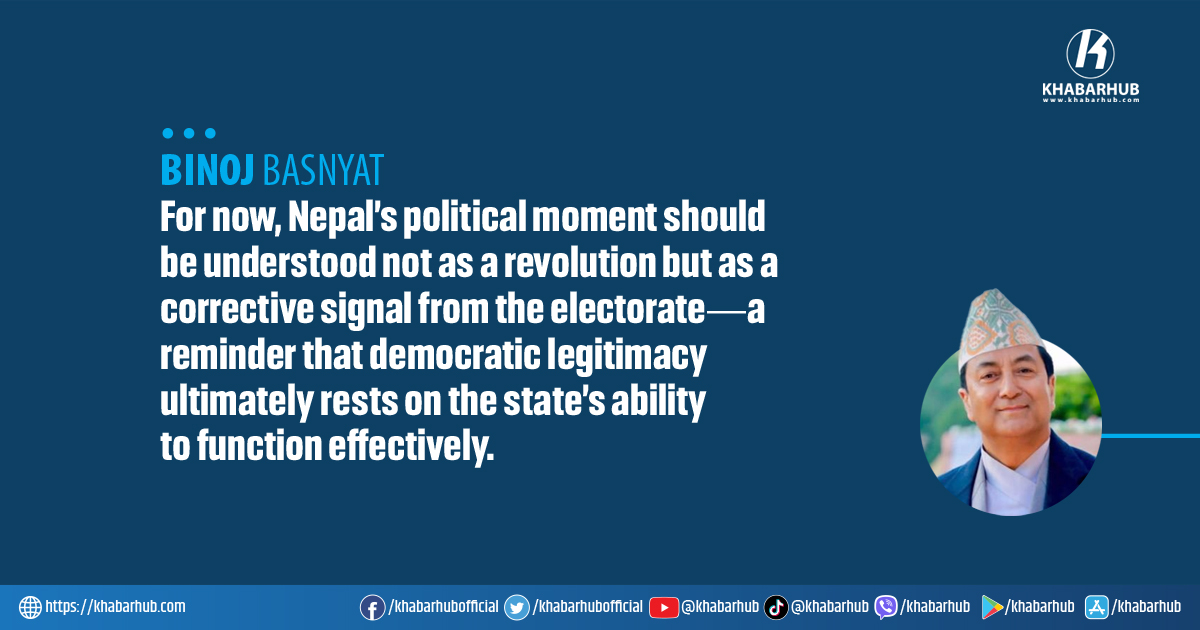
For now, Nepal’s political moment should be understood not as a revolution but as a corrective signal from the electorate—a reminder that democratic legitimacy ultimately depends on the ability of the state to function effectively.
Whether this signal evolves into genuine institutional renewal will depend not on electoral momentum alone, but on whether political leaders—old and new—can translate public frustration into lasting governance reform.
(Basnyat is a Maj. General (retired) of the Nepali Army and a strategic affairs analyst. He is also a researcher and is affiliated with Rangsit University in Thailand)






Comment