




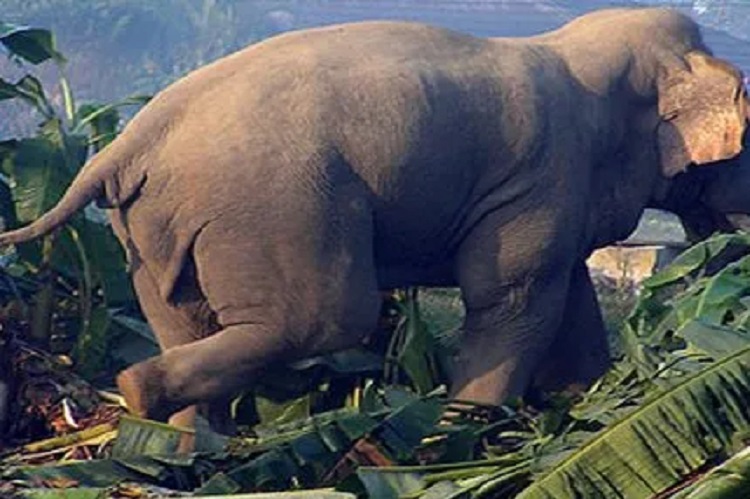
KANCHANPUR: Local residents living around Shuklaphanta National Park have been left anxious after wild elephants entered settlements, damaging houses and destroying stored food grains and standing wheat crops.
In recent days, herds of elephants have caused damage in Margathiya Camp and Baisakha Camp of Shuklaphanta Municipality–12.
Devaki Rana and her husband Dan Singh Rana of Margathiya Camp narrowly escaped unharmed after an elephant broke into their house at night. The couple had gone to sleep after dinner two days ago when they were startled by a loud noise against the mud wall of their house. They rushed outside to save their lives.
“The elephant broke the grass fence and thrust its trunk inside the house. We don’t know what would have happened had we not run away,” Devaki said.
According to her, the elephant destroyed two sacks of rice that had recently been brought home, 10 kilograms of lentils, and five kilograms of turmeric.
Locals said a large herd, including calves, had entered the settlement. While some elephants returned to the park through the village, two of them damaged houses and wiped out food supplies.
In Baisakha Camp, elephants have also destroyed crops. Farmer Bikhlu Chaudhary said elephants have been entering fields every evening for the past four days.
“The wheat has started to bear grain, but the elephants are eating it before it ripens,” he said.
He reported that wheat planted on his 10 kattha of land has been destroyed. Nearly two bighas of wheat cultivated by eight farmers have been ruined within four days.
According to locals, elephants enter the fields before dusk and return to the park only in the morning.
Another resident, Abaj Singh Dhami, said they have informed the ward office and park administration, but no effective measures have been taken so far.
“We are living in fear throughout the night. We are constantly worried that elephants might enter our homes,” he said.
Residents of Margathiya and Baisakha camps, which lie adjacent to the national park, said the problem of elephants damaging crops and physical structures recurs every year. Elephant movement intensifies particularly during the harvest season.
Community leader Sumla Rana stressed that while wildlife conservation is important, human safety must also be ensured.
“Along with conservation, there must be reliable security measures for people,” he said.
Locals have demanded the installation of electric fencing, solar lights, and sirens to control elephant movement. They say a long-term plan is essential to reduce recurring human-wildlife conflict.
Residents warned that unless timely and effective action is taken, such incidents could lead to serious human casualties in the future.






Comment