




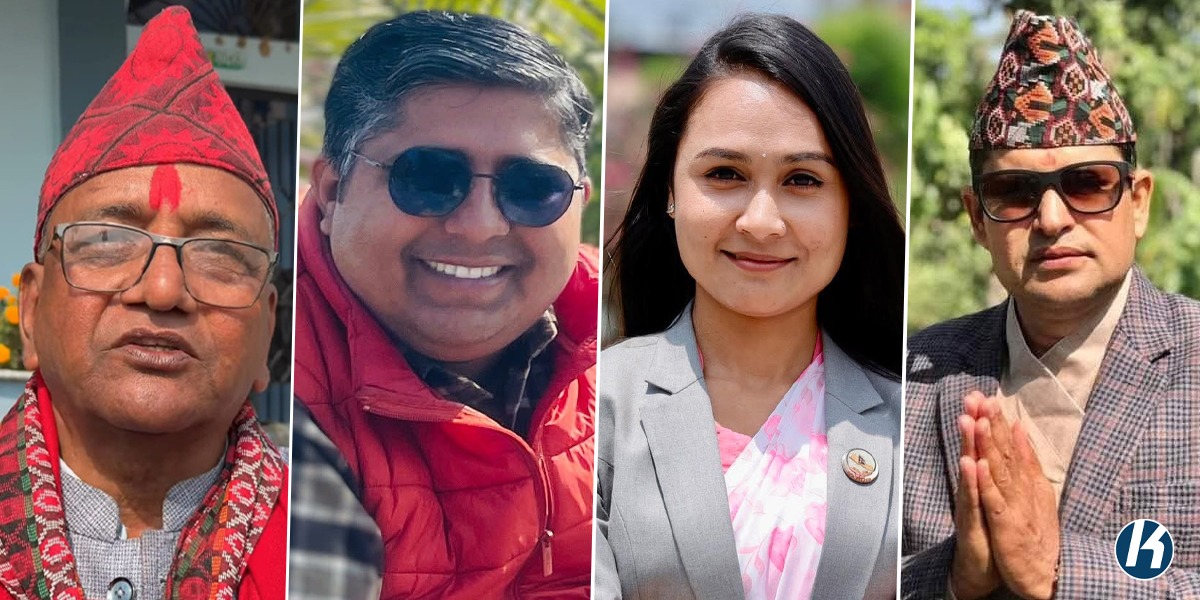
KATHMANDU: The electoral battle in Jhapa constituency-1 has taken an interesting turn as major parties have fielded new candidates, making the race highly competitive and leaving voters weighing their options carefully.
Nepali Congress (NC) Vice President Bishwaprakash Sharma, who won the seat in the previous election on his third attempt, is not contesting this time. The Nepali Congress has instead nominated its District Working Committee Vice President Keshab Raj Pandey, who was previously denied a ticket.
Pandey faces stiff competition from the CPN-UML’s Ramchandra Upreti and the Rastriya Swatantra Party’s (RSP) young candidate Nisha Dangi.
The Nepali Communist Party has fielded Ashesh Ghimire, while the Shram Sanskriti Party led by Harka Sampang has nominated Kewal Raj Rai. Despite being traditional rivals, the major parties have introduced fresh candidates, adding to voter uncertainty in the constituency.
Pandey is viewed as a strong contender, as Jhapa-1 was won by the Congress in 2022. However, RSP’s Nisha Dangi, who has gained popularity among young voters, is emerging as a serious challenger.
Local businessman Subat Rajbanshi of Kakarbhitta says voters are still undecided. “We want a leader who can ease cross-border trade and ensure fair customs duties so Nepali goods can reach Panitanki and vice versa,” he said.
Nepali Congress, UML and RSP appear to be the most active in the constituency. RSP has gained notable traction in urban areas, while rural voters and migrants from districts such as Panchthar and Taplejung are seen aligning with their traditional party loyalties. Senior Congress leaders and cadres are reportedly united behind Pandey, and Sharma has urged party workers to campaign actively in his favor.
There have been rumors of internal divisions within UML, particularly concerning support from the Agni Kharel faction for Upreti, though party leaders deny any rift. Upreti, a veteran communist leader, is also recognized for generating employment opportunities through cooperative initiatives.
Voters say local development issues will determine their choice. Deepa Mishra of Mechinagar-10 said residents want leaders who address pressing concerns such as timely fertilizer supply and fair prices for local agricultural products like betel nut.
Electoral history and numbers
Jhapa-1 has historically leaned toward UML, though the Nepali Congress secured victory in 2022. In that election, Bishwaprakash Sharma won with 29,614 votes, defeating UML’s Agni Kharel, who secured 25,249 votes.
Looking further back, UML candidates have won the seat multiple times, including Radhakrishna Mainali (2048 BS) and Devi Prasad Ojha (2051 BS). Nepali Congress’s Narendra Bikram Nembang was elected in 2056 BS. During the Maoist wave in 2064 BS, Dharma Ghimire won, followed by UML’s Rabin Koirala in 2070 BS. In 2074 BS, Ram Karki of the CPN (Maoist Centre) defeated Sharma.
In the 2079 BS proportional representation vote, Nepali Congress led with 25,420 votes, followed by UML with 22,547 votes. RSP secured 13,750 votes, while the Maoist Centre garnered around 5,000.
Currently, Jhapa-1 has 131,037 registered voters, 65,858 male and 65,209 female. According to the Election Commission, 10,690 new voters have been added, and many observers believe these first-time voters could play a decisive role.
With shifting political dynamics following the rise of new political forces, analysts suggest that younger voters may lean toward RSP. However, Pandey and Upreti are also considered strong due to their long-standing grassroots connections. As the campaign intensifies, the contest in Jhapa-1 remains wide open, with voters closely assessing experience, performance and promises before casting their ballots.
Demographic mix and local issues shape tight race in Jhapa-1
Jhapa Constituency-1 comprises wards 4, 5, 6 and 7 of Buddhashanti Rural Municipality, ward 15 of Mechinagar Municipality, and wards 9 and 10 of Bhadrapur Municipality. A significant number of residents in Buddhashanti and Mechinagar have migrated from the hill districts of Panchthar and Taplejung, and many among them appear inclined toward their traditional or “old” political parties.
The constituency is socially diverse, with voters from various castes, languages and religious backgrounds. Observers believe that Hark Sampang’s party may secure a portion of caste-based votes, while the remaining votes are likely to be distributed among candidates from the four major parties. In urban and semi-urban areas such as Kakarbhitta, Dhulabari and Buddhashanti, educated voters appear more focused on performance and capability than campaign rhetoric.
Arbin Tamang of Buddhashanti-6, currently working in South Korea and home on leave, says he will vote based on competence rather than party label. “Among the old parties, I find Congress more reliable than UML. A new party must also have a clear vision; otherwise, it cannot automatically deserve votes,” he said.
Referring to RSP candidate Nisha Dangi, he questioned her parliamentary impact and added, “In times of crisis, we need experienced leaders like Pandey and Mainali.” Tamang noted that although he works abroad, his vote will prioritize leaders who can support families like his who remain in Nepal.
Experience versus novelty
Among the candidates, Nisha Dangi has prior parliamentary experience as a proportional representative, while Pandey, Mainali, Ghimire and Rai are new contenders for a directly elected seat. Some voters question whether Dangi’s previous tenure has translated into tangible local gains, while others view her as a symbol of political renewal.
Although UML candidate Upreti does not face strong personal criticism, dissatisfaction toward national-level party leadership, particularly Chairman KP Sharma Oli, appears to influence some voters. Meanwhile, Congress candidate Pandey is seen as carrying the responsibility of preserving Bishwaprakash Sharma’s political legacy. Some also note his proximity to the Gagan Thapa faction within Congress.
Jamuna Limbu of Mechinagar-3 believes Dangi could capitalize on dissatisfaction within both Congress and UML. “Most tea shop discussions revolve around Dangi, Pandey and Mainali,” she said, indicating a three-way competitive race.
Ramkala Chapagain of Mechinagar-12 highlighted Mainali’s local engagement, including purchasing milk from local farmers and providing employment through cooperatives. “He supported us in difficult times. I feel we should support someone who stood by the community,” she said.
Campaign agendas and voter priorities
All five candidates are actively campaigning with promises centered on local economic concerns. Key issues include increasing wages for tea workers, stabilizing betel nut prices, improving agricultural seed production and market access, ensuring fair crop prices, and encouraging local entrepreneurship.
Congress, UML and Maoist Centre candidates are also emphasizing reduced customs duties at the Kakarbhitta border to facilitate trade. Meanwhile, the Rastriya Swatantra Party has positioned itself as a fresh alternative, urging voters to try a “new force” after repeatedly testing traditional parties.
With a diverse electorate, significant migrant population, and the addition of new voters, Jhapa-1 remains a highly competitive constituency where performance credibility, party loyalty and appetite for change are all influencing voter calculations.
Nepali Congress and RSP express confidence of victory in Jhapa-1
Both Nepali Congress and the Rastriya Swatantra Party (RSP) have expressed strong confidence of securing victory in Jhapa Constituency-1, with local leaders from both sides claiming their candidates are in a favorable position.
Leaders of the Rastriya Swatantra Party in Jhapa say they are certain of winning the seat. District Secretary Shambhu Suskera stated that while the party aims to win all five constituencies in the district, Jhapa-1 is the most secure.
Suskera, who was the runner-up candidate from Jhapa-4 in the 2079 elections, said, “We are comfortable in Jhapa-1. There is no difficulty. The majority of voters are in our favor.” RSP candidate Nisha Dangi has also been actively engaging with voters, telling supporters during door-to-door visits that her victory is assured.
Meanwhile, Nepali Congress leaders have projected Keshav Raj Pandey as a strong and winning candidate. Pandey said he entered the race with the clear objective of victory. “I am a servant of the people. I have stood with them in times of joy and sorrow,” he said while campaigning.
He added that it would be surprising if the Congress were to lose in Jhapa-1, given its organizational strength and voter response during outreach programs. According to him, while some voters may appear undecided, enthusiasm has grown as the campaign reaches deeper into communities.
CPN-UML candidate Ramchandra Upreti has also expressed confidence. He said he is contesting to win and highlighted his record of social service and efforts to create employment opportunities for locals. “People understand my background. I have worked honestly for this community,” he said, adding that his close connection with residents has helped him avoid backlash linked to national-level party controversies.
A UML district-level leader remarked that Upreti’s intellectual background and grassroots engagement make him a strong contender. However, the leader admitted that the party must work harder to counter what he described as confusion and negative perceptions surrounding the party.
With all major candidates publicly projecting confidence and intensifying grassroots outreach, the contest in Jhapa-1 remains highly competitive as voters weigh experience, performance and the promise of change.






Comment