




Ballots alone in Nepal alone cannot resolve the country’s deeper crises. Political paralysis has slowed decision-making and undermined public trust, while governance failures leave citizens frustrated with services and accountability. At the same time, millions of Nepalis living and working abroad—roughly one-third of the electorate—remain effectively excluded from voting, skewing representation and leaving policy incentives misaligned with demographic realities. Procedural democracy is on track, but without structural reform, inclusive participation, and coherent governance, elections risk becoming a ritual of rotation rather than a catalyst for stability and meaningful change.
Why Ballots Alone Won’t Deliver Stability
If Nepal will go to the polls on 5 March 2026 after months of political turbulence marked by youth-led protests, social mobilization, and growing public impatience with the political class. Procedurally, the election is on track. The Election Commission has finalized a voters’ roll of 18.9 million—nearly a million more than in 2022—expanded polling infrastructure nationwide, and overseen a largely peaceful nomination process. More than 3,000 candidates are contesting under the First-Past-the-Post (FPTP) system, while 120 political parties have registered, 64 of them submitting closed lists under proportional representation.
On paper, democracy is functioning.
Yet to treat this election as a solution to Nepal’s current crisis would be a serious misreading of the moment. Nepal’s central challenge is not electoral competition; it is structural—rooted in unresolved constitutional questions, an underperforming governance model, and the absence of a shared political end state. Elections can redistribute power, but they cannot, by themselves, correct systemic design flaws.
Protests Were a Symptom, Not an Anomaly
The protests that preceded the election were not reactions to a single law or a particular leader. They were the cumulative expression of frustration with a political system widely perceived as unresponsive, expensive, and incapable of translating democratic legitimacy into effective governance. For many young Nepalis, elections have become cyclical rituals that change faces but not outcomes.
A stable and prosperous Nepal will not emerge from electoral repetition alone. It will require legitimacy backed by performance, democratic inclusion that reflects demographic reality, and political competition anchored in a shared sense of direction. Without this, the election risks becoming not a turning point—but merely another pause between protests.
This distinction matters. The protests were not a rejection of democracy or constitutional order; they were a rejection of stagnation. When political systems absorb dissent without reforming themselves, frustration does not disappear—it accumulates. In such conditions, elections risk becoming pressure valves rather than engines of transformation.
The key question, therefore, is not who will win on 5 March, but whether elections conducted under existing institutional arrangements can realistically deliver stability, opportunity, and public trust.
An Undefined Political Destination
Nepal’s political discourse remains rich in aspiration and thin on clarity. Leaders routinely promise a “prosperous nation” and a “happy citizen,” yet these concepts remain vague and unmeasured. Does prosperity mean sustained job creation at home, or continued dependence on remittances? Does happiness imply dignity in public services, cultural reassurance, or merely relief from chronic uncertainty?
The absence of a shared national destination has turned elections into rotational contests for office rather than instruments of reform. Without agreement on where the country is headed, political competition becomes performative—high on rhetoric, low on delivery. Governments change, but expectations remain unmet, steadily eroding confidence in democratic mechanisms themselves.
Fragmentation Without a Mandate
The current electoral landscape reflects fragmentation rather than renewal. Established parties continue to dominate institutions despite declining public trust. Major ideological blocs—particularly on the left—have largely preserved traditional leadership structures, prioritizing continuity at a moment when demands for generational change are intensifying. Leadership reshuffles have occurred, but without a fundamental rethink of governance priorities.
At the same time, forces advocating a constitutional monarchy within a democratic framework have regrouped. Their appeal is not merely nostalgic; it reflects dissatisfaction with the performance of the republican order. Alongside them are new political movements and independent candidates—many drawing support from younger voters and anti-corruption sentiment. Their appeal is real, but their institutional experience is limited, and their numbers are unlikely to translate into decisive parliamentary power.
The most probable outcome is therefore a divided legislature. No single force is expected to command the two-thirds majority required for constitutional amendment. Coalition governments are likely, but without the coherence or mandate necessary for deep reform—resulting in political motion without strategic direction.
Politics as a Shield of Impunity
Joining politics has also been perceived as a shield or “immunity” for individuals convicted or accused of crimes and corruption. This perception arises from weaknesses in legal enforcement, political culture, and institutional independence. The issue can be explained under the following points:
One, Political Protection and Power: Once individuals enter mainstream politics, they often gain influence over state institutions such as the police, bureaucracy, and sometimes even judicial processes. This power can delay investigations, weaken prosecutions, or lead to cases being ignored altogether.
Two, Weak Rule of Law: Nepal’s rule of law has historically been fragile. Legal processes are slow, politicized, and inconsistent, allowing powerful politicians to avoid punishment while ordinary citizens face strict enforcement.
Three, Use of Politics to Escape Accountability: Many individuals accused or convicted of crimes, including corruption, money laundering, or even violent crimes, enter politics to firstly, gain legal protection, Second, influence law enforcement agencies. Thirdly, negotiate pardons or case withdrawals. This creates the impression that politics is a safe haven for criminals.
Four, Politicization of Anti-Corruption Agencies: Institutions like the Commission for the Investigation of Abuse of Authority (CIAA) are meant to be independent, but political pressure often limits their effectiveness. Cases against powerful politicians are sometimes stalled or selectively pursued.
Fifth, Party Loyalty Over Ethics: Political parties in Nepal often prioritize electoral success over moral integrity. Candidates with money, muscle power, or influence are protected despite criminal backgrounds, weakening internal accountability.
Sixth, Culture of Impunity: Frequent amnesties, case withdrawals, and political compromises have created a culture of impunity, where politicians believe they are above the law. This undermines public trust in democracy.
Seventh, Impact on Democracy and Society: This situation firstly, encourages corruption and discourages honest individuals from entering politics. Secondly, weakens democratic institutions, and thirdly, erodes public confidence in justice and governance.
Democracy with a Missing Demographic
An often-overlooked dimension of Nepal’s democratic reality is the scale—and political consequence—of outward migration. Nepal officially has 18.9 million eligible voters. Yet a substantial share of this electorate is not physically present in the country.
Estimates suggest that between two and three million Nepalis are working in India, largely as undocumented or seasonal labourers, while roughly 4.5 million are employed abroad outside India. This places Nepal’s migrant population at roughly 6.5 to 7.5 million people. Subtracting this figure from the total electorate indicates that only about 11.4 to 12.4 million voters—roughly 60 to 66 percent of those registered—are realistically present in Nepal to participate in the elections.
While many migrants remain registered voters, legal and logistical barriers prevent most from voting from abroad. As a result, turnout figures among voters inside the country may appear healthy, while overall democratic participation relative to the eligible population remains structurally constrained.
Why Migrant Voting Matters
This is not merely a technical issue of absentee voting. It is a constitutional, democratic, and strategic concern.
First, the right to vote is a foundational constitutional right. When millions of citizens—many of them economically vital—are effectively excluded from exercising this right, democracy becomes territorially incomplete. Citizenship, in practice, becomes conditional on physical presence, despite the state’s reliance on migrants’ remittances to sustain the economy.
While politics should be a platform for public service, in Nepal it has often been misused as a tool for protection against crime and corruption charges. Strengthening the rule of law, ensuring judicial independence, reforming political parties, and enforcing strict legal consequences are essential to end this culture of political immunity.
Second, migrant participation would serve as a powerful reality check on domestic politics. Migrants experience governance systems abroad, compare institutions, wages, service delivery, and accountability, and often possess a sharper sense of what functional governance looks like. Their participation would inject external benchmarks into domestic political debates, countering insular patronage networks.
Third, migrant voters are disproportionately young and economically productive. Excluding them structurally biases electoral outcomes toward older, less mobile populations more embedded in existing political arrangements. This skews policy incentives away from job creation, institutional reform, and long-term planning—reinforcing the very conditions that drive migration in the first place.
Enabling migrant voting would not solve Nepal’s problems, but its absence guarantees that electoral outcomes will continue to reflect only a partial national reality.
Manifestos Without Structural Math
Political party manifestos released ahead of the election promise familiar themes: prosperity, employment, good governance, anti-corruption, and stability. Yet a closer reading reveals a striking gap between ambition and arithmetic.
Few manifestos confront the structural constraints of Nepal’s governance model—overlapping federal competencies, weak administrative capacity, rising recurrent expenditure, and limited fiscal space. Promises of large-scale development, social protection, or economic transformation are rarely accompanied by credible plans for institutional reform, revenue expansion, or expenditure rationalization.
More importantly, there is little acknowledgment of electoral mathematics. In a fragmented parliament where coalition governments are inevitable, which manifesto commitments are realistically implementable? Where is the minimum consensus agenda—the meeting point across parties—that addresses governance paralysis rather than distributing ministries?
Without this convergence, manifestos function less as roadmaps for reform and more as campaign literature detached from governing reality. Elections then become competitions over narrative rather than mechanisms for policy choice.
The Risk of Reversion
The deeper danger lies after the election. A return to a familiar equilibrium—new leaders operating within unchanged systems—would represent a failure to honour the sacrifices that brought citizens into the streets. Such an outcome would reinforce the belief that elections merely recycle elites while leaving governance untouched.
History offers a warning: when symbolic change substitutes for substantive reform, frustration accumulates. When ballots fail to deliver, the street regains its appeal. Stability achieved through electoral repetition without reform is inherently fragile.
What Reform Would Actually Require
Nepal’s political forces now face a choice: manage instability through coalition arithmetic, or confront its causes.
First, constitutional arrangements must be open to structured review. Treating the constitution as untouchable has limited the system’s ability to adapt, producing institutional overlap, governance paralysis, and fiscal strain.
Second, governance must be recalibrated around performance. Public frustration is driven less by ideology than by lived experience—slow decisions, weak accountability, and corruption without consequence.
Third, foundational post-conflict choices—secularism, republicanism, and federalism—require honest, evidence-based evaluation. Avoiding these debates does not preserve stability; it merely pushes them outside constitutional channels.
Conclusion: Beyond the Ballot
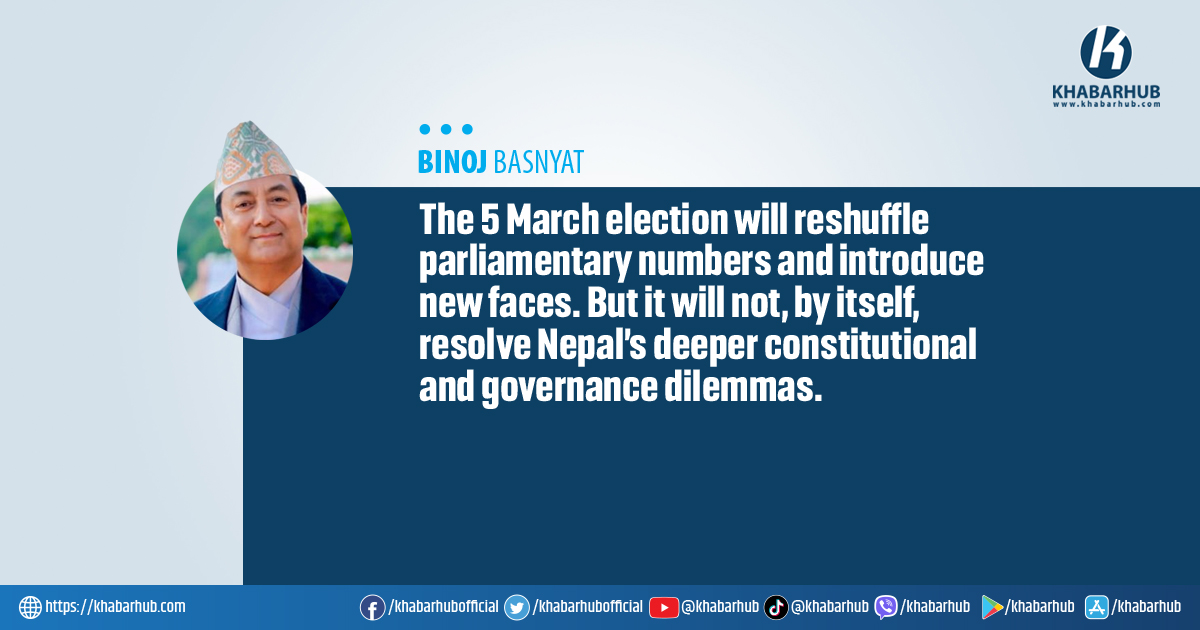
The 5 March election will reshuffle parliamentary numbers and introduce new faces. But it will not, by itself, resolve Nepal’s deeper constitutional and governance dilemmas.
While politics should be a platform for public service, in Nepal it has often been misused as a tool for protection against crime and corruption charges. Strengthening the rule of law, ensuring judicial independence, reforming political parties, and enforcing strict legal consequences are essential to end this culture of political immunity.
A stable and prosperous Nepal will not emerge from electoral repetition alone. It will require legitimacy backed by performance, democratic inclusion that reflects demographic reality, and political competition anchored in a shared sense of direction. Without this, the election risks becoming not a turning point—but merely another pause between protests.
(Basnyat is a Maj. General (retd) from the Nepali Army, strategic affairs analyst and is associated with Rangsit University, Thailand.)






Comment