




KATHMANDU: Political parties appear to have taken positions in their election manifestos that contradict their earlier stance on making school education compulsory and free through legislation.
While some parties that had opposed making school education mandatory and free through an Act have now pledged in their manifestos to gradually ensure compulsory and free schooling, others that previously stood firmly in favor of such provisions have remained silent on the issue in their latest commitments.
The issue surfaced prominently during discussions on the School Education Bill at the Education, Health and Information Technology Committee of Parliament. Lawmakers from the Nepali Congress and the CPN-UML were seen resisting provisions that would set a clear timeline to make school education free.
In contrast, lawmakers from the then CPN (Maoist Centre) and the Rastriya Swatantra Party had argued that the bill should explicitly guarantee free school education.
The question of whether to institutionalize free and service-oriented school education emerged as one of the most contentious issues from the drafting to the finalization of the School Education Bill.
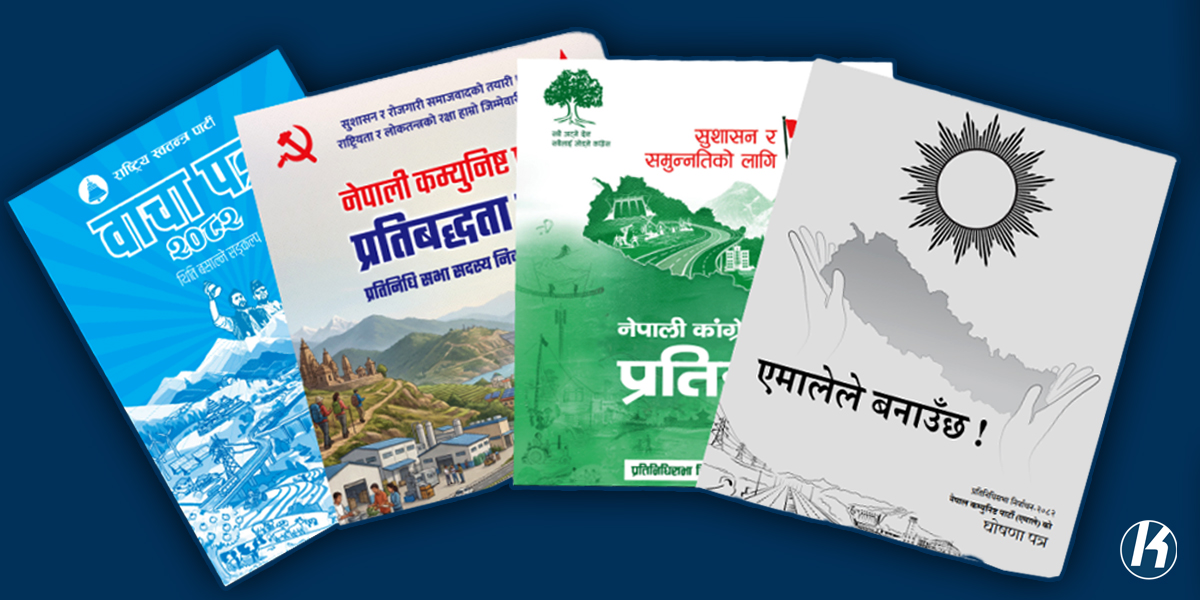
However, in the election manifestos unveiled by the four major parties, a striking reversal can be observed. Parties that previously championed free school education have now remained silent, while those that had opposed the provision are now expressing support.
The Nepali Congress, in its manifesto, has pledged to ensure that 20 percent of the national budget is allocated to the education sector to secure adequate resources for school education. If implemented, this commitment would require nearly doubling the current education budget, potentially addressing many of the challenges facing public and community schools.
Similarly, the CPN-UML has stated in its manifesto that school education will be made gradually compulsory and free, ensuring equal access to education for all children, including at the pre-primary level.
This position appears at odds with the stance taken by UML lawmakers during parliamentary deliberations on the School Education Bill, where they did not support provisions to gradually institutionalize free education. UML Chair KP Sharma Oli has also previously spoken about protecting accumulated assets in the private school sector without imposing additional taxes.
Meanwhile, the Nepal Communist Party has not explicitly mentioned making school education free in its manifesto. However, it has proposed that curriculum and human resource management up to the secondary level remain under the federal government, while operational responsibilities be handled by local governments.
The Rastriya Swatantra Party has indicated that privately operated schools should be recognized as complementary to public education in terms of access and quality. Its manifesto language suggests reluctance to commit to fully free school education, though it has pledged to organize education as a service-oriented rather than profit-driven sector.


Comment