




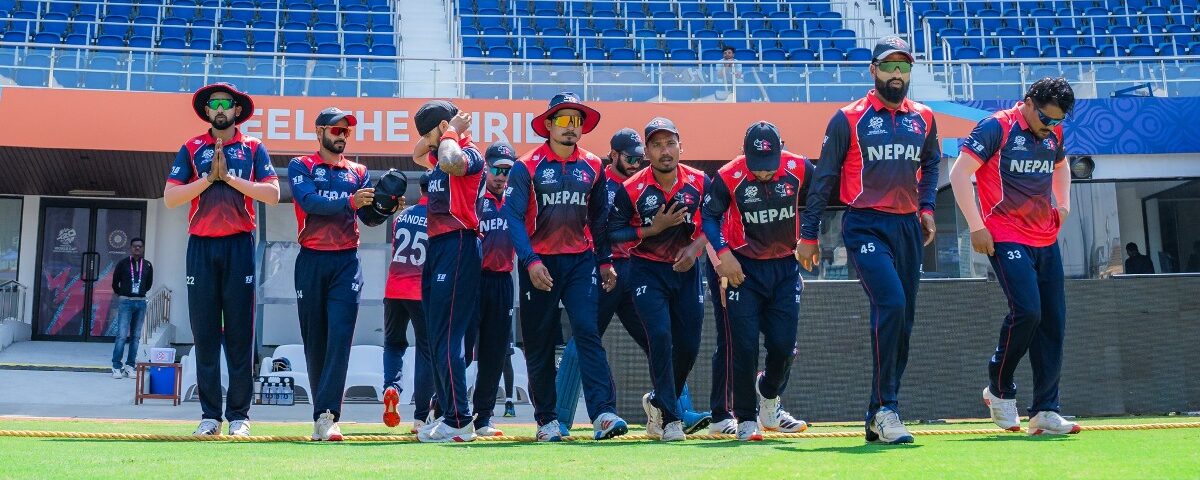
KATHMANDU: Nepal’s campaign in the ICC Men’s T20 World Cup ended without a Super 8 berth, but the team produced several encouraging moments despite an overall mixed performance.
Playing the tournament for the third time, Nepal suffered three consecutive defeats in the opening matches before ending their campaign on a high note with a seven-wicket victory over Scotland. The win marked Nepal’s first World Cup triumph in 12 years.
Since defeating Hong Kong and Afghanistan on their debut at the 2014 edition in Bangladesh, Nepal had endured six straight defeats in T20 World Cup matches before finally breaking the streak.
In the first three matches, Nepal struggled with both bat and ball. Hopes of reaching the Super 8 faded as the team failed to deliver against England, Italy and West Indies. However, a spirited performance in the fourth match restored some pride.
Dipendra Singh Airee stands tall
Vice-captain Dipendra Singh Airee emerged as Nepal’s standout performer. Promoted to bat at number 4, he scored 58 runs against West Indies, becoming only the second Nepali batter to score a half-century in a T20 World Cup after Subash Khakurel in 2014. His 58 remains the highest individual score by a Nepali player in the tournament.
Airee also became the first Nepali batter to score a T20 World Cup fifty against a Test-playing nation and the first Nepali to cross 100 runs in a single edition, amassing 119 runs in the first three matches alone.
He finished the tournament as Nepal’s highest run-scorer with 169 runs in four matches, 44 against England, 17 against Italy, 58 against West Indies and an unbeaten 50 against Scotland. His back-to-back half-centuries against West Indies and Scotland powered Nepal to their long-awaited win. He also contributed with two wickets, underlining his all-round value.
At a time when other batters struggled for consistency, Airee’s composure and sense of responsibility provided a positive narrative for Nepal’s campaign.
Mixed returns from the openers
Opener Kushal Bhurtel showed flashes of aggression but lacked consistency. After scoring a brisk 29 against England, he managed only 5 and 1 in the next two games. In the final match, however, he rediscovered form with a 43-run knock off 35 balls, including four sixes, offering hope for the future. He ended the tournament with 78 runs in four matches.
Fellow opener Aasif Sheikh also endured a modest campaign. Scores of 7, 20 and 11 in the first three matches put pressure on the middle order. He scored 33 against Scotland to help lay a solid platform but could not convert it into a big innings. He accumulated 71 runs overall and had limited impact behind the stumps.
The instability at the top order was a key factor behind Nepal’s early defeats.
Gulshan Jha’s limited role
All-rounder Gulshan Jha had a disappointing outing despite high expectations. Batting mostly at No. 7 in the first three games, he scored 3, 1 and 11. Promoted to No. 5 against Scotland, he made an unbeaten 24 in partnership with Airee, his best performance of the tournament.
However, the left-handed batter and medium pacer was not given an opportunity to bowl throughout the competition, leaving questions about role clarity and team balance.
Nandan Yadav impresses on debut
Medium pacer Nandan Yadav made a promising World Cup debut, featuring in all four matches. He picked up two wickets against England, including the prized scalps of Jos Buttler and Harry Brook, and finished the tournament with five wickets.
He claimed one wicket against West Indies and two more against Scotland, demonstrating potential as a reliable pace option for the future.
Sompal Kami’s milestone and comeback
Veteran all-rounder Sompal Kami made history by becoming the only Nepali cricketer to play in all three of Nepal’s T20 World Cup appearances. After missing the first two matches, he returned against West Indies with an unbeaten 26 but went wicketless.
In the final match against Scotland, however, Kami delivered a match-defining spell, taking three wickets for 25 runs, including crucial breakthroughs in the death overs. His experience proved vital in sealing the victory.
Although Nepal fell short of their Super 8 target, the final win provided relief and renewed optimism. The blend of youth and experience showcased glimpses of potential, but the tournament also highlighted the need for greater balance and consistency.
Individual brilliance, particularly from Airee, offered bright moments. Yet for Nepal to compete more effectively on the global stage, a stronger collective performance will be essential in future campaigns.





Comment