




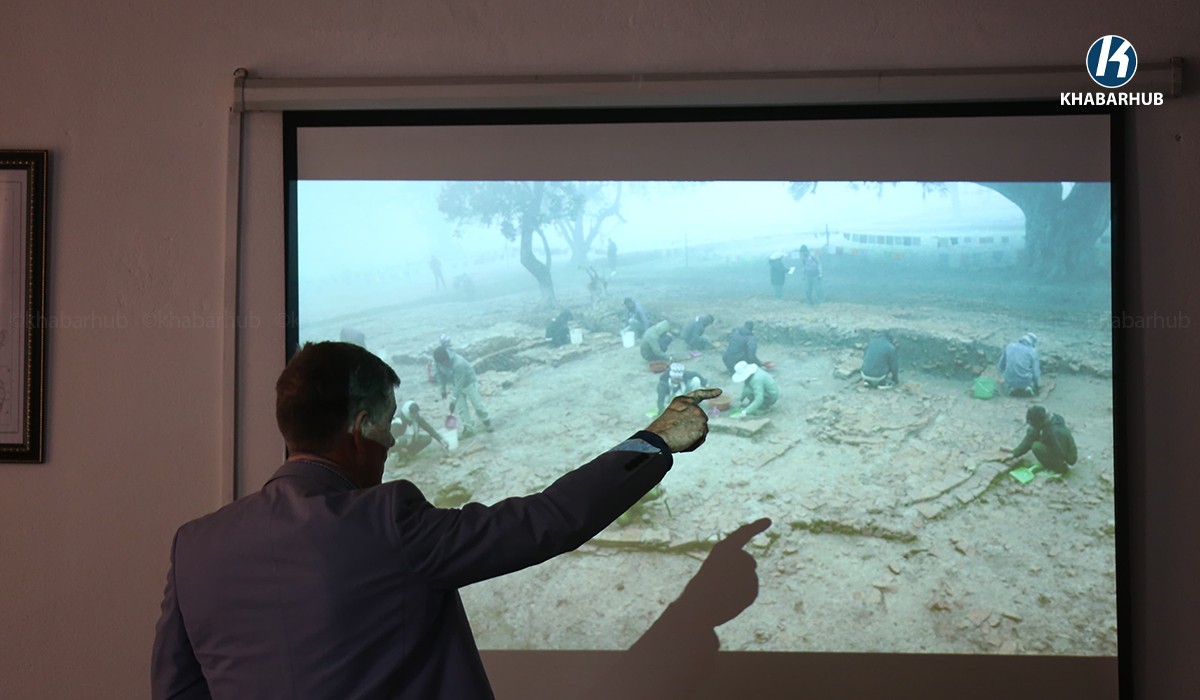
KATHMANDU: The Department of Archaeology has announced the discovery of Nepal’s first example of an apsidal Buddhist temple in Kapilvastu.
The announcement was made during a press conference on Wednesday by a joint team comprising officials from the Department of Archaeology, the Lumbini Development Trust and national and international experts affiliated with the UNESCO Chair at Durham University.
The team revealed that the temple was discovered within Tilaurakot–Kapilvastu, regarded as one of the best-preserved early historic cities and inner citadel complexes in South Asia.
According to the Department, apsidal temples are a distinct category of religious monuments in South Asia, characterized by curved walls that define the sacred core of the structure, with an entrance platform at the opposite end. The earliest known examples were rock-cut, while later structures were built using stone, timber or brick.
The newly discovered monument at Tilaurakot–Kapilvastu follows this architectural layout. However, experts described its location as unusual, noting that it was constructed within the city rather than as part of a separate religious complex. This makes it a rare example of an apsidal temple built inside an urban settlement.
The structure is believed to have been constructed near the center of the ancient city, above the remains of an earlier palace complex.
Archaeologists said the discovery of numerous oil lamps at the site suggests that it served as a long-standing focal point for religious activities by pilgrims and devotees visiting the ancient city.
The site continued to hold religious significance in the later history of Tilaurakot–Kapilvastu. Evidence indicates that an upper temple and monastery were deliberately sealed beneath a mound platform defined by brick paving.
The discovery is expected to contribute significantly to the understanding of early Buddhist architecture and urban religious practices in the region.



Comment