




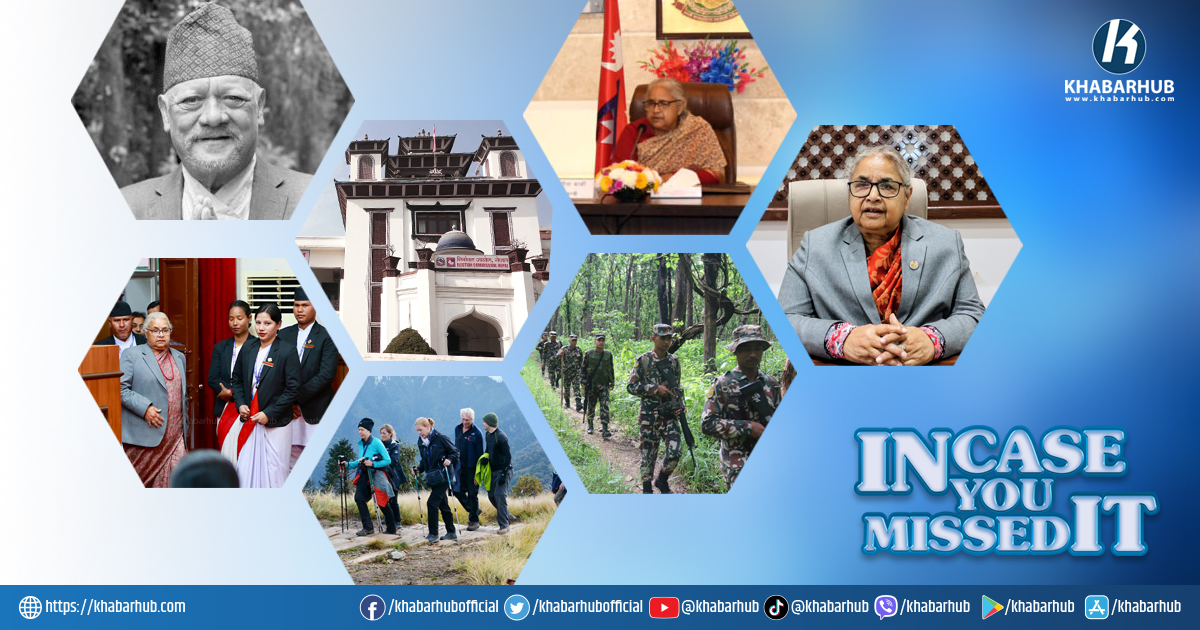
Last week’s developments in Nepal revealed a political system moving simultaneously toward electoral certainty and institutional stress. With the March 5 House of Representatives (HoR) election approaching, state institutions, political actors, and civil society are being tested on credibility, preparedness, and restraint. The week’s events, ranging from finalization of proportional representation candidate lists to the deployment of the Nepali Army for election security, underscore a country navigating a fragile transition shaped by post-Gen-Z movement politics, heightened public scrutiny, and unresolved questions of trust.
At the center of these developments lies the election itself: an event that is no longer just a democratic ritual but a referendum on whether Nepal’s political system can regain legitimacy after years of instability, judicial intervention, and public disillusionment.
PR: Diversity on paper, questions in practice
The Election Commission’s publication of the final closed list of 3,135 proportional representation (PR) candidates marked a major procedural milestone. On the surface, the numbers tell a positive story. With 1,732 female candidates against 1,363 male candidates, the PR system continues to function as a corrective mechanism in a political culture historically dominated by men. The inclusion of candidates from 63 political parties under 57 election symbols reflects a pluralistic, if fragmented, political landscape.
Yet the same process also exposed persistent weaknesses. The disqualification of 76 candidates from PR lists, including 21 blacklisted by the Credit Information Bureau (CIB), highlights systemic lapses in party vetting mechanisms. That candidates with unresolved financial liabilities, age discrepancies, or multiple listings could reach the final stage before being removed raises concerns about whether political parties take electoral integrity seriously, or treat the PR system as an administrative formality rather than a constitutional responsibility.
This episode reinforces a long-standing criticism of Nepal’s PR framework: while it excels at representation on paper, it often falters in accountability. Without stricter internal party discipline and earlier scrutiny, the Election Commission is forced into a reactive role, correcting errors that should never have reached the final stage.
Cabinet resignations and the politics of moral defense
Prime Minister Sushila Karki’s clarification regarding the resignation of cabinet ministers contesting elections offered a rare glimpse into the political logic of the post–Gen-Z era. Her defense of former ministers, Kulman Ghising, Mahabir Pun, Jagadish Kharel, and Bablu Gupta, was notable not just for its content but for its tone. By assuming full responsibility and rejecting accusations of dishonesty, the Prime Minister sought to frame their exit as principled rather than opportunistic.
However, the episode also exposes deeper contradictions. While Karki insists the ministers did not misuse their positions, the optics of technocrats entering government under public pressure and exiting to pursue electoral politics blurs the line between governance and ambition. Her admission that Gen-Z pressure influenced cabinet formation raises questions about how far street legitimacy can, or should, shape executive decisions.
This is not merely a personal defense; it is a test case for the ethical boundaries of transitional politics. As Nepal experiments with non-traditional leadership pathways, the challenge lies in ensuring that moral narratives do not replace institutional safeguards.
Karki–Oli talks: Stability through dialogue or strategic pause?
The meeting between Prime Minister Karki and CPN-UML Chair KP Sharma Oli, though officially undisclosed, was politically significant. It came amid UML accusations that the government might delay elections and Karki’s suggestion of a two-phase poll due to weather challenges, a proposal swiftly rejected by the opposition.
The silence surrounding the meeting’s agenda is telling. In Nepal’s political culture, ambiguity often signals negotiation rather than consensus. For the government, the talks were likely aimed at easing suspicion and reaffirming commitment to the election timeline. For the UML, they may have served as a strategic pause, keeping pressure on the government while avoiding direct confrontation.
What remains clear is that elections are not just a logistical exercise but a political battleground where trust between ruling and opposition forces is thin. Without sustained dialogue, even routine administrative decisions risk being interpreted as partisan maneuvers.
Withdrawing the Social Media Bill
The government’s decision to withdraw the Social Media Bill from Parliament was one of the week’s most consequential moves. Initially criticized for its vague provisions and potential to curb freedom of expression, the bill had become emblematic of fears that regulation could slide into censorship.
By withdrawing it, the government appears to have acknowledged public concern and international scrutiny. Yet this move also reflects the political calculus of an election season. Pushing through controversial legislation weeks before polls could have fueled further distrust, particularly among youth voters who were central to the Gen-Z movement.
Still, the withdrawal leaves unresolved questions. Nepal clearly needs a regulatory framework to address misinformation, digital harassment, and electoral manipulation. The challenge lies in crafting legislation that balances regulation with rights, a task that cannot be postponed indefinitely without consequence.
Enforcing the Code of Conduct
The Home Ministry’s directive to all 77 Assistant Chief District Officers (ADAs) to act as Election Code of Conduct Monitoring Officers signals the state’s determination to enforce electoral discipline. Combined with the deployment of the Nepali Army under the Integrated Security Plan, it reflects a security-first approach to safeguarding the polls.
While such measures may reassure voters in volatile regions, they also underscore the fragility of Nepal’s electoral environment. The involvement of multiple security agencies, Nepali Army, Police, Armed Police Force, and National Investigation Department, suggests that elections are being treated not merely as civic exercises but as potential flashpoints. The success of this approach will depend on restraint as much as readiness. Heavy-handed enforcement risks undermining the very legitimacy it seeks to protect.
Technology, TikTok, and the new frontline of elections
The Election Commission’s partnership with TikTok illustrates how technology has become a central battleground in modern elections. Acting Chief Election Commissioner Ram Prasad Bhandari’s warnings about misinformation reflect a growing awareness that electoral manipulation no longer relies solely on money or muscle power.
While collaboration with digital platforms is a positive step, it also raises concerns about selective enforcement and platform accountability. Technology can enhance transparency, but it can also amplify bias if not governed by clear, neutral standards.
Nepal’s challenge is not simply to prevent misuse but to ensure that regulation does not stifle political expression, particularly among young voters who rely heavily on digital platforms for information.
Judiciary and accountability: Signals from Supreme Court
The Supreme Court’s decision to uphold the detention of CAAN Director General Pradeep Adhikari in the Nalinchowk heliport corruption case sends a strong message about accountability. At a time when public confidence in institutions is fragile, judicial assertiveness offers a measure of reassurance.
Yet such cases also highlight systemic failures in procurement oversight and project planning. Accountability after the fact, while necessary, cannot substitute for preventive governance. Without structural reform, corruption cases risk becoming episodic scandals rather than catalysts for change.
Diplomacy, tourism, and cultural loss
Not all of last week’s developments were political. President Ram Chandra Paudel’s visit to Japan marked 70 years of diplomatic relations, reinforcing Nepal’s international partnerships at a time of domestic flux. Similarly, the arrival of over 92,000 foreign tourists in January points to cautious economic recovery, particularly in the tourism sector.
The passing of veteran actor Sunil Thapa added a somber cultural note, reminding the nation that political transitions unfold alongside personal and collective loss. Cultural figures like Thapa often serve as unifying symbols, transcending partisan divides, a role politics itself has struggled to fulfill.
Conclusion
Taken together, last week’s events reflect a country at a crossroads. Institutions are functioning, elections are advancing, and dialogue continues, but beneath the surface lies a persistent struggle for credibility. The weeks ahead will test whether Nepal can move beyond reactive governance toward a more stable, accountable political order.
The March 5 election is not just about forming a new House of Representatives. It is about whether Nepal’s political system can prove that it has learned from past disruptions, and whether it can translate procedural progress into genuine democratic trust.




Comment