




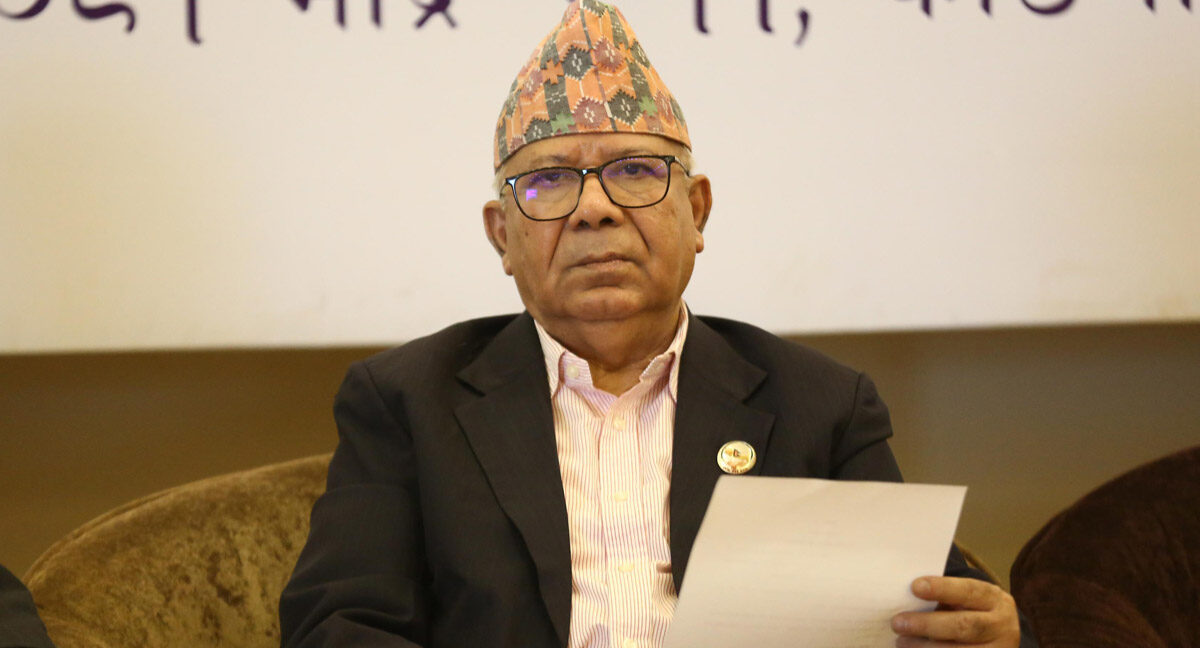
KATHMANDU: Nepali Communist Party (NCP) Co-Coordinator Madhav Kumar Nepal has indicated that there is no possibility of electoral coordination or collaboration with the CPN-UML at present. Amid reports of possible cooperation between NCP Coordinator Pushpa Kamal Dahal and CPN-UML Chairman KP Sharma Oli, Nepal said he has no information about any such discussions.
He maintained that the NCP is poised to emerge as a strong political force, noting that Coordinator Dahal has neither consulted him nor shared any indication regarding talks with Oli. “I have received no signal or hint about unity or coordination discussions between Oli and Prachanda,” Nepal said.
Stating that the current circumstances do not support coordination with the UML, Nepal recalled past remarks by Oli, who had allegedly used derogatory language against him. “How can unity be possible with someone who resorts to such language?” he asked, adding that Dahal could not pursue coordination with UML without informing him.
The former prime minister said cooperation could only be considered if Oli acknowledged past mistakes, reformed his approach, and offered an apology. “There is no basis for coordination in the current situation,” he asserted. Nepal’s remarks indicate that the NCP has not proposed any electoral alliance with UML, though he suggested that Oli may have initiated such overtures.
Nepal described his working relationship with Dahal as “comfortable” and based on mutual respect. “We are working together through consultation and discussion,” he said. “I had a lengthy discussion with Coordinator Dahal on Monday as well, focusing on strengthening the party.”
Nepal, who was elected from Rautahat-1 in the 2022 election, has returned to the constituency as part of his campaign. He has remained electorally successful since 2056 BS. This time, the Nepali Congress has fielded Anil Jha, formerly of the Nepal Sadbhavana Party, as its candidate in the constituency, while the Rastriya Swatantra Party has nominated Rajesh Chaudhary.
Expressing confidence in his prospects, Nepal said he expects to win again from Rautahat-1 and return to Parliament. Highlighting his contributions during his tenure as prime minister in areas such as development, education, health, and drinking water, he said voters should support him to help build a self-reliant economy.
Khabarhub spoke with Nepal regarding election preparations, possible political alignments, prospects for the NCP, public trust in veteran leaders, and his ongoing political partnership with Pushpa Kamal Dahal.
There is talk of electoral coordination between the CPN-UML and the Nepal Communist Party. What is your response?
Those who wish to spread rumors may do so. Coordinator Comrade Prachanda and I are well aware of KP Sharma Oli’s conduct and working style. The Coordinator has not informed me of any such discussions, and I have no knowledge of them. The wounds caused by Oli’s actions during the recent National Assembly elections have not yet healed, and under these circumstances, nationwide electoral coordination is simply not possible.
Has Coordinator Prachanda informed you about any talks with the UML on coordination?
No. It is not possible to know every conversation that takes place, but the Coordinator and I did discuss strengthening our own party when we met on Monday.
When and where did Prachanda and Oli last meet?
To my knowledge, there has been no recent meeting between them. I am aware that Prachanda met Oli before traveling to New Delhi, but I have no information about any meeting after that. Had such a meeting taken place, I would have known. There is no doubt that the NCP is emerging as a strong force, and those who feel threatened by this may be spreading confusion.
Has the Coordinator expressed any view on coordinating with other parties?
No. On Monday, we held a meeting of the election mobilization committee at Parisdanda. After the meeting, the Coordinator and I spoke briefly, but there was no discussion about coordination with any party. Our focus was solely on strengthening the party and building it into a force capable of securing a majority.
So, is there any possibility of electoral cooperation between the UML and the NCP?
Not in the current situation. We are not in a position to coordinate with individuals who use offensive language and hold entrenched prejudices. Our party has neither proposed nor discussed electoral coordination. Unity and cooperation are not on our agenda at this time.
I do not believe cooperation is possible with those driven by hostility and resentment. How can we unite with someone who only recently hurled insults at us? There is no justification for seeking unity now.
How strong is the understanding between you and the Coordinator? Are you satisfied with the respect you receive within the NCP?
We have moved forward through cooperation. There is a strong understanding and mutual trust between the Coordinator and the Co-Coordinator. Together, we have envisioned building a new party, one that corrects the weaknesses of the old party. Our effort has been to move ahead by strengthening trust and creating a responsible and credible political force.
What would you do if Prachanda decides to coordinate or collaborate with the UML in the elections?
We have never imagined such a scenario. Our relationship is moving forward through cooperation and continuous dialogue. Some forces may attempt to create misunderstandings between us, but we are fully aware of such efforts. Coordination would only become a topic if someone came forward saying they would collapse without it. Even then, we would offer advice, not submit ourselves. We are not prepared to bow.
Both Prachanda and I are well aware of KP Sharma Oli’s working style and approach to unity. Without self-correction, acknowledgment of mistakes, and a clear apology, coordination or unity is not possible.
There are rumors that Jhalanath Khanal is dissatisfied with Prachanda. How do you see this?
These are unnecessary and baseless claims. Such narratives are being created deliberately to weaken us and disrupt the election process.
There are also claims that Prachanda has sidelined Jhalanath Khanal.
These allegations are misleading. Differences, if any, can be resolved through dialogue. There is nothing that cannot be settled through discussion. All the propaganda circulating outside is false.
How secure do you feel in your constituency?
Across the country, our party’s position has significantly improved. At present, we are competitive in 42 constituencies. There is a visible wave of people leaving other parties and joining us. Traveling across the country, it is clear that the public’s attraction toward the party is strong, and securing a majority does not appear difficult.
How challenging is it to convince voters this time? Do you need to work harder than before?
We do need to work harder because of the confusion that has been deliberately spread. However, the Nepal Communist Party is not in a weaker position than in previous elections. People see us as a new and credible force.
As a party that has taken a fresh socialist direction, many individuals have joined us even without formal campaigning. We have presented clear policies on agriculture, education, tourism, and climate change.
Our top priorities include job creation, strengthening the health sector, and promoting science and technology.
Why should voters choose Madhav Nepal again?
Whether as Prime Minister, Foreign Minister, or Defense Minister, my contributions have helped steer the country’s political course in the right direction. I played an important role in strengthening democracy and consolidating the republican system.
Through a strong nationalist approach, I worked to address public grievances, provide housing for the landless, and initiate hydropower development. I have also been closely involved in expanding Nepal’s physical infrastructure.
During my tenure, several new initiatives were launched. The Youth Employment Fund was established, and the concept of creating employment opportunities for young people was formally introduced.
What remains to be done now to win again?
Our priority remains addressing the grievances of the people and resolving the problems faced by the youth. We aim to make the national economy self-reliant by creating employment opportunities. If necessary, we are prepared to reform education policy to achieve that goal.
We will introduce an education policy that is aligned with the demands of the time. No other party has such a clear vision or policy direction. Others are engaged in political theatrics and lack concrete plans. We have both the urgency and the energy to build the nation. Learning from past shortcomings, we are committed to not repeating mistakes and to serving the people with dedication.
How easy is it to overcome the challenge posed by new political forces?
The so-called new forces lack vision. Do they have a roadmap for national development? They have neither a programmatic framework nor experience in addressing national challenges. A party that has been forged through struggle and tested by crises is better positioned to lead. If people abandon such a party and place trust elsewhere, they may later regret that decision.
How many seats do you expect a party with three former prime ministers and a strong left base to win in this election?
We will emerge as the largest party by securing a respectable number of seats. There is no confusion about which party truly represents the communist movement, the NCP stands alone. Formed by the merger of 22 components, the party-building process is still ongoing, and achieving a majority is well within reach.
Will a majority be possible only through merger or coordination with the UML?
No. The NCP will secure a majority on its own. I have not spoken about the UML. We have complete faith in the Nepali people. They are discerning and will not choose any party other than the NCP. They are capable of distinguishing right from wrong and will not be misled. We trust the conscience and wisdom of the Nepali electorate.
Finally, once again, does the possibility of electoral coordination with the UML exist?
In the current circumstances, coordination is not possible. One must ask what kind of coordination it would be, where it would occur, and on what basis. The Nepali people have already rejected KP Sharma Oli. We are not prepared to weaken our party by revisiting coordination. This has already been discussed among Coordinator Comrade Prachanda and other leaders.
The challenges faced in the National Assembly cannot be resolved through coordination with any party. While we remain committed to protecting the constitution, democracy, and the republic, there is no justification for compromising with the same forces responsible for the present political deadlock.


Comment