




Current political discourse in Nepal is heavily fixated on the “Gen Z movement,” yet fundamental questions regarding ethical responsibility and political direction remain unresolved. Who truly represents this generation? Who is its leader, and what are its concrete agendas?
While the frustration on the streets is palpable, the movement currently resembles a ship without a captain or a compass. This absence of unified leadership makes the uprising vulnerable to misinterpretation, co-optation, and exploitation by those seeking to “fish in muddy waters.”
In previous historic moments, there was always a clear focal point. During the 1990 (2046 BS) movement, the legendary Ganesh Man Singh unified fragmented communist factions under a single democratic objective. During the Maoist insurgency, the primary stakeholders were identifiable: the Maoists, the monarchists, and the mainstream parties.
Today’s uprising lacks such identifiable actors to sit at a negotiating table. This vacuum has allowed opportunists to speak in the name of Gen Z without being accountable to them, even as youth continue to protest in the streets.
A particularly disturbing dimension, noted by former Chief Justice of the Supreme Court Kalyan Shrestha, is the unexplained shift between the protests of September 8 and 9. Until mid-afternoon on September 8, the uprising reflected a genuine, cross-societal desire for change. Then, the atmosphere shifted abruptly.
If criminal activities occurred during this window, why has criminal law not been applied decisively? Why are investigation reports being kept under lock and key? The failure to prosecute creates a culture of impunity, suggesting that accountability is being delayed or manipulated as a political chess piece.
As the former Chief Justice stated: “In a democracy, it is unacceptable to suppress dissenting views simply because an election atmosphere is rapidly intensifying. Elections must become a means to create a way forward, not an end in themselves.”
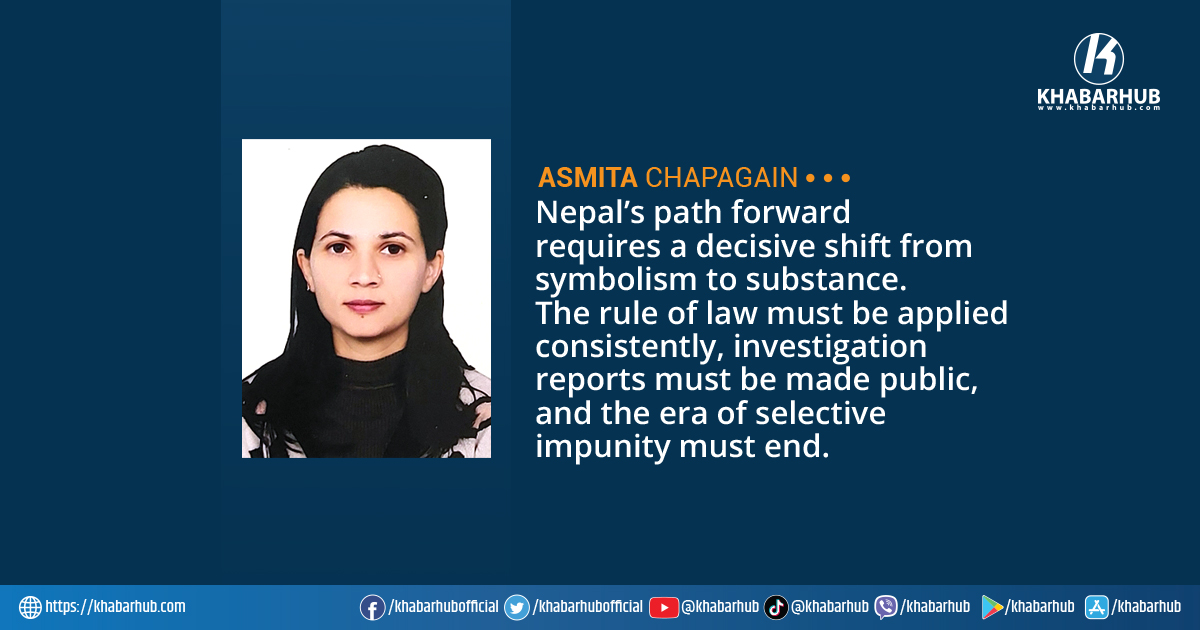
Nepal’s path forward requires a decisive shift from symbolism to substance. The rule of law must be applied consistently, investigation reports must be made public, and the era of selective impunity must end.
He added, “The election now stands before us. There is neither consensus to cancel it nor clarity on how to complete it meaningfully. We are trapped in a strange state, unable to embrace it, unable to abandon it. This dilemma poses a greater challenge than any past governing experience.”
A system without anchors
As Nepal approaches the March 5, 2026 election, a heavy cloud of uncertainty dominates. We are approaching the ballot box without a clear sense of where it will take the country. While “constitutional amendment” is a frequent talking point, it remains a hollow phrase; no one has clarified which laws would be amended or how consensus would be reached. It is highly unlikely that any single party will secure a majority, increasing the likelihood of a hung parliament where progress becomes an uphill battle.
According to former minister Prabhu Sah, the legitimacy of this election is questionable. If this movement was truly for Gen Z, why are their representatives still on the road? We are heading toward a “fake” and unethical landscape where original voices lack prestige. Those in power must stand against this trend; if the election is for Gen Z, why is there no distinct Gen Z group in the electoral race? This lack of clarity must be resolved. Even the limited agreements reportedly reached between interim leadership and Gen Z activists are now hanging by a thread as the government prepares to leave office. The question remains: who will honor these commitments?
“The real leaders of the Gen-Z movement are still on the streets, while those handing out water are running the government,” he said, adding that the situation deserves the attention of international bodies. He also argued that a system in crisis cannot produce positive outcomes.
This election has emerged not as a choice of progress, but as a last resort due to a failure of leadership and capacity. The legitimacy of law enforcement is wavering, courts are under strain, and diplomatic trust has eroded. As former minister Yogesh Bhattarai pointed out, the election was not the only option; Parliament could have been restored. The critical question is why Parliament was dissolved when alternatives existed, other than the fact that the intensity of the movement made dialogue nearly impossible.
This vacuum of leadership has been mirrored by a deeper crisis of representation. The Gen Z movement is not a monolith; it is internally divided. For instance, some demand the end of federalism, while others call for direct elections. While good governance and the end of corruption are the heartbeat of Gen Z demands, the political elite has shown little interest in engaging with these concerns.
An election alone cannot resolve these structural debates. So-called “new” parties lack a coherent ideology or economic vision, appearing to be united only for electoral competition. Scarcely a single voter has read a party manifesto. In this landscape, on what basis are citizens expected to vote: policy, celebrity, or social-media virality?
Constitutional expert Bipin Adhikari observes that hundreds of candidates have entered the fray without any real engagement with society. The traditional culture, where leaders rose through grassroots politics, has eroded. Instead, we see “lateral entry” from the top, with people appearing on ballots overnight.
The media landscape has also shifted. Traditional media no longer sets the agenda, while digital misinformation spreads like wildfire. Senior journalist Hari Bahadur Thapa noted that while people frequently ask what will happen next, journalists themselves are unaware and are scared. People are increasingly avoiding mainstream media due to “balanced and fair” reporting, yet many are now gravitating toward sensationalized fake news.
A state under strain
Nepal’s economic condition is the most pressing “fragile crossroads” of all. The private sector is paralyzed, investment is trapped, and manufacturing has become a luxury due to taxation, corruption, and commission-based practices. Prabhu Sah has criticized the heavy financial burden of maintaining Nepal’s three-tier system of 761 governments.
Local authorities are aggressively hiking taxes, with Kathmandu Metropolitan City reportedly collecting up to 80 percent tax in certain categories. This combination of high taxes and a “commission” culture has stifled local production; in Rautahat, for example, farmers have almost abandoned fish farming.
Former minister Yogesh Bhattarai added a sobering statistic: an estimated Rs 80 billion in national resources were destroyed during the uprising, and another Rs 20 billion will likely be spent on the election. This Rs 100 billion burden is a severe blow to an economy that cannot easily absorb it. Following the September 2025 incidents, reports suggest Nepalis booked nearly 10,000 apartments in Dubai alone. With units averaging Rs 10 million, an estimated Rs 20–25 billion—and likely more globally—has exited the country.
Society, including security forces, remains deeply traumatized. Large deployments alone cannot heal these psychological wounds; the internal confidence of our police forces must be actively restored. While the interim government claims it will deploy 500,000 security personnel for the election, an increase in numbers is not a solution without internal morale. Adhikari warned that while national security and economic hardships are rising, they have been largely brushed aside. We are now heading to snap polls under these unresolved conditions.
Gen Z must now be accountable and clearly inform voters about who represents them and who does not; otherwise, individuals will continue to take advantage of the movement in Gen Z’s name.
Furthermore, geopolitical dynamics are shifting rapidly, illustrated by India’s landmark free-trade agreement with the European Union concluded on January 27, 2026. Where Nepal stands in this changing landscape remains uncertain. Political stability alone is insufficient; tangible results are required to protect sovereignty and credibility. The deeper question persists: is a snap election enough when the economy is declining, external security risks are rising, and national sustainability is in doubt?
The path forward: Beyond the ballot
Returning to a snap election appears unavoidable, according to experts, but the ballot will have meaning only if foundational reforms precede it. The Political Parties Act (2072) and key electoral laws must be amended to ensure that constitutional intent is translated into enforceable law. Political parties must guarantee internal democracy, financial transparency, and inclusivity.
They should be treated as public institutions, and the Election Commission must be equipped with the authority and capacity to oversee them effectively. Mounting public frustration demands careful assessment; without it, the nation risks approaching the March 5 deadline in a state of chaos.
In the new House of Representatives, constitutional amendments will require cooperation among parties with differing and often incompatible agendas. Unless the lessons of the last decade are institutionalized—particularly those related to electoral reform and good governance—the country will once again struggle to find its direction. Regardless of who leads, all parties must negotiate and reach a common consensus.
A social and political environment that genuinely addresses Gen Z’s concerns must be created, and the government must materialize this through proper implementation of the Constitution, laws, and institutions; otherwise, the nation will become increasingly vulnerable to both internal and external threats.
Gen Z must now be accountable and clearly inform voters about who represents them and who does not; otherwise, individuals will continue to take advantage of the movement in Gen Z’s name. Even without direct representation in the Lower House, they can still vet for credible and capable candidates. True accountability lies in supporting candidates based on substance and experience. Populism and “lateral entry” are mere illusions that cannot replace grassroots politics. Citizens are no longer asking for political entertainment; they are demanding serious debate.
Nepal’s path forward requires a decisive shift from symbolism to substance. The rule of law must be applied consistently, investigation reports must be made public, and the era of selective impunity must end. To protect the nation, we must accommodate both the emancipated and the enlightened. This demands deep self-reflection from every individual. We must act not as mere spectators, but as the steady conscience of the nation. Our awareness is the anchor that can keep Nepal from drifting in the storm. Democracy can be restored if damaged, but if Nepal fails as a nation, is restoration even possible?
(Source: Discussion program organized by the Institute for Strategic and Socio-Economic Research [ISSR])





Comment