



“I will use my magic brush to amplify unheard voices,” I would confidently say whenever someone asked me why I wanted to study art. It was like a chant, so frequently repeated that it began to lose its essence. My mother, being her practical self, asked me how I actually intended to do so.
As I fumbled for an answer, she said, “You have to make bucketloads of money to make the kind of impact you’re dreaming of.” The 13-year-old me trusted her wisdom about being financially stable, yet something about her words didn’t sit right.
Underfunded and under-resourced art institutions, along with art being seen as a luxury rather than a viable profession in Nepal, loomed over me. Deep down, I knew that I would never use my magic brush to create commercial art. That conviction only made it more important to find another way to prove how I would use my “magic brush” to paint unheard voices onto the canvas of society.
Voices. This word echoed in my mind. What if the voices I wanted people to hear were always heard yet deliberately ignored? Everybody knows. We all know about social injustices, environmental crises, and the many problems in our society. But how? How, then, can I prove to my mother that I can create social change through art itself and not through financial gain?
To see is to participate, to step forward is to choose, and to remain comfortable is itself an act. As an artist, if my art unsettles, implicates, or demands reflection, then it is doing exactly what it must.
There is no definitive objective answer. Subjectively, the closest answer I found came when I travelled halfway across the world to Eswatini for high school. For my Visual Art course, I decided to create a solo exhibition on social injustices in the garment industry, the human cost of fast fashion.
Titled ‘Shrine to Vanity’, all 11 artworks bluntly depicted the daily struggles of the unseen faces behind the clothes we are wearing right now. Among them, one artwork (Stitched Sacrifices: The Red Carpet’s Dark Thread) stood out as an answer to the question I had been grappling with.
It was a diptych installation: one panel featured the faces of deceased garment workers, which I hand-stitched together with red thread. The other panel was a red carpet stained with the metaphorical blood of those workers in the pursuit of profit. To access the rest of the exhibition, visitors were required to walk across the installation, a choice they found unsettling. Some viewers hesitated and expressed discomfort when asked to step on the faces of garment workers who had lost their lives due to inhumane working conditions, while others questioned the ethics of such a display.
The unease I observed in their body language revealed a truth: accountability begins with discomfort. With each step forward, people were forced to confront their complicity. This immersive experience dismantled the walls of disassociation that we humans build, which enable such injustices to persist. Through my magic brush, I seek to blur these lines, revealing to viewers that they are not mere observers but active participants—part of the very cause of the issue.
This is my subjective answer to those voices being listened to, not just heard: accountability.
That night, after the exhibition had ended, I called my parents to share this revelation. Their response? “Paper is revered as divine and must not be trodden on.” As frustrated as I was that they had completely missed my point, I also felt the weight of their words. Had I really disrespected my own culture to make a point? I still yearn to find that delicate balance between cultural respect and artistic provocation, ensuring that my work resonates universally while staying rooted in empathy.
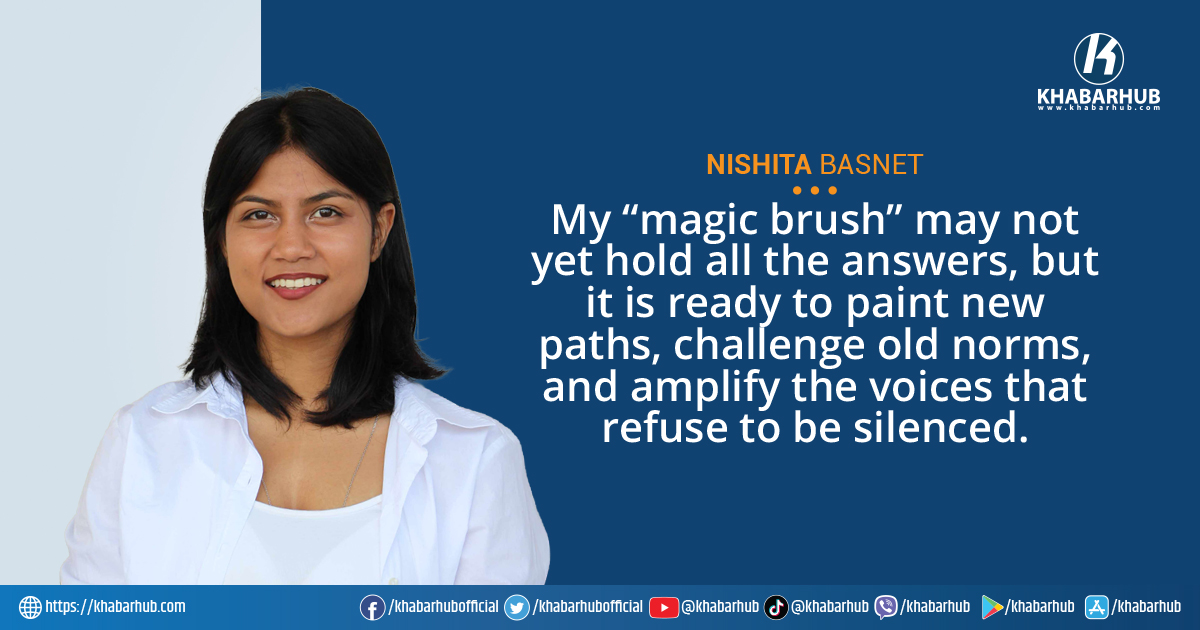
My “magic brush” may not yet hold all the answers, but it is ready to paint new paths, challenge old norms, and amplify the voices that refuse to be silenced. To see is to participate, to step forward is to choose, and to remain comfortable is itself an act. As an artist, if my art unsettles, implicates, or demands reflection, then it is doing exactly what it must.



Comment