




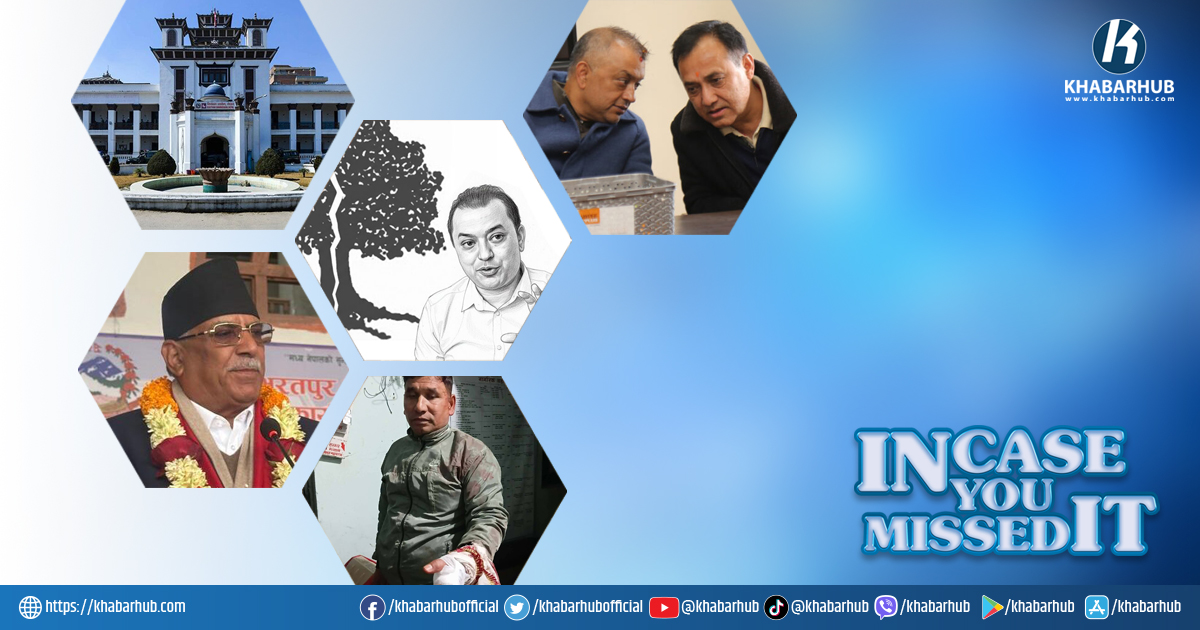
KATHMANDU: Last week unfolded as one of the most defining moments in Nepal’s recent political history, not because of a single dramatic event, but due to a convergence of decisions, reversals, and assertions that collectively revealed the evolving nature of power in the country.
From the Election Commission’s landmark recognition of a new Nepali Congress leadership to controversial prosecutorial retreats in high-profile corruption cases, from assurances about elections amid political fragmentation to economic signals pointing to stagnation, the week offered a revealing snapshot of Nepal’s democratic condition.
At its core, the week exposed a fundamental tension: institutions are functioning, but their credibility is increasingly scrutinized; political change is visible, but its depth remains uncertain.
Election Commission and Battle for Legitimacy
The Election Commission’s decision to recognize the Gagan Thapa–led Nepali Congress as the party’s official entity marked a historic rupture in Nepal’s oldest democratic party. By granting Thapa’s faction the party symbol, flag, and legal continuity, the Commission effectively transferred the Congress legacy away from Sher Bahadur Deuba’s long-dominant establishment.
This decision did more than settle a procedural dispute, but symbolized a generational and ideological shift. Thapa, long seen as the face of reformist politics within the Congress, has now moved from being an internal challenger to the formal custodian of the party’s identity. For supporters, this represents overdue correction: a response to years of centralized leadership, delayed conventions, and perceived stagnation. For critics, particularly within the Deuba camp, it is viewed as an institutional endorsement of a convention they consider procedurally flawed and politically coercive.
What makes this episode especially significant is how party democracy played out through state institutions rather than internal consensus. The Nepali Congress did not resolve its crisis through negotiation or compromise; it required arbitration by the Election Commission. This sets a precedent that may shape future intra-party disputes across Nepal’s political spectrum.
At the same time, the Commission’s decision also places a heavy responsibility on Thapa’s leadership. Inheriting the symbol and structure is one thing; unifying a fractured organization, retaining grassroots networks loyal to Deuba, and contesting elections amid bitterness is another. The split may be legally resolved, but politically, it remains raw.
Party split that reflects a systemic problem
The suspension and expulsion of Gagan Thapa, Bishwa Prakash Sharma, and Farmullah Mansoor by the Deuba-led establishment, carried out even as the Special General Convention elected new leadership, illustrated the depth of dysfunction within Nepal’s party system.
Nepal stands at a crossroads where the direction of change is clear, but its depth and durability are uncertain. Whether the coming weeks consolidate democratic renewal or reinforce public cynicism will depend not just on who holds power—but on how responsibly that power is exercised.
This was not merely a clash of personalities. It was a collision between two models of politics: one rooted in hierarchical authority and electoral alliances, the other advocating internal reform, transparency, and leadership rotation. The failure of multiple rounds of dialogue, including an eight-point compromise proposal, suggests that Nepal’s political culture still struggles to accommodate dissent within established structures.
The Congress split also carries broader implications. As one of the pillars of Nepal’s democratic transition, instability within the party weakens the overall party system. Voters may struggle to distinguish between ideological differences and personal rivalries, fueling cynicism and disengagement—particularly among younger voters who already feel disconnected from traditional parties.
Prosecutorial retreat and the crisis of accountability
Perhaps the most controversial development of the week was the Attorney General’s decision to withdraw organized crime and money laundering charges against all accused in the cooperative fraud cases linked to Gorkha Media, including Rastriya Swatantra Party (RSP) chair Rabi Lamichhane and fugitive businessman GB Rai.
While the official justification emphasized “non-discrimination” and legal consistency, the timing and sequencing of decisions have raised serious questions. Initially, relief was granted only to Lamichhane, a prominent political figure. Only later was the same benefit extended to other accused, reportedly to avoid accusations of favoritism.
For the public, however, the damage may already be done. Cooperative fraud cases have devastated thousands of ordinary citizens, many of whom lost life savings. Narrowing the charges to cooperative fraud alone—while allowing the possibility of reconciliation if money is returned—risks sending a message that financial crimes can be negotiated rather than punished.
More troubling is the perception that political stature influences prosecutorial discretion. Lamichhane’s release on bail, followed swiftly by charge withdrawals, has deepened concerns about the independence of legal institutions. In a democracy where anti-corruption rhetoric dominates political campaigns, such actions risk hollowing out public faith in justice.
Elections promised amid uncertainty
Against this backdrop, former Prime Minister Pushpa Kamal Dahal’s assertion that House of Representatives elections will be held on March 5 served as a stabilizing message. By invoking past experiences—such as the successful conduct of elections despite similar rumors—Dahal attempted to project continuity and inevitability.
Yet the reassurance comes at a time when political fragmentation is intensifying. The Nepali Congress split, shifting alliances, and legal controversies have all altered the electoral landscape. While the election machinery may be on track, the political environment remains unsettled.
The withdrawal of 175 candidates from the proportional representation closed lists further highlights the fluidity of party arrangements. Particularly notable was the mass withdrawal by the Loktantrik Samajwadi Party following mergers, signaling ongoing consolidation and recalibration. Such movements reflect tactical adjustments rather than ideological clarity, reinforcing the perception that electoral politics remains driven by arithmetic rather than vision.
Economic signals: Quiet but concerning
Away from the political drama, the economic news offered subtle but important insights. Commercial banks’ decision to lower term deposit rates for Magh suggests excess liquidity and weak credit demand. While lower rates may eventually stimulate borrowing and investment, they also indicate subdued economic activity.
For ordinary savers, declining deposit rates mean reduced returns at a time when inflationary pressures persist. The banking sector’s cautious posture reflects broader uncertainty—political instability, sluggish private investment, and limited confidence in short-term growth prospects.
Economic stagnation, combined with political turbulence, poses a risk: without tangible improvements in livelihoods, political change may feel cosmetic to citizens struggling with everyday costs.
Security gaps and governance challenges
The armed robbery of Nepal SBI Bank in Sindhuli was a stark reminder that governance challenges extend beyond Kathmandu’s political corridors. A coordinated armed attack on a financial institution in a rural municipality underscores persistent security vulnerabilities, particularly outside urban centers.
Such incidents erode confidence not only in law enforcement but also in the state’s capacity to protect economic infrastructure. As Nepal seeks to expand financial inclusion and formal banking in rural areas, security preparedness must keep pace.
Old radicals, new movements
Finally, the four-point agreement between Netra Bikram Chand’s Maoist faction and the Gen-Z movement led by Miraj Dhungana highlights an emerging pattern in Nepali politics: the convergence of legacy radical forces with youth-driven activism.
The alliance reflects mutual calculation. For Chand, it offers renewed relevance and access to a younger base. For the Gen-Z movement, it provides organizational experience and political leverage. Yet the dual strategy—street agitation alongside election preparation—raises questions about coherence and credibility.
Whether this partnership translates into substantive political change or remains symbolic will depend on its ability to move beyond protest slogans and articulate viable policy alternatives.
A system at a crossroads
Taken together, last week’s developments reveal a political system undergoing visible transformation but still constrained by old habits. Institutions are asserting authority, yet their decisions invite scrutiny. Political renewal is underway, yet accountability remains uneven. Elections are promised, yet trust is fragile.
Nepal stands at a crossroads where the direction of change is clear, but its depth and durability are uncertain. Whether the coming weeks consolidate democratic renewal or reinforce public cynicism will depend not just on who holds power—but on how responsibly that power is exercised.





Comment