




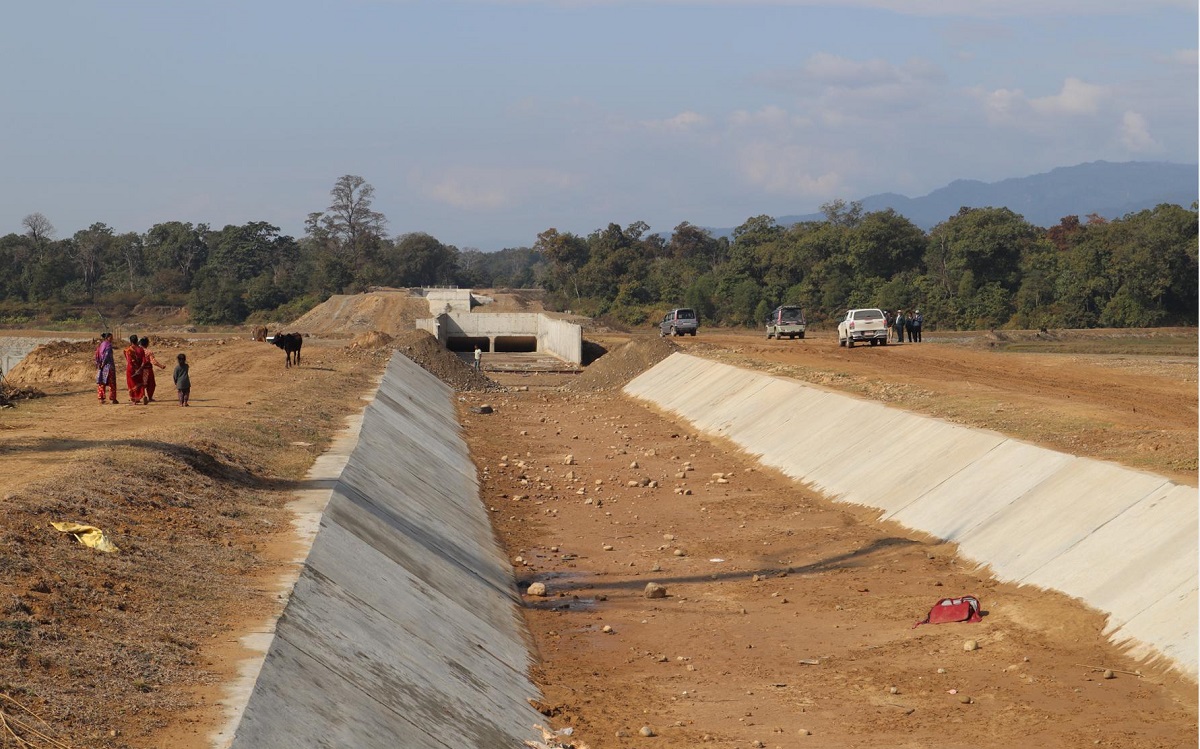
KANCHANPUR: Even three decades after the signing of the Mahakali Treaty between Nepal and India, uncertainty continues over the flow of water in the main canal of the third phase of the Mahakali Irrigation Project.
According to the Mahakali Treaty, India is required to release 300 cusecs of water to Nepal from the Tanakpur Barrage during the dry season and 1,000 cusecs during the monsoon. Nepal has prepared irrigation infrastructure to utilize the water in line with the treaty provisions, provided India releases water as agreed.
Although water has been released twice from Tanakpur for testing the main canal, the Indian side has yet to ensure regular water supply. Meanwhile, the third phase of the Mahakali Irrigation Project has already completed several branch canals in areas where the main canal has been constructed, repeatedly demanding water release to begin irrigation.
Despite steady progress in physical construction, the issue of water flow in the canal remains uncertain. Launched 18 years ago as a national pride project with the goal of irrigating 33,520 hectares of land in Kanchanpur and Kailali, the third phase of the Mahakali Irrigation Project has achieved only 27 percent progress so far. An estimated Rs 9 billion has already been invested in the project.
According to the project office, a contract worth Rs 1.97 billion was signed with a construction company to build a 19-kilometer-long main canal up to Malakheti in Kailali. The canal is being constructed in four phases.
Project Engineer Rajesh Pokharel said repeated correspondence has been made through the department and the ministry to secure water for irrigation.
“When we coordinate with India’s NHPC, they say all structures are ready to release water once they receive instructions from higher authorities,” Pokharel said. “We have also made repeated requests from our side, but this issue requires initiative at the highest level.”
Former Sudurpaschim Province minister and provincial assembly member Prakash Rawal stressed that the federal government must take the issue seriously and ensure timely completion of the project to provide irrigation facilities to farmers.
“There is still no clarity on when water will flow in the main canal of the Mahakali Irrigation Project,” Rawal said. “As a result, provincial and local governments are being forced to focus on underground irrigation as an alternative.”
Rawal also said that while he was a provincial minister, the Mahakali Irrigation Project had formally requested the provincial government to halt budget allocations for underground irrigation.
“If the project cannot be completed on time, alternative measures must be adopted,” he said. “Calling it a national pride project is not enough. The federal government must take concrete initiatives.”
Similarly, social activist Liladhwaj Basnet from Mahendranagar said that haste during the signing of the treaty without adequate study has led to the current situation.
“Due to agreements made without proper assessment, billions have been invested, yet water has not reached the main canal,” Basnet said. “This issue requires intervention from the central government.”
The Mahakali Treaty defines the rights, duties, and obligations of both Nepal and India regarding the utilization of Mahakali River water. Although construction of the third phase began with the aim of extending irrigation up to Malakheti in Kailali, farmers in the region have long been dependent on underground irrigation and rain-fed farming.
“The main canal has reached our doorstep, but there is still no certainty about when water will arrive,” said Bhim Chaudhary, a farmer from Bedkot Municipality. “Years have passed with the hope of irrigation facilities, but there are still no signs of relief.”
The Mahakali Treaty between Nepal and India was signed in 2052 BS (1996).




Comment